Mongolia: The Eastern Steppes
-
May 2027
Paul French
-
May 2029
Paul French
Tour Price to be Determined
2029
Tour Price to be Determined


Tour Price to be Determined
2029
Tour Price to be Determined
We offer a unique itinerary to the far east of Mongolia, a land of the endless sea of grass, of golden steppe as far as you can see, where the only signs of humans are the tracks we drive on and the occasional nomad’s ger. Out here, there are ornithological discoveries still to be made. The avian influence is Manchurian in origin, and our main targets will be Jankowski’s Bunting, Baer’s Pochard, Siberian Crane, Mongolian Short-toed Lark, Ochre-rumped Bunting, polivanovi Reed Parrotbill and Marsh Grassbird. It’s also just possible that Swinhoe’s Rail can be found here… We’ll be travelling light and camping – there’s no other option on most nights – and covering huge distances by in 4x4s, the majority of it on dirt tracks. However, the vehicles we use are comfortable, our drivers are marvelously proficient, and the tracks are usually smooth going.
In 2027 and 2029 this tour can be taken in conjunction with Mongolia: Central.
Day 1: Participants should arrive in Ulaanbaatar no later than this evening. We'll convene for a brief introductory meeting and dinner together at our hotel. Night in Ulaanbaatar.
Day 2: We’ll set off early this morning on our all-day drive to the Baruun Urt region, stopping first in Nalaikh for provisions. On the way, we’ll see the more common Mongolian birds, with Red-billed Chough and Daurian Jackdaw along the roadsides, and Black Kite, Steppe Eagle, and Upland Buzzard dominating the skies. Night in Baruun Urt.
Day 3: After a pre-breakfast hunt for migrants among the small stands of trees near our hotel, we’ll continue on another all-day drive east to an area of sacred hills deep in the steppe. Depending on whether there have been wildfires or not, we’ll either see a sea of gold or a sea of fresh new green. Either way, the steppe will be alive with larks, and among the many huge Mongolian Larks, we should have no trouble finding the more dainty Mongolian Short-toed Lark. We may also encounter Siberian migrants, as out here the only feature that attracts them are the dirt tracks! Taiga Flycatcher may be the most common, but we could also encounter other forest dwellers such as Brown Shrike or Siberian Blue Robin. We will also be scanning as we go for that most prized of steppe shorebirds: Oriental Plover. Out here is where they are at their most numerous, and we have a good chance of finding one or two along the journey.
Once we arrive at our destination, we’ll find ourselves truly alone in the wilderness. The landscape is seemingly endless, and from our slightly elevated camping position on the edge of the hills, it spreads out like a vast canvas. If we are lucky, we may be treated to one of the world’s great mammal spectacles, the huge herds of Mongolian Gazelle. On our 2023 scouting tour, we estimated the visible herd at over 100,000. We’ll spend two nights camping here at Dornod Mongol National Park.
Day 4: A small population of Rufous-backed (Jankowski’s) Buntings was discovered around 2019 in these isolated hills. It was previously thought to be restricted to a handful of sites in northern China and it remains one of Asia’s most endangered birds. After the long drives of the previous days, we’ll spend all day exploring a limited area. Hopefully, our search for the bunting will also reveal northbound migrants sheltering in small, vegetated gullies. Buntings are likely to feature strongly and should include include Meadow, Little and Black-faced, while with luck we may also find Chestnut, Tristram’s, and Yellow-throated. These gullies often hold a myriad of surprises, and in 2026 we discovered Mongolia’s first Blue-fronted Redstart, along with Chinese Pond Heron, Yellow-rumped, Dark-sided and Asian Brown Flycatchers, Siberian and Eyebrowed Thrushes, Siberian Blue Robins and Siberian Rubythroats, all while being entertained by nesting Amur Falcons. Night camping.
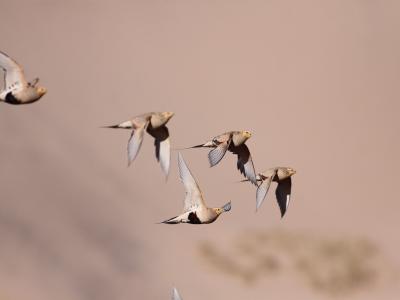
Day 5: Driving further east, we take a dirt track that goes through some incredible steppe. Mongolian and Mongolian Short-toed Larks are very common here, and we may also encounter Pallas’s Sandgrouse. Along this track we have also encountered Great Bustard and, more unexpectedly, Wolf. We’ll eventually arrive at a lake and wetland complex deep in the steppe where we’ll camp for two nights. The reedbeds here are home to Marsh Grassbird and Reed Parrotbills (here of the northern race polivanovi – sometimes touted as a potential split from birds further south in China), while Ochre-rumped Bunting gives out its simple but pleasant songs from the surrounding marshes. We’ll camp as close to the reeds as we can and could be watching all three from our tents by nightfall! Night camping.
Day 6: We’ll have all day to explore this area, mostly by foot but we’ll also use our vehicles as necessary. The local lakes host good numbers of waterfowl, including Falcated Duck, and we should find White-naped and Demoiselle Cranes, with a chance of the rare Red-crowned Crane. The reedbeds should be alive with perhaps the world’s most easterly Paddyfield Warbler, as well as Black-browed and Oriental Reed Warblers and Bearded Tit. Migrant shorebirds should include Pacific Golden Plover, Marsh Sandpiper, and perhaps Asian Dowitcher, while migrants such as Dark-sided Flycatcher and Arctic Warbler might be hunting along the reed edge. There is at least one record for Swinhoe’s Rail, and while this would require extraordinary luck, considering only a handful of birding visits have been made here, we should remain hopeful and vigilant! Night camping near Ikh Tashgai.
Day 7: We’ll drive all day, firstly to the frontier town of Khalkhgol to refuel, then west to the town of Choibalsan. Khalkhgol has proven to be an amazing place for Siberian migrants and Mongolian rarities, and we may have time to explore a small part of the environs to try our luck. On our way to Choibalsan, once again, we’ll be passing through extensive steppe, keeping alert for larks, Oriental Plover and migrants. Perhaps a Siberian Buff-bellied Pipit or Dusky Thrush may drop by, and any small patch of water will be worth investigating. Night in Choibalsan.
Day 8: We should arrive at Chukh Lake in time for lunch. Our main target will be Baer’s Pochard, a critically endangered duck whose numbers have fallen dramatically at all of its wintering sites. Very small numbers are recorded in Mongolia in spring, at mostly random locations, but one or two have visited this lake in recent years, and it seems to be fairly reliable. Also here will be good numbers of waterfowl including Ferruginous Duck, Falcated Duck, and Stejneger’s Scoter. A marsh at the north end of the lake holds a few pairs of Eastern Marsh Harrier, and migrants are attracted to its margins. With luck, we may get good views of Yellow-breasted Bunting, or perhaps even a displaying Marsh Sandpiper. Night camping at Chukh Lake.
Day 9: After birding Chukh Lake in the early morning, we’ll begin the long drive back west along the Ulz River valley. We’ll be passing through the Daurian steppe and alongside some huge cereal fields, keeping a watchful eye out for Great Bustards along the way. We’ll be stopping for birding breaks along the way, especially where the river bends to meet the tracks, and we can look down into riverside bushes for migrants as well as enjoying the huge Sand Martin colonies in this area. There are also occasional places where the forest comes down to the valley floor, and we may enjoy lunch serenaded by Pine Bunting and Yellow-breasted Bunting. We are likely to make camp near the town of Norovlin.
Day 10: Once we arrive in the Khurkh Valley and find a camping spot, we will set about scanning the area. This extensive and unique wetland is of major importance for breeding and migrating cranes. Pairs of White-naped are scattered throughout, and they may even have chicks by this point. Flocks of Common Crane pass through, and Hooded Crane is a regular feature of the marshes in spring. The main prize is the critically endangered Siberian Crane, and this valley is a regular stop for them on their spring migration. Great Bustard, a species that remains in serious decline throughout its range, is also possible. The valley runs roughly north-south and is a major migration route for the more usual Siberian migrants, with many possibilities such as Chestnut-eared and Yellow-breasted Buntings, and perhaps a Japanese Sparrowhawk or Oriental Cuckoo. Night camping in Khurkh valley.
Day 11: We’ll spend the morning birding the Khurkh valley area, then depart in time to arrive in Ulaanbaatar and our hotel for dinner. Night in Ulaanbaatar.
Day 12: The tour concludes this morning with transfer to the airport for international departure, or to continue on to the Mongolia: Central tour.
Note: The information presented below has been extracted from our formal General Information for this tour. It covers topics we feel potential registrants may wish to consider before booking space. The complete General Information for this tour will be sent to all tour registrants and of course supplemental information, if needed, is available from the WINGS office.
ENTERING MONGOLIA: United States and United Kingdom citizens will need a passport, valid for at least six months beyond your date of entry, and with at least one blank visa page, but a tourist visa is not required for stays of fewer than 90 days. The Mongolian Border Agency may collect biometric data (scanned fingerprints) on your arrival.
Citizens of other countries should contact their relevant embassy for advice. In the United States, this is the Embassy of Mongolia at 2833 M Street NW, Washington, DC 20007, telephone: (202) 333-7117 or https://mongolianembassy.us/
If required by the embassy or visa-granting entity, WINGS can provide a letter for you to use regarding your participation in the tour.
It is always a good idea to take photocopies of your passport and air ticket with you when traveling abroad. They can prove invaluable in helping you get replacements if your original documents are lost or stolen. You should pack the photocopies separately from the originals.
COUNTRY INFORMATION: You can review the U.S. Department of State Country Specific Travel Information here: https://travel.state.gov/content/travel.html .
Review foreign travel advice from the UK government here: https://www.gov.uk/foreign-travel-advice and travel advice and advisories from the Government of Canada here: https://travel.gc.ca/travelling/advisories.
HEALTH: The Centers for Disease Control and Prevention (CDC) recommends that all travellers be up to date on routine vaccinations. These include measles-mumps-rubella (MMR) vaccine, diphtheria-tetanus-pertussis vaccine, varicella (chickenpox) vaccine, polio vaccine, and your yearly flu shot.
They further recommend that most travellers have protection against Hepatitis A and Typhoid. Please contact your doctor well in advance of your tour’s departure as some medications must be initiated weeks before the period of possible exposure.
The most current information about travelers’ health recommendations can be found on the CDC’s Travel Health website here: https://wwwnc.cdc.gov/travel/destinations/list
Advisories and recommendations by agencies such as the CDC can, and do, change frequently. It is essential that you contact your own doctor to obtain the latest information on the region you are visiting.
Altitude: The elevation of the tour ranges from approx. 2000 – 3500 feet (approx. 600-1000 meters).
Insects: Biting insects can be encountered, especially around the lakes, but are usually not too much of a problem. Insect repellent (preferably with a high percentage of diethyltoluamide – DEET) will provide adequate protection. Care must be taken, however, to avoid getting the DEET repellent on optical equipment as DEET dissolves rubber and plastic and can damage coated lenses. Camping supply stores and outfitters carry some reasonably effective alternatives, which contain natural products and aren’t corrosive.
Drinking water: Tap water is not safe to drink in Mongolia but we will carry bottled water with us, or use boiled spring water for making tea and coffee.
Smoking: Smoking or vaping is prohibited in the vehicles or when the group is gathered for meals, checklists, etc. While in the field or traveling, use of a smokeless alternative such as nicotine gum is requested. Please do not smoke at short stops while traveling. If you smoke in the field, do so well away and downwind from the group and leave ample time between smoking and getting back into the vehicle. If you are sharing a room with a non-smoker, please do not smoke in the room. If any lodge, accommodation or location where the group is staying or is gathered has a more restrictive smoking policy than WINGS’ policy, the more restrictive policy will prevail. The leader reserves the right to modify this policy if the situation warrants it.
GENERAL NOTE: This tour will spend a lot of time a long way from “anywhere”. In fact, we are the only international company offering this itinerary, and it will certainly give you a taste of the endless sea of grass that makes up the eastern third of Mongolia. We will be travelling in very remote areas with few people and long distances between birding spots. The first full day in particular could be very long and completely spent in the cars, so please bear this in mind. We can easily arrange extra nights in Ulaanbaatar. Our ground agent can also arrange cultural tours of Ulaanbaatar for early arrivals.
PACE OF TOUR AND DAILY ROUTINE: This tour does not require high levels of fitness or stamina. Most of the walks are easy and short over good ground. Around the lakes, the ground may be wet and uneven with tussocks, so waterproof walking boots or decent rubber boots are recommended. Bear in mind there are no trails, so we will always be birding on grass or dirt. There are no uphill walks.
There will be a lot of driving, and we spend a lot of time in the tour vehicles. Most of the first and last day will be on tarmac roads of varying quality, but the rest of the tour will be almost exclusively on dirt tracks. Most of these are in good condition and our 4x4 vehicles are excellent at providing a comfortable ride. However, there will inevitably be occasional bumps and dips along the way. The birding sites are a long way apart, and some days will be spent mainly driving. We will be stopping along the way to look for birds, but expect some full days driving, especially at the beginning of the tour as our first main birding area is approx. 500 miles (800km) east of Ulaanbaatar. It’s worth mentioning that we are traveling through and birding in very open country devoid of any cover. Impromptu ‘bush stops’ may therefore have to rely on using one of our vehicles as a sort of ‘mobile bush’.
There may be one or two very early pre-breakfast starts but generally, days begin with breakfast at 06:30 a.m. or 07:00 a.m. and usually end no later than 6 p.m. We try to allow an hour or more before dinner and checklist.
We will be travelling with our camp crew. On arrival at a campsite they generally prioritise erecting the toilet tent and kitchen tent, followed by the individual tents. There will be no need for us to help set up camp.
CLIMATE: Weather in Mongolia can be very mixed at this time of year and you need to dress accordingly. Generally it will be warm during the day but it can be very cold (below freezing) at night and in the early mornings. During previous tours we have experienced temperatures ranging from 23F to 100 F (-5C – 37C) Rain and strong wind is possible at almost any time.
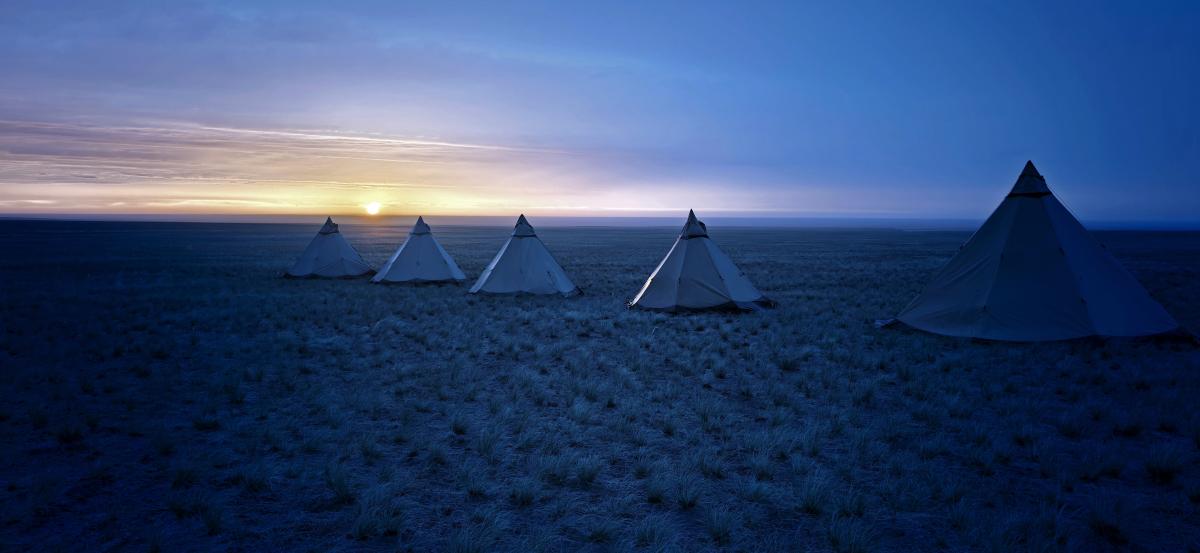
CAMPING ACCOMMODATION: We’ll stay in hotels on the first night in Ulaanbaatar, the next in Baruun Urt, on the night of Day 7 in Choibalsan, and on the last night back in Ulaanbaatar. The rest of the nights we’ll be camping in tents provided by the ground agents at campsites which they will set up near prime birding locations or, on travel days, at suitable locations along our route. Camping beds are provided and the tents are large enough to stand up in. Bedding is provided in the form of a mattress, sheets, blanket, pillow, pillow case and duvet. You will be issued the same bedding each night of camping. If you wish to, you are welcome to take your own sleeping bag or sleeping bag liner.A sleeping bag will be essential if the temperature does drop below freezing and is therefore highly recommended. The camp beds are just about big enough for our 6’2” (1.85m) leader, but he actually prefers to take a ‘therm-a-rest’-style camping mattress and sleep on the floor. The therm-a rest can also be combined with the provided mattress to form a thicker more comfortable base on the camping beds. Water is available for washing and our ground agents also provide both small and large towels. Our tents are tepee-style, large enough to walk around in and excellent against all but the very strongest winds. You will be required to share a tepee-style tent if you are not paying the single room supplement.
Our crew will erect one or two “toilet tents”, which consist of a sit-down camping-style toilet. They will also erect a gravity-style shower tent and hot water can be provided for this.
FOOD: All the food is carried with us from Ulaanbaatar. The camp cook is very experienced in preparing a variety of meals ‘on the road’ and we are constantly surprised at the quality and variety of the meals provided. Water, coffee and tea are provided by the ground crew. We will also carry beer and soft drinks but probably cannot keep these chilled. Vegetarians can be catered for.
Food Allergies/Requirements: We cannot guarantee that all food allergies can be accommodated’ Participants with significant food allergies or special dietary requirements should bring appropriate foods with them for those times when their needs cannot be met. Announced meal-times are always approximate depending on how the day unfolds. Participants who need to eat according to a fixed schedule should bring supplemental food. Please contact the WINGS office if you have any questions.
We can't render google maps without your cookie consent. To see the map, please reset your cookies, then accept all, then reload this page.
2026 Narrative
The vast steppes of Mongolia have long held an allure to birders and those who like the road less travelled. This, WINGS first tour to the east of Mongolia following 16 years of running tours through the centre, proved that not only can you go and find a brace of north-east Asia’s most sought-after bird’s, you can do so while enjoying a hatful of Siberian migrants and the relative comfort of our tented camps. We were to travel approx. 2800km, much of it off-road on (mostly!) smooth tracks, enjoying the all too rare feeling of being the only people for as far as you can see. Jankowski’s Bunting and Baer’s Pochard topped the list of specialties, but we also found Mongolia’s first Blue-fronted Redstart as well as mouth-watering migrants such as Yellow-rumped Flycatcher, Siberian Thrush, Siberian Rubythroat and Siberian Blue Robin. Throw in Great Bustards, White-naped Cranes, Eastern Imperial Eagle, Asian Dowitchers, Pallas’s Sandgrouse, Ochre-rumped Bunting and vast steppes full of Mongolian Larks and Mongolian Short-toed Larks, then this really was a special sort of adventure for all.
Days 1-3 (19-21 May): After arrivals and a meeting for dinner at our hotel, our tour began before breakfast in Ulaanbaatar, a city sandwiched between forested hills to the north and open steppe-desert to the south. A stroll around the park next to the hotel gave us Little Bunting, Olive-backed Pipit and a surprise Long-tailed Rosefinch. Our journey to the far east would take two days, and the first day was relieved by a quick stop to enjoy a large Siberian House Martin colony, then lunch along the Kherlen River at Chinggis. Here, Taiga Flycatchers buzzed from the willows, a Booted Eagle drifted over and our first shorebirds appeared, including Green Sandpiper and several Wood Sandpipers. With the leader's calming (and prophetic) words of “we’ll see more of these later” to various birds seen from the cars, we pushed on east towards our surprisingly swish hotel for the night in the town of Baruun-Urt. The following morning was a bit of a surprise, as even with no inclement weather to speak of, it was immediately clear there had been an overnight arrival of migrants. A couple of small patches of trees near the hotel held several Black-faced and Little Buntings, Asian Brown, Taiga and Dark-sided Flycatchers, Arctic Warbler, many Pallas’s Leaf Warblers, a flock of 30 Hawfinches and some rather dapper Common Rosefinches. A lovely Siberian Rubythroat skulked in the riverine willows, and a hulking Thick-billed Warbler surprised us at the back of a school, competing with Eyebrowed Thrush for our attention. All was topped off by finding a Chinese Pond Heron, still a scarce migrant in these parts.
Continuing southeast, we left the tarmac behind and began our off-roading. Steppe Eagle and Upland Buzzards were passed by, but a shout of "Oriental Plover!" had us hitting the brakes and circling back to enjoy this stunning and enigmatic shorebird. Built seemingly entirely of legs, wings and a huge white head, they often allow close approach, and this one was no exception as it treated us to extended views. Another few miles and another appeared! All in all, we logged an impressive seven on this journey. After a long day's drive, we arrived at our ready and waiting campsite for a well deserved rest and our first night under canvas in the wilds. The steppe stretched out before us as we looked north from the edge of Dornod Mongol NP, gentle hills rising behind us being the only feature in an otherwise gently rolling landscape.
Day 4 (22 May): A full day in the Dornod Mongol NP, or “Janko Mountain” as it's also called after the most famous of its inhabitants. Despite a brisk breeze, we easily found our first pair of Jankowski’s (or Rufous-backed) Buntings sending its simple but pleasing song across the valley. The habitat here is just grass and very low sparse bushes, but it’s a combination that is increasingly rare, and the buntings are correspondingly rare with it. In fact, it is now listed as Endangered and likely to be upgraded to Critically Endangered soon. This recently discovered population in the wilds of Mongolia may yet prove to be of critical importance to the species. With this in mind, it was amazing to find a total of 20 birds comprising seven pairs and two trios in this relatively small area. The surrounding air was thick with the song of Blyth’s Pipits and the occasional Meadow Bunting, a pair of Sakers cruised the ridges and a couple of pairs of Amur Falcons were going about the important business of sorting a nest site.
These hills also contain small valleys with dense bushes along their bottoms, and these are very attractive to north-bound migrants, being the only bushes for many, many miles in any direction. In addition to the expected Taiga Flycatchers, Black-faced Buntings and Pallas’s Warblers, we managed to connect with several Siberian Blue Robins, a Siberian Rubythroat, a couple of Siberian and Eyebrowed Thrushes, Paddyfield and Thick-billed Warblers, several Dark-sided Flycatchers, a simply stunning Yellow-rumped Flycatcher, a brief Tristram’s Bunting for a lucky couple, but best of all, a complete surprise in the form of a female Blue-fronted Redstart, being the first record for Mongolia.
Days 5-6 (23-24 May): After a walk through the steppe and our first real views of Mongolian Short-toed Lark, along with hulking Mongolian Larks, we drove further east through some of the most impressive steppe we were to experience. The number of larks was incredible, a pair of Pallas’s Sandgrouse showed nicely along the track and we even drove alongside a sprinting Wolf for a short way, until it dropped a shoulder and disappeared off into the distance. Perhaps a bigger surprise was when a male Great Bustard rose up in front of us and lumbered slowly into the distance. Arriving around lunchtime in the Ikh Tashgaii area (after an eventful experience getting stuck in marsh!), we settled into a new habitat and began enjoying the waterbirds on offer. Stejneger’s Scoters and White-winged Black Terns entertained on the lake, and both Citrine and Eastern Yellow Wagtails added splashes of colour around the margins. A walk towards a reed fringed lake saw us get wet feet, but eventually a couple of Ochre-rumped Buntings appeared, singing from the wet grassland. In the reeds, brief views were managed of Reed Parrotbill and Bearded Reedling, but the increasing winds made viewing difficult, and given the forecast was the same for the following day we decided to cut our losses and head onwards early the next morning. It proved to be a very varied day, as we started with a good wader showing near our camp, with Asian Dowitcher, Terek Sandpiper, Long-toed Stint and Oriental Plover all performing. Another Great Bustard appeared, also immediately flying off to the north. Setting off to the north west, we first went through the border town of Khalkhgol where we logged a Black Redstart and several Oriental Turtle Doves, but the strong winds hampered our efforts here too so we continued onwards to Choibalsan.
Days 7-8 (25-26 May): An early morning stroll around Choibalsan was surprisingly productive given the huge number of locals out enjoying the early morning cool for their fitness goals. Several Dark-sided Flycatchers and a Two-barred Warbler competed with a stunning male Bullfinch, while flocks of Pacific Swifts screamed overhead. The drive to Chukh Nuur saw us have a well-timed stop at a small lake where a flock of 70 stunning Spotted Redshanks fed with a couple of Red-necked Stints. Arriving at Chukh Nuur, we had lunch and then set about scanning the lake for our main target, Baer’s Pochard. It didn’t take too long to find, and we reckoned there were three males, along with a couple of hybrid Baer’s PochardxFerruginous Duck – an ominous sign for the future. Enjoying the pochards was our main focus for a while, but also here were large numbers of Falcated Ducks, Stejneger’s Scoters, Garganeys, Red-necked Grebe and more, all just gently milling around this highly productive lake. A marsh in the northeast corner gave us some great looks at Yellow-breasted Buntings and Eastern Marsh Harriers, while several Temminck’s Stints crept along the lake shore. The next day, after some early morning birding around the lake again, we set off back west, driving along the Ulz river valley. A couple of Great Bustards treated us to extended views, but a huge Sand Martin colony was also much appreciated, especially as it had migrant Chestnut and Yellow-breasted Buntings in attendance. Our lunch stop turned out to be well chosen too, with singing Pine Bunting eventually showing well, plus a large flock of Hawfinch and several Yellow-breasted Buntings.
Days 9-10 (27-28 May): After an overnight camp near the town of Norovlin, we continued westwards, with a stop for Eastern Imperial Eagle, and into the Khurkh valley. A well known birding hotspot, we pitched camp and were immediately enjoying White-naped Cranes close to us. A Black Stork, a family of White-tailed Eagles and plenty of Common Cranes were also in the area, and it didn’t take long to find a small group of Hooded Cranes. Despite much searching, we couldn’t locate any Siberian Cranes, but nonetheless the valley was highly rewarding for some gentle scope scanning. After an early morning checking all of the likely crane spots, we once again headed west, stopping for lunch at Gun Galuut, before reaching Ulaanbaatar in the late afternoon.
Very well organised, very full-on. Lots of birds, amazing scenery and views of Mongolian life. Very long days, 2800km on mainly bumpy dirt tracks, and mostly wild camping - all of which I enjoyed hugely. The vehicles (landcruisers) were spacious and comfortable and extremely well driven by the three Mongolian drivers in very challenging conditions. The camping equipment was extremely good, and the seven camp crew looked after us superbly.
- Melanie P. on Mongolia: The Eastern Steppes
I was looking for an adventure that would push my limits. This trip did not disappoint.
- Thomas L. on Mongolia: The Eastern Steppes
This tour will typically be offered every other year, on odd years.
We can assist with booking extra nights at our Ulaanbaatar hotel and airport transfers upon request.
Maximum group size is eight with one WINGS leader.
More Tours with these Leaders