Mexico: Baja California's Cape Region
-
Feb 5-13, 2028
Rich Hoyer


The Cape Region of southern Baja California is in some ways a familiar place. Many of the area’s plants and animals are also found in California or the Sonoran Desert of Arizona and west Mexico, but there are obvious differences, and those differences have attracted natural historians for decades. There are many endemic plants and animals, among them four currently recognized bird species and a number of distinctive subspecies, some likely to be split in the future. The tropical habitats of the southern peninsula are also a major wintering area for birds from western North America, and the nearshore waters are rich and diverse. In our quest for the Cape Region’s specialties, we’ll be entertained by the spectacles of mixed flocks of wintering passerines, multitudes of shorebirds, and even some seabird watching, but the tour highlight for some will be the side trip to commune with the Gray Whales of Magdalena Bay.
This is a complete natural history tour, with a focus on the birds but with attention paid to the plants, reptiles, mammals, and insects of the Cape Region.


Day 1: The tour begins at 6:00 pm in the lobby of our hotel in San José del Cabo, Mexico.
Day 2: We’ll bird the estuary of San José where a shallow, meandering freshwater creek meets the sea in an ever-changing delta only a few hundred yards across. In a region beset by an often very extended dry season, the creek is a veritable oasis. Being so close to human populations always results in unanticipated changes in the nature of the marsh vegetation, but there are usually a few Belding’s Yellowthroats in the stands of giant bullrush and cattails, and sometimes they can be abundant. The shallows also host ducks such as Cinnamon and Blue-winged Teal, several herons and egrets including Reddish Egret, Common Gallinule, and Pied-billed Grebe. A look over the ocean often results in Magnificent Frigatebird and Brown Pelican, and Heermann’s Gull is usually present. Later we’ll visit nearby desert, home to California Scrub-Jay, Blue-gray Gnatcatcher, Verdin, and possibly Gray Thrasher. We’ll spend the rest of the day checking areas with larger trees in search of wintering migrants, and we’ll likely get our first views of Xantus’s Hummingbird. Night in Los Barriles.
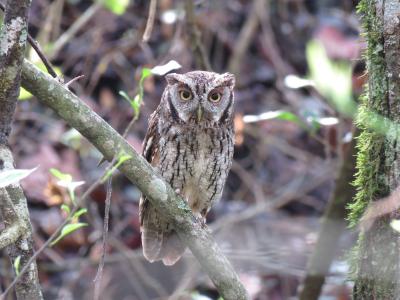
Day 3: We’ll depart very early for the northern foothills of the Sierra La Laguna, traveling a road that reaches an elevation of about 2500 feet. We’ll search for several endemic forms (many likely true species) that prefer the oak woodlands and even some that occasionally descend from the higher elevation pine-oak. Among birds we should see are California Towhee, the pale “San Lucas” American Robin, the dark-eyed “Narrow-fronted” Acorn Woodpecker, the “Viosca’s” Band-tailed Pigeon, without a tail band, and the not-so-different Warbling Vireo. If we’re very lucky, we could see the endemic subspecies of White-breasted Nuthatch, Oak Titmouse, and Spotted Towhee, but the one that is most likely is the relatively common “Cape” Northern Pygmy-Owl with its slightly higher-pitched and faster-paced song. Wintering Cassin’s Kingbird occurs here, and the woodland is home to many wintering passerines such as a few Black-and-white and abundant Black-throated Gray Warblers. If the weather is sunny, this is also a good spot for the highly colorful San Lucan Rock Lizard and the endemic Cape Spiny Lizard. After lunch, we’ll return to our hotel and sea watching which might reveal Brown Booby and the ever-present Magnificent Frigatebird. Night in Los Barriles.
Day 4: We’ll have a relaxed morning in the deserts and estuaries on the Gulf of California coast. The desert here has abundant Bursera microphylla trees which provide food for wintering Gray Vireo and Ash-throated Flycatcher, while resident California Quail, Greater Roadrunner, Costa’s Hummingbird, Loggerhead Shrike, Cactus Wren, California Gnatcatcher, and Black-throated Sparrow are possible. We might stumble into flocks of wintering Brewer’s and Clay-colored Sparrows almost anywhere, and some years Lark Bunting is numerous. After lunch we’ll continue, with a birding stop or two, to our next hotel on the charming waterfront in La Paz, with nothing scheduled for the rest of the afternoon. Night in La Paz.
Day 5: We’ll spend a very full but slow-paced morning in the La Paz area, including some of the best shorebird mudflats in Western Mexico. Numbers of Least and Western Sandpipers, Willet, Long-billed Curlew, Marbled Godwit, and Wilson’s, Black-bellied, and Semipalmated Plovers winter here, and a full complement of herons and egrets is possible. The nearby sewage ponds and well-watered agricultural fields hold Black-bellied Whistling-Duck, Crested Caracara, American Avocet, Black-necked Stilt, Vermilion Flycatcher, and American Pipit among many other birds, keeping us busy for the rest of the day. For obvious reasons, Peregrine Falcon and Merlin also consider this a great place to spend the winter. The area is also notable for the list of vagrants that have been discovered here, and we’ll make an attempt to see any that have been reported, or perhaps we’ll find our own. We’ll have a break after lunch during which birders might spot a Blue-footed Booby patrolling the harbor waters across the street from our hotel while others might choose a stroll in the shopping district. There will be an optional late afternoon outing to the nearby mudflats and mangroves, or perhaps a return to the sewage ponds. Night in La Paz.
Day 6: We’ll have the first part of the day to bird near La Paz, venturing a bit farther afield to the north of town where a giant cactus grove is home to both Gila Woodpecker and Gilded Flicker. Farther north, the rocky shore should have American Oystercatcher, Yellow-footed Gull, and Brandt’s Cormorant while patches of mangrove might harbor Ridgway’s Rail, the lovely Mangrove Yellow Warbler, and Northern Waterthrush. The nearby dwarf desert with fascinating plant forms will draw our attention, and Tiger Whiptail and Zebra-tailed Lizard will tease us as they dart away. If there are any flowers, some interesting butterflies such as Mexican Giant and Hepburn’s Metalmarks and the snazzy Silver-banded Hairstreak could occur. We’ll depart right after lunch to make the three and one-half-hour drive across the Baja California Peninsula to Puerto San Carlos, a Pacific Coast fishing village on Magdalena Bay. Night in Puerto San Carlos.
Day 7: We’ll take a four-hour boat trip on the bay during which we may get extremely close to Gray Whales, an experience not soon forgotten. It’s about an hour’s boat ride to the mouth of the bay where the whales tend to congregate as they arrive from their summer feeding and gestation areas as far north as the Chukchi and Beaufort seas off northwestern Alaska. Sometimes loafing, sometimes in active courtship and mating, they often approach the boats out of curiosity. Plenty of birds will be seen along the way with Royal Tern, Brandt’s Cormorant, Western Gull, and Brown Pelican in amazing abundance. After the boat ride and perhaps some mangrove birding, we’ll make the long drive back south, ending the day in the lush oasis of Todos Santos on the west side of the peninsula. Night in Todos Santos.
Day 8: We’ll have an easy day of birding near Todos Santos. Palm oases, hedgerows, parks and agricultural fields can hold concentrations of wintering birds, such as warblers, sparrows, buntings, and orioles, and in the process, we might discover a fun vagrant. We’ll also be back in the range of Xantus’s Hummingbird and Belding’s Yellowthroat, so we might have a chance to reacquaint ourselves with these endemics. Night in Todos Santos.
Day 9: We’ll have a very relaxed final morning, with some birding within walking distance of our hotel, such as at the nearby beach where we often see Humpback Whales breaching in the distance. In late morning we’ll make the 80-minute drive to the Los Cabos airport where the tour ends around noon in time for your mid-afternoon international departure.
Note: The information presented here is an abbreviated version of our formal General Information for Tours to Mexico: Baja California. Its purpose is solely to give readers a sense of what might be involved if they take this tour. Although we do our best to make sure that what follows here is completely accurate, it should not be used as a replacement for the formal document which will be sent to all tour registrants, and whose contents supersedes any information contained here.
ENTERING MEXICO: Mexico requires a valid passport for entry by US citizens. Citizens of other countries may need a visa and should check their nearest Mexican embassy. Your passport should be valid for at least six months after the date the tour ends. Tourist cards are required and are obtained upon entry at the border customs.
LEAVING MEXICO: For those flying into Mexico, the tourist tax is included in your flight ticket by the airline. For those entering by land, the tourist permit must be paid for at a bank before exiting the country; this can usually be done at the border when you get the permit.
COUNTRY INFORMATION: You can review the U.S. Department of State Country Specific Travel Information at https://travel.state.gov/content/travel/en/international-travel/International-Travel-Country-Information-Pages/Mexico.html, and the CIA World Factbook background notes on Mexico at https://www.cia.gov/the-world-factbook/countries/mexico/.
Review foreign travel advice from the UK government here: https://www.gov.uk/foreign-travel-advice and travel advice and advisories from the Government of Canada here: https://travel.gc.ca/travelling/advisories
CLIMATE: The southern Baja California Peninsula is usually warm and dry in late winter. Early mornings are pleasantly cool, and rain is possible but very unlikely.
HEALTH: The Centers for Disease Control and Prevention (CDC) recommends that all travelers be up to date on routine vaccinations. These include measles-mumps-rubella (MMR) vaccine, diphtheria-tetanus-pertussis vaccine, varicella (chickenpox) vaccine, polio vaccine, and your yearly flu shot. They further recommend that most travelers have protection against Hepatitis A and Typhoid.
Don’t forget that the sun in Mexico can be very intense. Please bring adequate protection, including a sun hat and a strong sun screen of at least 15 rating.
Biting insects and arachnids are seldom a major nuisance; during this season chiggers and mosquitoes are all but non-existent.
Please note that any health/medical information contained herein is gleaned by WINGS from websites that are dedicated to traveler’s health issues. Advisories and recommendations by agencies such as the CDC can and do change frequently. We urge you to consult with your physician. The most current information about travelers’ health recommendations can be found on the CDC’s website here: https://wwwnc.cdc.gov/travel/destinations/list
PACE OF THE TOUR: As with all tours in the tropics, we’ll try to be in the field around dawn, which means daily starts about 6:00 a.m. on most days; some a little earlier or later. All days will include one to two hours at the hotel before dinner or after lunch with optional late afternoon outings.
Walking is mostly along roads and wide trails that are level to gently sloping, with the possibility of some short stretches of steeper gradients. We’ll also occasionally be walking off the road and trails in wide washes, with some small boulders to navigate. Good foot gear is essential, and many people find a collapsible hiking stick invaluable for walking over rough ground and down rocky sides of washes. Since birding often involves standing still for periods, some people like to have a small travel stool to sit on. Our longest walk will be about one mile each way over the course of an hour or more.
FOOD: Most breakfasts and one lunch will be picnics, with remaining lunches and all dinners in restaurants. Despite common perception, spicy food is easy to avoid in Mexico. The food ranges from very good to outstanding, and we eat at some very nice restaurants featuring very fresh seafood and organic, locally grown vegetables.
ACCOMMODATIONS: Our hotels offer standard amenities.
DRESS: Informal throughout. Comfortable field clothes and shoes are essential.
TRANSPORTATION: Transportation during the tour is by 12-passenger vans driven by the leader.
SMOKING: Smoking and vaping is prohibited in the vehicles or when the group is gathered for meals, checklists, etc. If you are sharing a room with a non-smoker, please do not smoke in the room. If you smoke in the field, do so well away and downwind from the group. If any lodge, accommodation, or location where the group is staying or is gathered has a more restrictive smoking policy than the WINGS policy, the more restrictive policy will prevail.
We can't render google maps without your cookie consent. To see the map, please reset your cookies, then accept all, then reload this page.
2026 Narrative
In Brief: Our week of driving around the entire tip of Baja California Sur, birding our way as explored the amazing and varied habitats, was a true delight. Seeing the three lowland endemic birds of Belding's Yellowthroat, Gray Thrasher, and Xantus's Hummingbird was almost too easy, but that freed us up to enjoy other aspects of the natural history, such as the plants, butterflies, and lizards. Lazuli Bunting, Varied Bunting, and Vermilion Flycatcher were among the more colorful favorites, while our experiences with Ospreys and American Oystercatchers were particularly memorable. We also found some of the endemic subspecies of birds which may eventually be split, and vagrants were a highlight, topped by Mexico's first Taiga Flycatcher that had been found only two weeks before our tour started. A Northern Parula was also an excellent find on our last hotel's grounds. Also worth mentioning was our amazing morning boat ride on Bahia Magdalena with several very close Gray Whales, countless birds, and an amazing lunch in a remote fishing village. Perfect weather, delicious fresh seafood everywhere, and delightful company all combined to make this an immensely enjoyable tour.
In Detail: We started the tour with what was perhaps our best meal in San José del Cabo, celebrating the birthdays of two participants. The birding then began on Day 2 as we walked to the mouth of the Estuary of San José, where we padded the list with many ducks, grebes, herons, and other water birds, while enjoying a Crested Caracara at close range and a surprise Pectoral Sandpiper, an extremely rare bird in the middle of winter this far north. We spied our first Belding's Yellowthroats and saw a male Orchard Oriole. After a delicious lunch in the town of Miraflores, we birded the woodland near the wash where Gray Thrasher and Xantus's Hummingbird ma de their first appearances, while we enjoyed particularly good views of wintering Western Flycatcher and Black-throated Gray Warbler.
Our earliest morning was on day three of the tour in order to bird the oak zone of the Sierra La Laguna. The dark-eyed endemic subspecies of Acorn Woodpecker was readily spotted upon our arrival, while a single "San Lucan" American Robin (the mostly likely of the next splits) was late to appear but showed well. While getting good looks at a "Cape" Northern Pygmy-Owl that responded to imitation, the megararity of the year in Mexico appeared for brief views – the Taiga Flycatcher that had been found a couple weeks earlier. Wintering Black-throated Gray Warbler and Ash-throated Flycatcher were further highlights, while the owl-like songs of White-winged Doves echoed in the canyon. We made a stop on the way back to the hotel where MacGillivray's Warbler and Varied Bunting were good finds, and a nice sighting of a super colorful San Lucan Rock Lizard under the magnificent rock figs was worth a stop.
A more relaxed morning out of Los Barriles saw us stopping along a bumpy track in some dense coastal desert scrub where we soon found our first and only Gray Vireo of the tour. We also found California Gnatcatcher, Verdin, and Black-throated Sparrow here, while a singing Greater Roadrunner well up the hillside sat cooperatively for spotting-scope views. It was fun birding the marshes north of La Ribera by the beach, full of ducks, Belted Kingfisher, White-faced Ibis, a scarce Solitary Sandpiper, and a Reddish Egret. We also added more Gray Thrashers here and had our closest view of Belding's Yellowthroat of the tour.
We started our full day based in La Paz on the Centenario mudflats, where the tide was still well out, making for some distant scope birding. But it was pleasantly cool with no heat shimmer, so we had good views of Long-billed Curlew, Marbled Godwit, Wilson's Plover, and many other shorebirds. Highlights here were a single "Large-billed" Savannah Sparrow on its winter grounds and a Parasitic Jaeger that occasionally flew out to harass the Forster's Terns. The sewage pond complex was super productive, especially since access had been improved for birding. Vermilion Flycatcher and Summer Tanager were especially memorable here, but we also had Yellow-headed Blackbird, close Black-necked Stilts, Least Grebes, Cinnamon Teal, and many other species. We returned to the ex-Grand Plaza Hotel mudflats in the late afternoon to find that the tide was still out way out, and the light even worse, but the birding was better. American Avocets were a bit closer, the flock of Black Skimmers had increased in size, and we managed to pick out the rare Pacific Golden-Plover that had been found wintering here by other birders. Other highlights were a pair of Osprey at a nest, Monk Parakeets building nests in palm trees, and two Magnificent Frigatebirds that perched on a lamp post, the male inflating his gular pouch as we watched. We were able to walk right underneath him, the sunlight shining through his vascularized, red balloon at ridiculously close range.
Saving the long drive north for the afternoon, we ambled up to the deserts just north of the city for a morning, stopping for Mangrove Yellow Warblers and at a desert wash for interesting butterflies, flowers, and Gilded Flicker. Seawatching wasn't too productive at the point, but we had our best views of Yellow-footed Gull so far, a pair of Loggerhead Shrikes at close range, and distant Mobula Rays leaping out of the water. On the way back to town, we paused for more Yellow-footed Gulls, finding three with colored leg bands. After our long drive north, we made a stop just outside of Puerto San Carlos where we managed to get views of two Ridgway's Rails among the three pair that duetted back at us, and in the meantime, we enjoyed Reddish Egrets coming to roost and a pair of Osprey nesting next to the pond and bringing in their afternoon catch, including a fascinating California Needlefish.
Our morning boat ride on Bahia Magdalena was picture perfect – nearly windless, warm, and fog-free. Our boatman had been delayed by a flat tire on his boat trailer, but we still had time to paus for excellent views of Little Blue Heron in multiple plumages as well as many shorebirds at the point by the docks. We soon had wonderful, soul-satisfying views of Gray Whales in near record time. We spent a while with a few different animals in the clear and surprisingly shallow water right next to the boat, but only after we had passed Isla Patos which was chock full of countless cormorant, pelicans, gulls, and a nice group of American Oystercatchers. Other bird highlights included a raft of Surf Scoters, not present every year, a few Black-vented Shearwaters sitting on the water, two Pacific Loons, and many Brant shortly before returning to the docks.
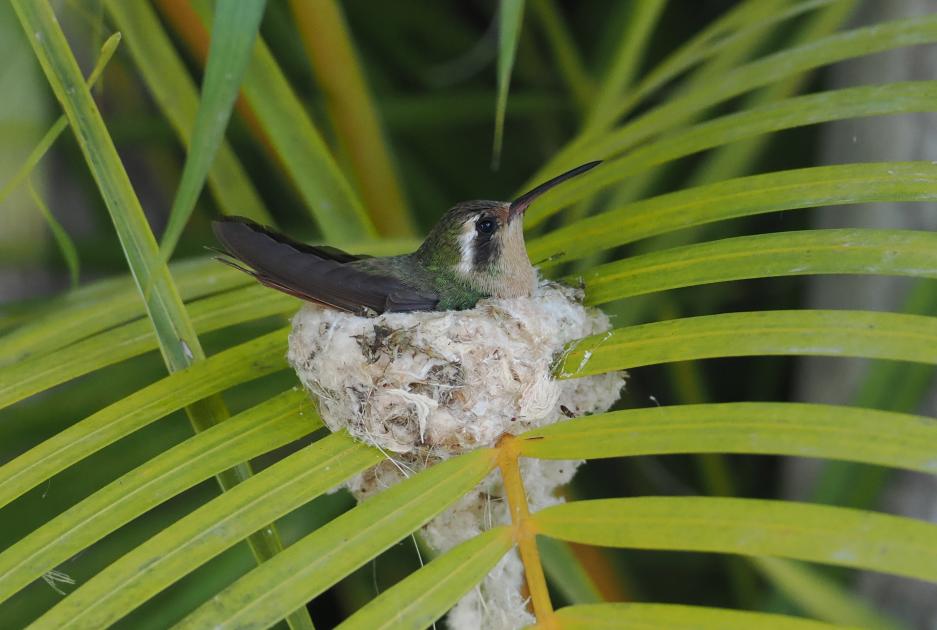
We spent a very relaxed morning in and near Todos Santos, where on our hotel grounds were the aforementioned Northern Parula, a Xantus's Hummingbird on nest, Green-tailed Towhees in the dense thickets, and great views of Scott's Orioles. We were accompanied by sisters Nina and Lisa from Seattle birding the marshes at the mouth of the main wash by town, where Hooded Orioles, a Summer Tanager, heard Least Bitterns, and a few more Belding's Yellowthroats were highlights. Afternoon birding took us to some coastal desert scrub and dense wash habitat where we saw quite a few birds, including a stunning male Varied Bunting, close Black-throated Sparrows, and the spectacle of dozens of California Gulls, Heermann's Gulls, and Brown Pelicans taking advantage of the spoils from the fisherman returning from their days' work.
There was one last morning of birding before our final transfer back to the San José del Cabo airport, where near our lodging the morning dew on spider webs were a fine backdrop for the Gray Thrashers, Hooded Oriole, California Quail, and Xantus's Hummingbirds. A side drive up to a desert reservoir in the foothills provided two write-in birds, a scarce Swainson's Hawk and a very rare for the Cape region Canvasback.
Rich has such a deep knowledge of general natural history, not just birds, and a sense of delight in everything we saw. In addition, he is just an all-around nice, helpful person, which made it a really special experience to be able to travel around with him. Plus he can change a flat tire like a boss and was completely calm and in control during what could have been a rather frightening and unpleasant experience. And he drove all the way back to Cabo to pick up a new vehicle for us in the middle of the night when the rental company failed to show up with a new vehicle. There's no way to avoid things like that, and the sign of a really top-notch guide is the ability to deal with unforeseen circumstances with competence and grace, which Rich exceeded.
- Lisa S. on Mexico: Baja California's Cape Region
Rich Hoyer is a rock star leader with his encyclopedic knowledge base of living organisms. His daily organization of all aspects of the tour was outstanding. The consideration of food for picnic breakfasts and one lunch was delightful, as were his snack peanuts and cookies. Clone him if you can get a mouth swab. :-)
- Dianne S. on Mexico: Baja California's Cape Region
Rich Hoyer is a rock star leader with his encyclopedic knowledge base of living organisms. His daily organization of all aspects of the tour was outstanding. The consideration of food for picnic breakfasts and one lunch was delightful, as were his snack peanuts and cookies. Clone him if you can get a mouth swab. :-)
- Dianne S. on Mexico: Baja California's Cape Region
Maximum group size seven with one leader.