Mexico: The Yucatan and Cozumel
-
Nov 29 to Dec 7 2026
Roland Rumm
-
Dec 5-13, 2027
Roland Rumm
-
Nov 26 to Dec 4 2028
Rich Hoyer
2026
Single Room Supplement $520
2027
Tour Price to be Determined
2028
Tour Price to be Determined


2026
Single Room Supplement $520
2027
Tour Price to be Determined
2028
Tour Price to be Determined
Mexico’s Yucatan Peninsula is famous for its spectacular Maya ruins, warm climate, and delicious regional cuisine. It is also a notable center of bird endemism with species such as Black-throated Bobwhite, Yellow-lored Parrot, Yucatan Woodpecker, Yucatan Wren, and the recently split Yucatan Gnatcatcher. Our tour distills the best of the Yucatan into a short, unhurried trip that takes in the peninsula’s dry forest, coastal scrub, lagoons, mangroves, and tall humid forest before ending on Isla Cozumel, with its Caribbean flavor, island endemics, and great snorkeling. At this season many migrant warblers from eastern North America are present, and flocks of resident flamingos feed among throngs of migrant shorebirds.


Day 1: The trip begins at 6:30 pm at our hotel south of Cancún. Night in Puerto Morelos.
Day 2: We’ll drive south, birding an attractive botanical garden in the morning, and then continuing south to the town of Felipe Carrillo Puerto, our base for two nights in the Zona Maya. On the way we'll explore the unusual coastal ruins of Tulum, where Yucatan Jay and Cave Swallows fly below sailing Magnificent Frigatebirds. Night in Felipe Carrillo Puerto.
Day 3: We’ll have a full day’s birding in the rich forests near town, where species include Ornate Hawk-Eagle, Wedge-tailed Sabrewing, Keel-billed Toucan, Northern Bentbill, White-browed Gnatcatcher, Blue Bunting, and the very local Gray-throated Chat and Rose-throated Tanager. We even have a fair chance of coming across a swarm of army ants, which should be attended by Ruddy and Northern Barred Woodcreepers. Night in Felipe Carrillo Puerto.
Day 4: We’ll spend the morning birdwatching in the forest near our hotel, where we’re sure to encounter new species. After lunch we’ll drive north to the picturesque Yucatan town of Valladolid. Night in Valladolid.
Day 5: We’ll spend much of the morning looking for orioles, parrots, and others while also visiting another set of Maya ruins*, where the surrounding woodland provides another taste of the Yucatan’s distinctive avifauna. Birds here could include Ferruginous Pygmy-Owl, Cinnamon Hummingbird, Turquoise-browed Motmot, and Orange Oriole. After lunch we’ll travel north toward Dzilam de Bravo, which hosts a healthy population of the recently split Yucatan Gnatcatcher. Once we are successful, we’ll continue east to Rio Lagartos, our base for the next two nights. Night in Rio Lagartos.
Day 6: We’ll bird locally around Rio Lagartos. The arid scrub here is home to two very local endemics, the tiny Mexican Sheartail and the garrulous Yucatan Wren, both of which we should see. We’ll also take a boat through mangrove-fringed lagoons in search of American Flamingo, Reddish Egret and Boat-billed Heron, while we'll get closer looks at several species of terns, shorebirds, and keep an eye out for Rufous-necked Wood-Rail. After lunch we’ll visit nearby areas in search of the specialties of the northern coast. Night in Rio Lagartos.
Day 7: In the morning, we’ll bird locally targeting anything that we may have missed, which could be Lesser Roadrunner or Gray-crowned Yellowthroat. We’ll then drive to Playa del Carmen for a ferry ride to the Caribbean island of Cozumel. Night in Cozumel.
Day 8: Mexico’s Cozumel Island has an interesting mix of Caribbean, Yucatan Peninsula, and island-endemic birds. We’ll spend a leisurely day exploring the island in search of White-crowned Pigeon, Cozumel Emerald, Caribbean Elaenia, Black Catbird, Yucatan and Cozumel Vireo, Cozumel Wren, Western Spindalis, and the distinctive races (or species?) of Bananaquit and Blue-gray Gnatcatcher. Wintering migrants include Palm, Prairie, Cape May, Yellow-throated, Black-throated Blue, and Swainson’s Warblers. Night in Cozumel.
Day 9: We’ll have an optional early morning walk before returning to the hotel where the tour concludes with our transfer to Cozumel airport for flights homeward.
*Note: We will likely visit the smaller, yet still impressive and more forested ruins of Ek-Balam. Those who might prioritize a visit to the more famous (and crowded, i.e. not very birdy) ruins of Chichén Itzá should consider arriving a day early and taking a locally organized tour on their own early on Day 1.
Note: The information presented here is an abbreviated version of our formal General Information for this tour. Its purpose is solely to give readers a sense of what might be involved if they take this tour. Although we do our best to make sure that what follows here is completely accurate, it should not be used as a replacement for the formal document which will be sent to all tour registrants, and whose contents supersedes any information contained here.
ENTERING MEXICO: U.S. citizens traveling to and from Mexico must have a valid passport valid for at least six months after the tour’s ending date, and with at least one blank page for an entry stamps. Citizens of other countries may need a visa and should check their nearest Mexican embassy. If required by the embassy or visa-granting entity, WINGS can provide a letter for you to use regarding your participation in the tour.
COUNTRY INFORMATION: You can review the U.S. Department of State Country Specific Travel Information here: https://travel.state.gov/content/travel.html and the CIA World Factbook here: https://www.cia.gov/the-world-factbook/. Review foreign travel advice from the UK government here: https://www.gov.uk/foreign-travel-advice and travel advice and advisories from the Government of Canada here: https://travel.gc.ca/travelling/advisories.
PACE OF THE TOUR: We start most mornings with picnic breakfast at 6:30 (EST when in Quintana Roo) or 5:30 (CST when in Yucatán), with departure for birding a half-hour later. It gets dark early (by 7 p.m. EST) so we won’t be out late except one night of owling, when we may have a later dinner soon after returning to town. On half of the days there will be the opportunity for a siesta break after lunch, followed by afternoon birding, and nearly every day we schedule an hour off before dinner.
Almost all the birding is along level roads or largely flat ground, with no narrow forest trails. We walk slowly and since birding often involves standing still for periods, some people like to have a small travel stool to sit on. One day we’ll take a boat trip for about three hours in mangrove lagoons. The only climbing you will need to do is in our hotels, most of which do not have elevators but do have two or three stories.
HEALTH: The Centers for Disease Control and Prevention (CDC) recommends that all travelers be up to date on routine vaccinations. These include measles-mumps-rubella (MMR) vaccine, diphtheria-tetanus-pertussis vaccine, varicella (chickenpox) vaccine, polio vaccine, and your yearly flu shot. They further recommend that most travelers have protection against Hepatitis A and Typhoid.
Please contact your doctor well in advance of your tour’s departure as some medications must be initiated weeks before the period of possible exposure.
No specific inoculations are necessary. Special medications may be unavailable so bring enough to cover your needs for the entire trip.
The most current information about travelers’ health recommendations can be found on the CDC’s Travel Health website here: https://wwwnc.cdc.gov/travel/destinations/list
Insects: Biting insects and arachnids are seldom a major nuisance although chiggers can be locally numerous, and mosquito numbers vary greatly from year to year. Cozumel typically has the most mosquitos, especially in the evening near the mangroves. Bring a good insect repellent for mosquitoes and other insects that we’ll occasionally encounter.
Smoking: Smoking or vaping is prohibited in the vehicles or when the group is gathered for meals, checklists, etc. If you are sharing a room with a nonsmoker, please do not smoke in the room. If you smoke in the field, do so well away and downwind from the group. If any location where the group is gathered has a stricter policy than the WINGS policy, that stricter policy will prevail.
Miscellaneous: We do not often encounter snakes and take time to observe them whenever possible; most are not venomous, and venomous ones are not aggressive.
We avoid tap water but filtered and bottled water are readily available at our hotels in the tour vehicles, and any water and ice served at restaurant tables is drinkable. Gastrointestinal problems are always a possibility while traveling; you may want to bring Imodium or some other reliable anti-diarrhea medication. Finally, you may wish to bring a broad-spectrum antibiotic in case of stubborn bacterial infections.
The sun in Mexico can be very intense. Please bring adequate protection, including a sun hat and a strong sunscreen.
CLIMATE: We’ll be here during the winter dry season, but weather is always unpredictable, and a cold front could pass through at any time. Daytime highs could reach the low 90s with lows possibly in the 50’s (°F) range. It is usually humid and rain is quite possible. We suggest a folding umbrella or light rain gear.
ACCOMMODATIONS: Our hotels and lodges are always among the best available among the smaller hotels (we try to avoid the larger, all-inclusive resorts). The Hotel Hacienda Morelos is a comfortable hotel right on the beach, with a/c in all rooms, and a refreshing swimming pool. The Hotel Esquivel in Felipe Carrillo Puerto is a basic Mexican hotel away from the touristy areas, so nothing fancy should be expected. It has a/c and ceiling fans in the rooms, as well as microwave and refrigerator. It's only a few miles to our excellent birding road. The Hotel El Mesón del Marqués in Valladolid is a pleasant historic hotel with an excellent restaurant, set on the corner of the colonial zócalo (town square) opposite a large cathedral. The hotel in Rio Lagartos is nothing fancy but room, with refrigerator and air conditioning. The hotel on Cozumel is a modern resort hotel with all of the usual facilities and is located right across the street from a good snorkeling opportunity, especially for beginners.
FOOD: We have picnic breakfasts most days, consisting of various bakery products, cheese, yogurt, and bananas. Lunches and dinners are in restaurants and are typically very good; most dishes are not spicy unless hot sauce is added; and this can be very hot indeed in the Yucatan, the home of the habanero pepper.
Food Allergies / Requirements: We cannot guarantee that all food allergies can be accommodated at every destination. Participants with significant food allergies or special dietary requirements should bring appropriate foods with them for those times when their needs cannot be met. Announced meal times are always approximate depending on how the day unfolds. Participants who need to eat according to a fixed schedule should bring supplemental food. Please contact the WINGS office if you have any questions.
TRANSPORTATION: Transportation during the tour is by 10- or 15-passenger van/bus, depending on the group size. Participants must be able to ride in any seat in our tour vehicle; anyone susceptible to motion sickness should bring an appropriate remedy.
We can't render google maps without your cookie consent. To see the map, please reset your cookies, then accept all, then reload this page.
January 2026 Narrative
Starting the tour at dawn wasn't a challenge, as this lone bastion of Eastern Time Zone in Mexico saw sunrise at 7:30 a.m. The birding was nonstop for the first hour of light, where a tree chock full of Yucatan Jays was later occupied by a Laughing Falcon, then both Hooded and Altamira Orioles. After the fly-by of two Crane Hawks, we enjoyed perched White-fronted Amazons, our first of a few stunning Blue Buntings, and a Black Catbird that took patience to see well. A highlight from the botanical gardens was a male Hooded Warbler in the open forest understory, while the gorgeous site of Tulum offered us a point-blank Rufous-browed Peppershrike.
The now wide and paved Vigia Chico road proved to still be among the best birding roads in the Yucatan Peninsula. After our breakfast Bat Falcons, we came across a mixed flock that contained a pair of Tropical Royal Flycatchers, a rare bird in these parts. The Mayan Antthrush that sang in the open was followed by several more mixed flocks in which we saw Rose-throated Tanager, Black-and-white Warbler, and Blue-winged Warbler among many others. Having lunch in town with a good view of the sky was a good choice, as this is how we spied a juvenile Gray Hawk and a Zone-tailed Hawk hunting over town. A return to the Vigia Chico road in the afternoon gave us a Turquoise-browed Motmot and a hard-earned Yucatan Flycatcher.
Owling in the early morning was a success with Mottled Owls, but we also heard two calls from a single reluctant Yucatan Poorwill during this new moon. It was only just light enough to enjoy a Keel-billed Toucan singing from a close cecropia, and as the dawn progressed, we spied Black-headed Trogons, a pair of Pale-billed Woodpeckers, several Boat-billed Flycatchers, a pair of Black-crowned Tityras, Black-cowled Oriole, Morelet's Seedeaters, and brief views of a Yucatan Woodpecker. The afternoon's drive went by quickly, and we were soon enjoying one of the finest dinners of the tour as well as some amazing gelato.
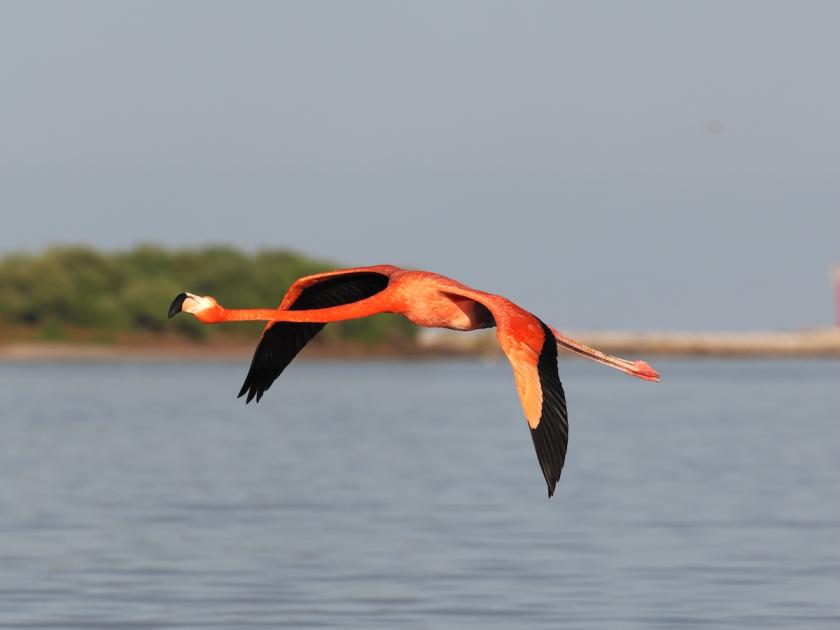
We picnicked at Hacienda San Miguel, where the birdy dawn included vibrant Summer Tanager and Orange Oriole, Turquoise-browed Motmot, and a furtive but well-seen Yellow-breasted Chat. The sprawling complex of Chichén Itzá was fascinating but not very birdy except some wonderfully close encounters with several Yucatan Jays. Our stop for Yucatan Gnatcatcher was quickly very successful, but the many birds along the drive had us pausing for Tropical Mockingbird, Vermilion Flycatcher, Crested Caracara, and many others. We spied our first Yucatan Wrens with one last stop, and as we were checking into our bayside hotel just before sunset, a magical skein of American Flamingos flew over.
There were many highlights on our boat trip through the Ría Lagartos, not the least of which were the many American Flamingos. Searching among the abundant Laughing Gulls we spied a Royal Tern with a color band that was eventually revealed to be a six and a half-year-old bird originally from Georgia. We lucked out with a retreating tide that offered foraging habitat for Rufous-necked Wood-Rail, a hard bird to find. We had amazing views of Mangrove Yellow Warbler and Common Black Hawk in the trees, while a trip outside the jetties allowed us close views of the very local breeding Snowy Plovers. It was fun to spend time watching a Double-crested Cormorant with a Gulf Toadfish that after three minutes finally went down the hatch. We got close to a very large Morelet's Crocodile before heading back to town for some land-based birding. We visited a busy marsh with close Black-necked Stilts and a nesting Roseate Spoonbill and later found the private access to a little swamp where Boat-billed Herons were the main attraction. The afternoon drive introduced us to some new habitats but no access to the salt flats, and we ended up scouting out our target birding area for the morning.
We had one last morning in the specialized habitats of the northern coast, where some of the highlights actually came from a small wetland behind the mangroves. The biggest surprise was an American Pygmy Kingfisher, but we were also pleased by a Least Bittern, a furtive Ruddy Crake, and Common Gallinules mixed in among the American Coots. We later visited a drier site where activity in the brushy area included Gray-crowned Yellowthroat, Blue-black Grassquit, and a couple family groups of charming Yucatan Wrens. We flushed a bevy of Black-throated Bobwhite, which was soon followed by a sneaky Lesser Roadrunner in the tall grass that eluded most of the group. After one last wonderful and speedy lunch, we bid farewell to the American Flamingos right in front of our hotel and made the drive to Playa del Carmen. After spying the tour's only Peregrine Falcon in flight as we were driving through town, it was then a quick goodbye to our driver Basilio and an efficient ferry ride to the island.
Our one full day on Cozumel was indeed full. Cozumel Emerald was the first endemic species we saw, though they were far outnumbered by the gorgeous Green-breasted Mangos in a flowering Kapok tree. In same tree were many warblers, the prize among which was a lovely male Black-throated Blue Warbler. We soon had great views of Cozumel Wren, but the Cozumel Vireos we encountered were reluctant to show themselves as well. A trio of Western Spindalises were great to see, and we lucked into a roosting Common Pauraque deep in the forest understory. The afternoon outing resulted in more great views of Cozumel Emerald, but most of our time was at a marsh where many Ruddy Crakes were seen, as well as a bold Sora that fed and then bathed at length in the open. Perhaps avoiding the increasing winds up high, a Short-tailed Hawk made an extremely close and low pass overhead.
Those flying out of Cozumel on our last day had a short morning of birding in a mostly abandoned development where we saw one more very shy Cozumel Vireo, but highlights were seeing three different Swainson's Warblers and the tour's only Caribbean Dove, singing at close range on a large branch.
- Rich Hoyer
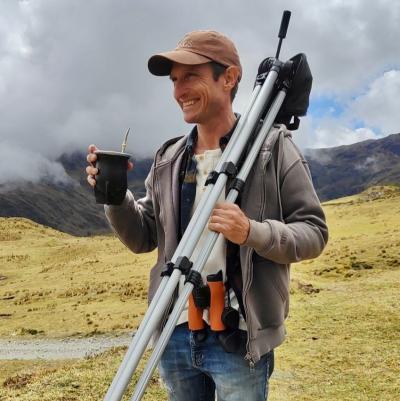
Rich Hoyer is a birder extraordinaire. His birding eye and ear skills are phenomenal, and he has an encyclopedic knowledge of avian natural history which he shared with us generously. He was very skilled at helping each of us see each bird. His Spanish language skills were also invaluable.
- Genevieve C. on Mexico: The Yucatan and Cozumel
Our 2 guides, Richard Hoyer & Roland Rumm, were exceptional at finding birds and making sure that all their clients, including me who is slow at finding them, saw them all well. The use of 2 scopes, of course, greatly helped. The Yucatan is a beautiful part of Mexico that deserves to be explored beyond the beaches and the Mayan ruins where most tourists flock. I loved the itinerary particularly because it included the Northern coast Rio Lagartos, a typical fishing village and the departing point to an enjoyable 4 hour-long boat ride around its estuary, an on the opposite side of the peninsula, the small but rich in birds island of Cozumel. This tour is definitely another winner for WINGS.
- Catherine L. on Mexico: The Yucatan and Cozumel
Maximum group size eight participants with one leader, 10 with two leaders.
More Tours with these Leaders