March 2028 Sailing (Buenos Aires to Santaigo, Chile)
Have you dreamed of taking an extended pelagic trip along the Humboldt Current or traveling to such legendary places as Cape Horn, the Beagle Channel, the Strait of Magellan, and the Falkland Islands? What about seeing 30 to 35 species of tubenose, 8 species of albatross, 4 species of penguin, 3 species of diving-petrel, among others? If so, you may not have imagined that this could be done on a comfortable and well-appointed Holland America cruise ship, which also happens to be stable enough to permit telescope use even in these turbulent waters. We feel this cruise offers the best accessible seabirding experience in South America, and probably one of the best in the world.
If we have your attention, we should say that in addition to spending six full days at sea, we’ll arrange land-based expeditions to such wonderful areas as penguin colonies on the Falkland Islands, the Patagonian steppe around Punta Arenas, and the primeval Nothofagus forest near Puerto-Montt. During our landings we’ll look for sought-after specialties such as Chucao Tapaculo, Black-throated Huet-huet, Magellanic Plover, and Magellanic Woodpecker at stops in Chile, King Penguin, Brown Skua, and Ruddy-headed Goose on the Falklands, and Giant Wood-Rail and Rufous-capped Antshrike in Uruguay.
Details on booking space with both WINGS and Holland America Cruises can be found here. To return to the main tour page, click here.
This sailing can be combined with our repositioning cruise from Chile to California.
----------------------------------------
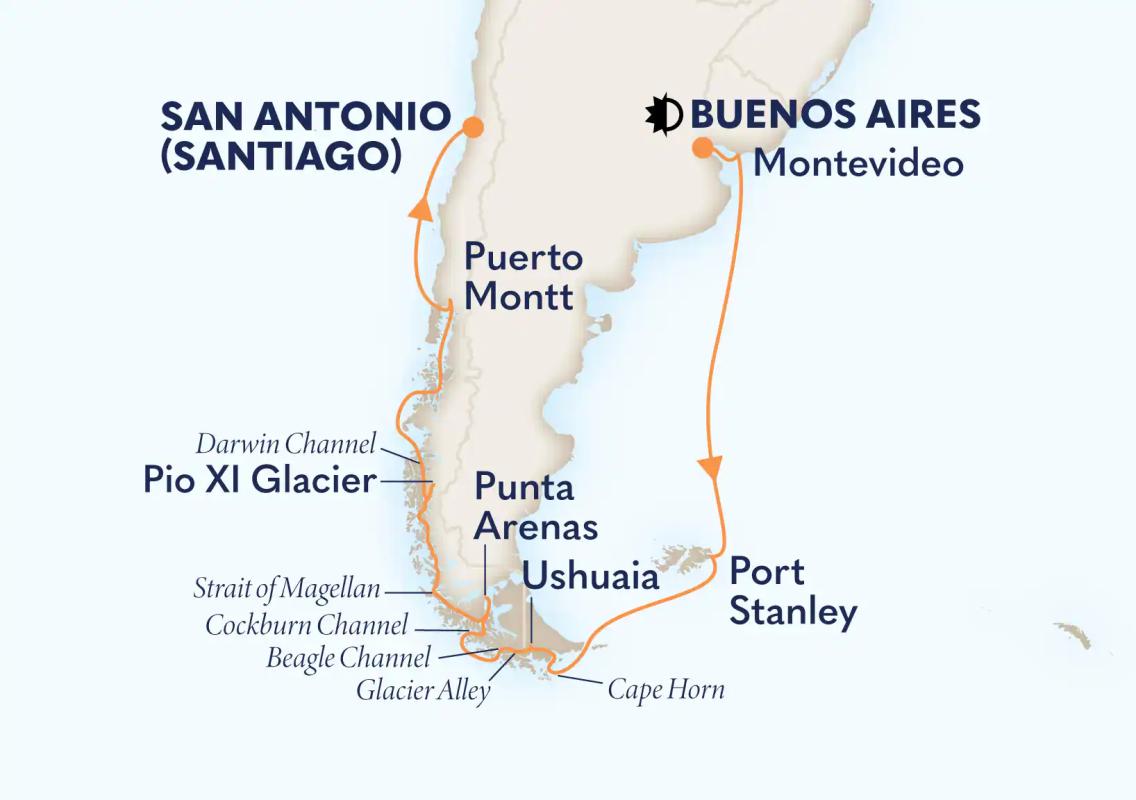
MARCH 2028 SAILING ITINERARY (Buenos Aires to Santiago):
Pre-tour extension: Ceibas, Argentina.
We’ll take advantage of being in Argentina by visiting the Ceibas area, a mix between pampas and Chaco habitat. This area is extremely birdy, and a visit there is usually very rewarding.
Ext Day 1: The pre-cruise extension begins this evening in Buenos Aires. Night in Buenos Aires.
Ext Day 2: With an early start to beat the heat, we’ll drive north to the Ceibas area, where birding is excellent in a variety of habitats, especially wetlands and Chaco scrubland. In this remarkably rich area we often see more than 100 species in a single morning, often including Giant Wood-Rail, Long-winged Harrier, Nacunda Nighthawk, White-fronted Woodpecker, Scimitar-billed Woodcreeper, Lark-like Brushrunner, Chotoy Spinetail, White Monjita, White-naped Xenopsaris, and Red-crested Cardinal. Birding is in this pampas-like open to semi-open habitat, and we’re certain to have some outstanding photo opportunities. After lunch we’ll board our cruise ship and spend the afternoon familiarizing ourselves with it. Night in Buenos Aires harbor.
Cruise Itinerary:
Day 1 (Ext Day 2): The cruise begins this afternoon in Buenos Aires, Argentina. We’ll gather on board in the evening for an introductory meeting. This and all subsequent nights on our cruise ship.
Day 2: We’ll leave the ship as early as possible and drive to Costanera Sur Reserve, close to the harbor. The number of possible species is large, and many of them will not be seen again on our tour. We’ll look for Giant Wood-rail, Gilded Sapphire, Checkered Woodpecker, Narrow-billed Woodcreeper, Masked Gnatcatcher, Red-crested and Yellow-billed Cardinal, Black-and-rufous Warbling-Finch, among many others. At day’s end we’ll drive back to the ship and later depart port for Uruguay.
Day 3: We’ll spend the full day in Montevideo’s immediate surroundings. Monk Parakeet, Rufous Hornero, and Picazuro Pigeon are common and at nearby wetlands we’ll scan for shorebirds and gulls and, in the reedbeds and shrubs, for Rufous-sided Crake, Great Pampa-finch, Firewood-gatherer, and the beautiful Spectacled Tyrant and Freckle-breasted Thornbird. In shrubbier habitat, we have a good chance of finding Green-barred Woodpecker, White-crested Tyrannulet, Short-billed Elaenia, White-throated Hummingbird, and, with some luck, even Rufous-capped Antshrike.
Day 4: On our first full day at sea, we’ll encounter our first tubenoses including Yellow-nosed Albatross, White-chinned Petrel and hopefully Cory’s and Manx Shearwaters, and we may find a few Long-tailed or even Pomarine Jaegers. It may be a quiet birding day compared to those we experience farther south, but we’ll be able to familiarize ourselves with the different seabird families we’ll encounter later.
Day 5: We’re now in the South Atlantic sailing toward the Falkland Islands. Seabirds will be a completely different species mix from those we saw yesterday: Soft-plumaged Petrel, often abundant, Great Shearwater, the elegant Atlantic Petrel, and the minuscule Gray-backed Storm-petrel among others. We may also see a few Southern Right Whales.
Day 6: Just before we arrive in Stanley, several hundred Gentoo Penguins, breeding in the dunes, will welcome us to the Falklands. Once off the boat, we’ll immediately begin our drive to Volunteer Point. It will be a longish, off-road excursion on a fairly rough track, but we’ll be rewarded by a huge mixed colony of King, Gentoo, and Magellanic Penguins. Other species that occur here include Upland and Ruddy-headed Geese, Two-banded Plover, Rufous-chested Dotterel, Southern Giant-Petrel, Falkland Steamer-duck, Dark-faced Ground-Tyrant, and with luck even a few Falkland’s (White-bridled) Finches. After our return to Stanley, we should have time for shopping or a beer in a truly British pub. We’ll depart in the evening toward Cape Horn in Chile, and we’ll want to be outside looking for Great Shearwater, and possibly our first Slender-billed Prion.
Day 7: We’ll continue our journey toward storied Cape Horn. We’ll check the common Black-browed Albatross for the rare Gray-headed, and we should also see a few Wandering and Southern Royal Albatrosses, and possibly even the very rare Light-mantled Albatross. Small petrels will also be interesting; we have a chance for Black-bellied Storm-Petrel and Common Diving-Petrel. In the afternoon, Black-browed Albatross and Sooty Shearwater will probably be abundant as we sail around Cape Horn Island, enter the Beagle Channel, and continue toward Ushuaia, Argentina.
Day 8: We’ll arrive early morning in Ushuaia, the southernmost town in the world, and drive through stunning landscapes directly to Tierra del Fuego National Park where we’ll explore the fantastic Nothofagus forest in search of the impressive Magellanic Woodpecker. We also have a good chance for the beautiful Spectacled Duck and the loon-like Great Grebe.
On the way back to Ushuaia we might stop at a less scenic place - the garbage dump - looking for White-throated Caracara, usually found with its two relatives, the Chimango and Southern Caracaras. Additional stops on the coast should provide excellent views of Kelp Goose, South American Tern, and Flying and Flightless Steamer-Duck as well as good numbers of the beautiful red-billed Dolphin Gull. We’ll depart Ushuaia in the afternoon, sailing into the Beagle Channel towards the Chilean town of Punta Arenas. As the sun fades, we’ll pass by islands covered with hundreds of breeding Imperial Cormorant, and we’ll likely see good numbers of the elegant South American Tern and Chilean Skua.
Day 9: We’ll have plenty of time to explore the Patagonian steppe around Punta Arenas, where our main target will be the pink-bubble-gum-legged Magellanic Plover, the lone species in its family. We’ll have as well a good chance of finding Lesser Rhea, Upland and Ashy-headed Geese, Two-banded Plover, Austral Negrito, and Black-faced Ibis, among many others. We’ll also visit lakes and wetlands where we expect several waterfowl species including Crested Duck, Yellow-billed Pintail, Red Shoveler, Flying Steamer-duck, Coscoroba Swan, and maybe even the uncommon Silver Teal.
After our steppe birding, we’ll make a few more stops along the Strait of Magellan looking for Kelp Goose, Flying Steamer-Duck, Magellanic Oystercatcher, and groups of Peale’s Dolphin which sometimes fish very close to shore.
Day 10-13: We’ll have four full days sailing through the majestic Chilean Fjords, visiting places such a s Sarmiento, Cockburn or Darwin Channels and Pio XI Glacier. The landscapes are wonderful and in addition to the scenery, we should be surrounded by Black-browed Albatross, Chilean Skua, and Southern Giant-Petrel. We should see as well numerous Magellanic Diving-Petrel and might detect a few Magellanic Penguin.
According to the routes taken by the ship, often weather dependent, we might exit some of these channels by day. In outer waters, seabirding can be excellent and we expect our first Salvin’s Albatross and our last Gray-headed, and perhaps a few Slender-billed Prion. Sooty Shearwaters, breeding by millions on some of these islands, will probably be the most common seabird. Stejneger’s Petrel is regular, and although they are very fast fliers and usually avoid the ship, we should have some good views. We’ll also hope to see the recently described Pincoya Storm-petrel among the numerous Fuegian (Wilson’s) Storm-petrel, as well as the rare, in these waters, Subantarctic Little Shearwater.
If we cross the Golfo de Penas by day, we might also have an eight-albatross day: Black-browed, Salvin’s, and Northern Royal will be the most common, but we have good chances of finding the huge Snowy and Antipodean Albatrosses as well as Southern Royal, and with good luck possibly even Chatham and Buller’s.
Day 14: We’ll leave the ship as soon as it arrives in Puerto-Montt harbor and drive south to the wonderful Alerce Andino National Park. We’ll be birding in impressive Nothofagus forest, looking for four species of tapaculo: Black-throated Huet-huet, Chucao, and Ochre-flanked and Magellanic. All of them should be easy to hear, but we’ll have to be lucky to see them! The austral migrant Chilean (White-crested) Elaenia is common, and there are lots of other species including White-throated Treerunner, Thorn-tailed Rayadito, Austral Parakeet, Patagonian Sierra-finch, and even the rare Magellanic Woodpecker. On our way back to Puerto-Montt we’ll make several stops and may see the splendid Black-faced Ibis or the local subspecies of Ringed Kingfisher. We may also find a few Hudsonian Godwit, come from northern Alaska or Canada to winter on the rich mudflats on Chiloé Island near Puerto-Montt.
We’ll depart in the afternoon, and everyone will want to be on the outside deck looking for Pincoya Storm-Petrel. This enigmatic species was discovered in 2009 by a group of birders making a similar cruise, and was officially described in 2013. For the most part, this species has only been seen in the Gulf of Corcovado, and we have good chance of seeing it as we leave Puerto-Montt.
Day 15: During our last sailing day, the most common albatrosses will be Salvin’s and Black-browed, but we’ll probably also find a few Northern Royal Albatross. We’ll sail within a few miles of Mocha Island, where 90 percent of the world’s Pink-footed Shearwaters breed. By now, we should be able to separate White-chinned and Westland Petrels, and Sooty Shearwater, three very similar-looking seabirds. Among the Stejneger’s Petrels we have a chance of finding rarer Pterodroma petrels such as Juan-Fernandez and De Filippi’s and with a bit of luck we’ll see a few whales - Fin and Humpback are the most common - migrating north towards their breeding areas.
Day 16 (Ext Day 1): We’ll disembark at the port of San Antonio, near Santiago, Chile, in time to catch international flights home, continue with the Santiago to Los Angeles Cruise, or join the 3-day Santiago extension.
Post-cruise Santiago extension
The area around Santiago offers wonderful birding in amazingly varied habitats, from the stunning scenery of the High Andes to the coastal wetlands and the dry scrublands in between. We’ll make a special effort for the Chilean endemics found around Santiago, and have a good chance of seeing seven of the 12: Chilean Tinamou, Dusky and White-throated Tapaculo, Moustached Turca, Crag Chilia, Dusky-tailed Canastero and Chilean Mockingbird.
Ext Day 1: The post-cruise extension begins this morning in San Antonio. We’ll leave the ship as early as possible, but our actual schedule for the day depends on the disembarking procedure and timing. After meeting our driver at the San Antonio harbor, we’ll visit scrublands where we have a chance to find our first Chilean endemics such as Chilean Mockingbird, White-throated Tapaculo or Dusky-tailed Canastero. We’ll have lunch at a good restaurant by the rocky shore, where we may detect Blackish Oystercatcher along with another Chilean endemic, the Seaside Cinclodes. In the afternoon, we’ll head to a small wetland where Stripe-backed Bittern is sometimes seen, as well as Red-gartered Coot, Yellow-winged Blackbird, and/or Plumbeous Rail. Night in Santiago.
Ext Day 2: We’ll spend all day at 8000–9000 feet elevation in the Maipo and Yeso valleys, home to the delicate Diademed Sandpiper Plover, one of the world’s most beautiful shorebirds and our main target. Other interesting species could include Crag Chilia, a stunning ovenbird endemic to Chile, and, in the high-elevation bogs, Gray-breasted Seedsnipe, Greater Yellow-finch, Rufous-banded Miner, White-sided Hillstar, White-browed Ground-tyrant, and if were very lucky the rare Creamy-rumped Miner. The scenery is absolutely stunning and is as much a reason to make the journey as the birds. Night in Santiago.
Ext Day 3: We’ll leave early for the ski resort of Farellones, stopping at different elevations from the Mediterranean matorral shrublands to the alpine zone at 8250 feet. Our route is excellent for several Chilean endemics, including the cryptic and difficult-to-see Chilean Tinamou and the charismatic Moustached Turca. At high elevations we’ll almost certainly find Rufous-banded Miner, Black-winged Ground-dove, Band-tailed Sierra-finch, and Greater Yellow-finch, but the Andean Condor will probably attract the most attention as we have a good chance of seeing a few of these giants during our picnic lunch near Farellones. After lunch we’ll reach the highest point of our excursion, Valle Nevado at 9,850 feet, where we usually have excellent views of condors. The rare Creamy-rumped Miner and Black-fronted Ground-tyrant are also often here.
The post-cruise excursion ends at 5 pm at our hotel near the Santiago airport.