
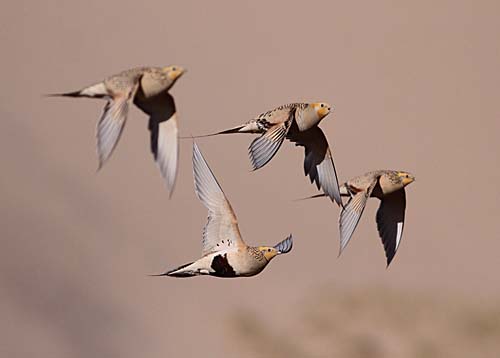
Pallas’s Sandgrouse against a backdrop of Gobi Desert dunes Photo: James Lidster
Mongolia lies at the heart of the vast continent of Asia. It’s a land where nomadic horsemen still ride across windswept steppes, where shamanism and ancient Tibetan Buddhism still flourish, and where, according to legend, lies the last resting place of Chinggis Khan, leader of the once great Mongol empire. This exotic country is also full of natural wonders: the vast Gobi Desert, which covers one third of Mongolia; the endless steppes strewn with lakes; the picturesque Altai Mountains; and the rich taiga forest—all remote, beautiful, fascinating, and full of birds.
Our trip will be more than just a birding tour; it will be a true adventure. From the capital city of Ulaanbaatar we’ll travel across land, much of it unchanged for centuries, and, as befits a culture famous for its nomadic way of life, we’ll camp as we go. We’ll gaze upon stunning landscapes seen by few Westerners and on birds most Western birdwatchers can only dream about: with perseverance and a little luck we should see Black-billed Capercaillie, Altai Snowcock, Pallas’s Fish Eagle, Oriental Plover, Relict Gull, Amur Falcon, Pallas’s Sandgrouse, Hodgson’s Bushchat, Blyth’s Pipit, and Kozlov’s Accentor, among many others.
We’ll travel in 4x4 vehicles admirably suited to the terrain and stay in reasonably comfortable ger camps that are testament to Mongolia’s nomadic heritage. We’ll mingle with the locals tending their flocks of sheep, cattle, goats and horses, much as they have done for centuries, and we’ll walk along pathways few have trod.
In 2026, this tour can be taken in conjunction with our new tour Mongolia: The Eastern Steppes
Days 1-2: The tour begins this morning in Ulaanbaatar, where we’ll be met at the airport by our translator and local guide, then drive by 4x4 directly to the edge of the Siberian taiga and our first birding stop of the tour: Jalman Meadows. This comfortable ger camp (pronounced ‘gear’, these round tents are known elsewhere as yurts) sits in a scenic valley surrounded by habitats ranging from riparian poplar forest to larch-covered hillsides, and home to an array of species including Black Grouse (whose wonderful bubbling calls can be heard from our gers), Common and Oriental Cuckoos, Grey-headed and Black Woodpeckers, Red-flanked Bluetail, Amur Stonechat, Red-throated Thrush, White-cheeked Starling, Azure and Willow Tits, Yellow-browed, and Two-barred Warblers, and the remarkable looking Long-tailed Rosefinch. It is also the home to the sought-after Black-billed Capercaillie, perhaps our primary target.
We’ll have a second day around the ger camp, including more time looking for the Black-billed Capercaillie should we need it. With luck we may be able to find more northern species, such as Three-toed Woodpecker. Each ger is equipped with a wood-burning stove, and, should the weather turn inclement, there is always someone on hand to light it for you — even first thing in the morning. Nights at Jalman Meadows ger camp.
Day 3: It’s a short drive to Gun Galuut Nature Preserve. Before we reach our ger camp, we’ll pass small lakes where we could find Stejneger’s Scoter, Garganey, and often a surprise or two. In 2018 we found the first Velvet Scoter for Mongolia and in 2023 recorded both Smew and Falcated Duck. It can be a good area for waders, with Asian Dowitcher and Broad-billed Sandpiper being realistic s among the more common Little Stint and Kentish Plover. This is an area for White-naped Cranes, and impressive flocks of Demoiselle Cranes can fill the sky. A small area of riverside bushes by our gers is an excellent spot for migrants, and we’ll take time to investigate these. Lanceolated and Chinese Bush Warblers have been found here in the past, and Eastern House Martins nest within the ger camp. Beyond the camp, we’ll journey into the hills and around a large marsh area, checking that all the large white birds aren’t “just” Whooper Swans, as in some years Siberian Crane has been seen here. Mongolian Lark is common, and their distinctive song flight will become a regular feature of our future birding. We’ll also focus on mammals, with the main attraction being the world’s largest sheep, the Argali. We may also be lucky with smaller mammals such as Daurian Ground Squirrel, while thermal scoping after dark could reveal Siberian Jerboa and Daurian Hedgehog. Night at Gun Galuut Ger Camp.
Day 4: It’s a very long, all-day drive to the southern Gobi and the town of Dalanzadgad. We’ll break the journey with a small number of stops for the occasional leg stretch and for lunch. We’ll spend the day watching the landscape get gradually drier and transition from semi-steppes to semi-desert to desert. On the way we’ll undoubtedly see the more common residents such as Black Vulture, and we have a chance of something a little less obvious like Asian Desert Warbler. Our ger camp will have a few trees around the grounds, and we should arrive in time for a little exploration of the grounds to see what’s about. Migrant Dusky Warblers can be almost common and Daurian Shrike often breeds on the grounds. Night in ger camp.
Day 5: We’ll take a pack breakfast and lunch and drive to the nearby Gobi Altai and into Yolyn Am, or “Valley of the Vulture.” We’ll spend most of the day walking along the flat valley bottom where species such as the near-endemic Kozlov’s (Mongolian) Accentor can be found alongside Brown Accentor, Chinese Beautiful Rosefinch, Godlewski’s Bunting, Common Rock Thrush and the red-bellied form of Black Redstart. White-winged Snowfinch is abundant, and this is one of the best places in the country to see Wallcreeper. Several pairs breed, often showing at eye level for extended periods. Overhead we should see the mighty Lammergeier (Bearded Vulture) and Himalayan Vulture. The valley can also act as a migrant trap, and the stream and rough grass could hold thrushes, warblers, and buntings. For those whose interests include mammals and reptiles, this is also the best place to look for Halys Pit Viper, whose presence is often revealed by the mobbing of Isabelline Wheatears. We should also be treated to great views of Alashan Ground Squirrel and endearing Pallas’s Pika, while Siberian Ibex inhabit the cliffs above us. We’ll also be conscious that both Pallas’s Cat and Snow Leopard are possible; indeed we were treated to a Pallas’s Cat sighting here in 2023, but seeing their prey is far more likely. Back at our ger camp we’ll check the trees once more as every day brings the possibility of new arrivals. Night in ger camp.
Day 6: We’ll set off across the Gobi in search of one the most enigmatic and sought-after birds of southern Mongolia, the Oriental Plover. These stunning (the males) shorebirds breed at low density across huge areas of Mongolia, but this area seems particularly good for them, and we’ll scan the semi-desert for sight of a bright white head. Our destination is Khongoryn Els, one of the world’s largest sand dune complexes and a part of Gobi Gurvan Saikhan National Park. At the foot of the main dunes there’s a small stream with grazing meadows where Common Snipe, and Common Redshank breed alongside Long-legged Buzzard, and Steppe Grey Shrike. The fresh water can also act as a magnet for tired migrants who have just transited hundreds of miles of Gobi sand. A nearby river that forms a boundary between the marshes and some smaller dunes is a regular haunt of the enigmatic Saxaul Sparrow, while the subtly marked Hill Pigeon may be seen dropping into drink. Night at ger camp.
Day 7: After breakfast we’ll set off for the Valley of Lakes and Orog Nuur, a large ephemeral lake at the foot of Ikh Bogd Mountain in the Gobi Altai Mountains. The journey is long and off-road, and out here we’ll feel very much in the middle of nowhere. However birds are available for the patient; Pallas’s Sandgrouse should be seen in a few places, and we will be on the lookout for the smart Henderson’s Ground Jay. These characterful birds are found at low density but usually perch atop bushes between rapid chases along the desert floor. We’ll also be on the lookout for Black-tailed and Mongolian Gazelles, both of which are regularly seen kicking up the dust as they sprint over the desert. The lake itself has large areas of reedbed, from which Great Bitterns boom and over which North Lapwing and Black-tailed Godwit display. Our support staff for the first time will have set up our own camp on the shores of the lake and in the shadow of the mighty Ikh Bogd. It’s a special place to spend a couple of nights. Night camping at Orog Nuur.
Day 8: We’ll explore the environs of Orog Nuur, and also ascend part way up one of the canyons on the flanks of Ikh Bogd. The lakeshore could produce any of the region’s waterbirds, and we’ve had stunning views of Asian Dowitcher. Exploring the canyon may turn up Grey-necked Bunting and perhaps even a surprise, either avian or mammalian. After dinner and a sundowner we’ll be lulled to sleep by the sounds of bittern, “wikking” godwits and song flighting Richard’s Pipits. Night camping at Orog Nuur.
Day 9: Driving west along the Valley of the Lakes, we’ll go through more Saxaul forest and have additional chances for Henderson’s Ground Jay and Asian Desert Warbler. We’ll visit a small wetland that has proved productive over the years. Falcated Duck, Temminck’s Stint, and Paddyfield and Oriental Reed Warblers are all possible, as are perhaps the most easterly Savi’s Warbler in the world. We discovered that this marsh seems to hold breeding Water Rails and on several occasions we’ve detected migrant Baillon’s Crake. Later we’ll continue west, eventually arriving on the shores of the largest lake in the region, the fabled Böön Tsagaan Nuur. We’ll probably have time for a short exploration of the immediate camp surroundings, as well as time for some thermal scanning of the campsite for nocturnal mammals. Night camping at Böön Tsagaan Nuur.
Day 10: We’ll have a full day to explore the shores of Böön Tsagaan Nuur. During breakfast we may be treated to a passage of Pallas’s Sandgrouse as they come to the small river near our camp to drink, and from then onwards the day should just get better. White-winged Tern should be abundant and waterfowl might include Swan and Bar-headed Geese and Ferruginous Duck. We’ll almost certainly see Pallas’s Gull and this is one of the most reliable sites in the world for finding Relict Gull in breeding plumage; however, despite having a good track record with them here, they are migrants and never guaranteed. This is also one of the few spots left in Mongolia for Pallas’s Fish Eagle. Migrant shorebirds might be numerous and could include Pacific Golden Plover and Greater Sand Plover. It can be an excellent site to get superb views of Pacific Swift and the pekinensis form of Common Swift feeding low over the marshes, and migrant passerines may also feature, from lydiae Pallas Reed Bunting trying to hide in the short grass to Red-throated or Dusky Thrushes feeding along the small river. We may also be lucky enough to find the stunning white-headed leucocephala race of Western Yellow Wagtail, the easternmost and probably rarest of the Western Yellow Wagtail forms. Every year is different, and we never know what we might find. Night camping at Böön Tsagaan Nuur.
Day 11: We’ll leave early for the Khangai Mountains. It’s another all-day drive, but we’ll stop en route for occasional birding breaks and lunch. Our destination is the Khukh Lake, a large lake high in the Khangai Mountains where the full suite of high-altitude bird specialties can be found. Night camping at Khukh Lake.
Day 12: We’ll have a full day to explore the high-altitude habitats around the magnificent lake. We are in the realm of some of Mongolia’s most special and sought after birds; Altai Snowcock display on the crags, while Hodgson’s (White-throated) Bushchat, Güldenstadt’s (White-winged) Redstart, Altai Accentor and sushkini Asian Rosy-Finch bound around the boulder fields. We’ll take it slowly, probably shifting our gaze between memorable birds and the stunning surroundings. Night camping at Khukh Lake.
Day 13: Leaving the lake and alpine species behind, we’ll drive through the Khangai to a woodland area on the north side of the mountains. Here, we’ll be explore the woods looking for Pallas’s Rosefinch and Eversmann’s (Rufous-backed) Redstart, as well as more common woodland birds such as Pine Bunting, Olive-backed Pipit and Hume’s Warbler. Night camping at Terkshin Tsugaan Nuur.
Day 14: After a morning birding the woodlands, we’ll begin the drive back east, through the Khangai mountains towards the bird rich Ugii Nuur. We’ll make several stops along the way among the passes to explore this very under-watched area. Night in ger camp at Ugii Nuur.
Day 15: We’ll have the entire day to explore the shores of Ugii Nuur and catch our breath from the previous long mileage days. This large lake holds good numbers of Stejneger’s Scoter and potentially numbers of other wildfowl too, such as Arctic Loon, Great Crested, Common Pochard and Tufted Duck. It’s also a reasonably regular haunt of migrant Relict Gulls, although we would need some luck to find one. The journey around the lake should reveal, as well as more unpredictable species such as Père David’s Snowfinch and Steppe Eagle which will no doubt be keeping a close eye on the many rodents. This is a good area for the unexpected, and recent records of Siberian Crane and Baer’s Pochard hint at what is possible. Night in ger camp at Ugii Nuur.
Day 16: From Ugii Nuur we’ll continue east, first stopping at the roadside lake of Bayan Nuur, an excellent site for several reedbed species such as Eastern Marsh Harrier and Bearded Tit, and a regular site for Eastern Spot-billed Duck, Paddyfield Warbler and Pallas’s Reed Bunting among others. There may also be a selection of migrant waders that could include Pintail or Swinhoe’s Snipe, plus a few breeding Eastern Yellow Wagtails. There is an outside chance of Brown-cheeked Rail, if we’re willing to get our feet wet. We’ll then continue to the famous Hustai National Park, an area of hills, steppes and birch woodland. This is one of just three locations in Mongolia where one can see Przewalski’s Horses, ancient animals brought back from the edge of extinction many years ago through a captive breeding program. Mongolian Marmots and Brandt’s Voles scurry across the grassland, Meadow Bunting and Blyth’s Pipit sing from the hills, while Saker and Hobby hunt overhead and Golden Eagle cruise the ridge tops. Night at Hustai National Park ger camp.
Day 17: We’ll spend the morning looking for species we may have missed. Hustai is particularly good for Père David’s Snowfinch and Daurian Partridge, and the trees along the Tuul river hold White-crowned Penduline Tits as well as potentially some late migrants. We’ll then make the short journey to Ulaanbaatar, arriving in time to go to a Mongolian cultural show, complete with traditional dancing and throat singers, before having our final dinner in a local restaurant. Night in Ulaanbaatar.
Day 18: The tour concludes this morning in Ulaanbatar with transfer to the airport for homeward flights.
Updated: 25 April 2024
Prices
- 2024 Tour Price : $7,090
- Single Occupancy Supplement : $720
- 2025 Tour Price Not Yet Available
- 2026 Tour Price Not Yet Available
Notes

Questions? Tour Manager: Erin Olmstead. Call 1-866-547-9868 (US or Canada) or (01) 520-320-9868 or click here to email.
* Tour invoices paid by check carry a 4% discount. Details here.
We can assist with booking extra nights at our Ulaanbaatar hotel and airport transfers upon request.
Maximum group size 10 with one leader.