
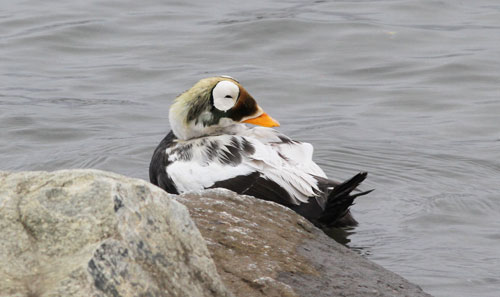
A Spectacled Eider rests on the rocks in Nome Photo: Will Russell
As more and more North American birdwatchers have discovered, spring birdwatching in Alaska is an experience to be found nowhere else on this continent. There is first of all the excitement of seeing many species whose North American range is almost exclusively from Alaska, and hopefully seeing them well. Second, there is the distinctly arctic flavor of high-latitude birdwatching at a season of very long days filled with tundra birdsong and, from mid-June on, tundra wildflowers and Arctic butterflies in abundance. For the veteran birdwatcher there is Bering Sea island birdwatching at Gambell on St. Lawrence Island, where in some years a variety of species from Asia occur. Finally, there is Alaska itself, huge, wild, varied but always beautiful: the icy shores of the Bering Sea and mountainous vastness of the Seward Peninsula.
To listen to a recent radio piece on birding around Nome with WINGS please follow this link. In the fall of 2019 Paul Lehman published a comprehensive account of the birds of Gambell through Western Field Ornithologists (WFO), and we have decided to include a digital copy of this volume when you register for the tour.
Day 1: The tour begins this evening at our Anchorage International Airport area hotel with a meeting followed by dinner. After dinner there might be some birding around the hotel and Lake Spenard, where in some years Barrow’s Goldeneyes are present with a variety of other waterfowl. Night in Anchorage.
Gambell will likely remain the most unusual destination I’ve encountered in the US. I liked everything about it—experiencing the landscape, being in the Yupik community, driving an ATV, wearing twenty layers of clothes. Then there was the birding. Gavin and Jon were wonderful, knowledgeable, attentive. The birding exceeded my expectations. Then there was Rich Hoyer’s cuisine (the word “food” does not apply). I came home to find that I had gained four pounds; I savored every ounce. I would be happy to repeat the whole Gambell trip again.
After Gambell, Nome was somewhat of a shock—resembling the Alaska I’ve been to in the past. We saw a fine suite of birds, including the Great Knot that Gavin found minutes after we started birding outside town. I particularly liked the expedition for the Bristle-thighed Curlew. Gambell-Nome made a terrific combination.
J. Dunham, July 2018
Day 2: We’ll fly this morning to Nome and after a short layover, transfer to a smaller aircraft for the 50-minute flight to Gambell. Weather is always a factor in this part of the world, and there is a chance that we won’t be able to continue immediately to Gambell, where the small airstrip requires visual flying conditions.
Gambell is a Yupik village of about 600 inhabitants at the northwestern tip of St. Lawrence Island. It is usually cold (28-40 degrees F) and often overcast; fog, rain, snow, and wind can occur in rapidly changing combinations. The terrain can make the days of walking seem long, but we’ll have motorized transport to reach prized birds quickly. Still, though, one should come to Gambell expecting to do a good deal of walking. Night in Gambell.
Days 3-8: Birdwatching at Gambell varies from excellent to incredible, combining the possibility of Asiatic birds with (normally) a spectacular passage of seabirds. We’ll also hope to see at least some of the birds that breed locally in western or northern Alaska but nowhere else in North America, such as Red-necked Stint (infrequent in recent years), Bluethroat, and White Wagtail. A few pairs of Rock Sandpipers (tschuktschorum subspecies) breed along with Semipalmated Plovers, Dunlins, Western Sandpipers, Red-necked Phalaropes, Lapland Longspurs and Snow Buntings. Our days will be spent covering and recovering areas that can harbor strays. The number of wanderers from Asia vary greatly from year to year. In some years they are simply very few, indeed almost none, while in a few there are many. In most years there are a scattering. The number of Asian species recorded arriving at Gambell appears related to the entire Bering region in general and the overall weather with storms from the southwest being the most optimal situation. The long list of Asian species we’ve seen during the last 30 years includes Lesser Sand-Plover, Common Greenshank, Green and Terek Sandpipers, Gray-tailed Tattler, Great Knot, Little, Temminck’s, and Long-toed Stints, Common Snipe, Oriental Pratincole, Black-tailed Gull, Common Tern (distinctive Asian black billed subspecies, longipennis), Common Cuckoo, Sky Lark, Siberian House-Martin (newly-split Siberian breeding species with more white on rump), Dusky Warbler, Common Chiffchaff (dull eastern tristis subspecies; all but one of the nearly ten Alaska records are from Gambell, all since 2012!), Taiga Flycatcher, Siberian Rubythroat, Red-flanked Bluetail, Dusky, Naumann’s, and Eyebrowed Thrushes, Fieldfare, Asian (Siberian) Stonechat, Gray Wagtail, Olive-backed Pipit, Brown Shrike, Rustic Bunting, Brambling, Common Rosefinch, Eurasian Bullfinch, and Hawfinch. In most years we find Common Ringed Plover, and a pair often nests south of the village. Red-throated Pipit is also recorded about on about half of the tours. We should add that strays also come from the North American side, and that list is nearly as long.
When there are no exotic birds to chase, seawatching from the point is almost always superb: Arctic and Yellow-billed Loons, Emperor Goose, Common, King, Steller’s and sometimes Spectacled Eiders, all three species of jaeger, many gulls, including the distinctive Asian vegae subspecies of Herring, often Slaty-backed, and rarely Black-headed, Ivory or even Ross’s, and literally hundreds of thousands of alcids including one or a few locally breeding Dovekies (usually seen sitting up on the cliffs on the side of the mountain but numbers seem to be diminishing) pass continuously. We also have a decent chance of seeing Black Guillemot (arctic mandtii subspecies). In recent years we have encountered a few Stejneger’s Scoters, a recent split from White-winged Scoter (which is also present and more numerous). In addition to the birds, Gray Whales pass by the point very closely and depending on the ice conditions we might see a few seals (four species occur) or with great luck a Walrus. Orca and even Beluga Whales have been see too. Over the last several decades we have seen greatly reduced sea ice, and in recent years the last of the ice flows have disappeared weeks, even months before our arrival. As a result ice-loving species such as Ivory Gull and Spectacled Eider are now recorded much less frequently. Nights in Gambell.
Day 9: This afternoon (weather permitting) we’ll fly back to Nome and then continue to Anchorage. Night in Anchorage.
Day 10: Our main tour concludes this morning in Anchorage.
Nome Extension
Day 9: Those staying for the Nome Extension will remain in Nome for a three-night stay. Night in Nome.
Days 10-11: There are several important birdwatching areas around Nome, notably Safety Lagoon (with many waterfowl and shorebirds) and the Kougarok and Teller Roads. These sites may produce Willow and Rock Ptarmigans, Pacific and American Golden-Plovers, Bar-tailed Godwit, Aleutian Tern, Northern Shrike (rather rare), Bluethroat, Northern Wheatear, Eastern Yellow Wagtail, Rusty Blackbird, and possibly Gyrfalcon or Arctic Warbler (numerous but often arrives after our departure). If it’s open, we’ll spend one day at or near the north end of the Kougarok Road looking for the globally scarce Bristle-thighed Curlew, an endemic breeder to western Alaska. It’s a long drive but the vast tundra and mountain scenery would make the day memorable even without the presence of one of North America’s rarest breeding birds. This area is also home to Moose and the Grizzly Bear and an introduced population of the prehistoric looking Muskox, all of which we’ll hope to see. Nights in Nome.
Day 12: After a bit of birding in the morning we’ll fly back to Anchorage around noon. Night in Anchorage.
Day 13: The Nome extension concludes this morning in Anchorage.
Pribilofs Extension
Days 12-17: Our Pribilofs tour begins the evening of Day 12 with dinner in Anchorage. On Day 13, weather permitting, we hope to leave on our flight this morning for St. Paul Island in the Pribilof Islands. As with other Bering Sea islands, weather, particularly fog, is often an issue and there is a chance that our flight will be delayed. Once on the island we’ll have ample time to discover the richness of a Bering Sea seabird colony. The auk family is thought to have evolved in this region, and we should see a wide variety of the members of this family. Add in Northern Fulmar, Red-faced Cormorant, and the near-endemic Red-legged Kittiwake, and the sum is memorable. In addition to the birds on the cliffs, we should see the endemic Pribilof subspecies of the Pacific Wren and the large, dark, gray-faced and near endemic subspecies (umbrina) of the Gray-crowned Rosy-Finch.
Our visit to St. Paul will concentrate on the nesting species, but in early to mid-June we can also hope for late migrants and perhaps a rarity or two. Our previous tours to St. Paul at this season have recorded Common Pochard, Tufted Duck, Red-necked Stint, Wood Sandpiper, Common Snipe, Black-headed Gull, Common and Oriental Cuckoos, Eyebrowed Thrush, Olive-backed Pipit, Siberian Rubythroat, Brambling, and Hawfinch in addition to a rather long list of other Asian species. As is often the case with rare migrants, weather conditions are important (westerly winds are best). In some years no Asian rarities are seen while we are there. In addition to the birds, Northern Fur Seals are easily viewed on the beaches. Nights in St. Paul.
Day 17: After a final morning at St. Paul, we’ll return to Anchorage in the late afternoon, where the Pribilofs tour concludes in the evening.
Updated: 30 January 2024
Prices
- 2024 Gambell Tour Price : $6,950
- Gambell Single Occupancy Supplement** : $490
- Nome Extension : $1,750
- Nome Extension Single Supplement : $550
- Pribilofs Extension : $5,550
- Pribilofs Single Occupancy Supplement** : $770
- 2025 Tour Price Not Yet Known
Notes

Questions? Tour Manager: Matt Brooks. Call 1-866-547-9868 (US or Canada) or (01) 520-320-9868 or click here to email.
* Tour invoices paid by check carry a 4% discount. Details here.
This tour is limited to 16 participants with two leaders. Jon Dunn is the primary leader.
**Single room occupancy is often not available at Gambell or St. Paul in the spring due to very limited lodging.
Please note that the Extension prices indicated above are valid only if taken with the main tour; please contact the WINGS office for prices without the main tour.