
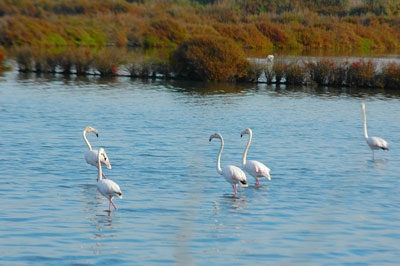
Greater Flamingoes in the Tagus River estuary Photo: Sunbird
Portugal offers a fantastic diversity of habitats and birds in a relatively small area, which enables visiting several species rich areas in this lovely country without traveling long distances.
Within a half hour’s drive from Lisbon’s International Airport, two remarkable protected wetlands, the Tagus Estuary and the Sado Estuary Natural Reserves, support an extensive set of birds including White Stork, Booted Eagle, and Dartford Warbler, in addition to an excellent selection of ducks, waders, gulls and terns.
A further hour’s drive will take us to Alentejo and the rolling plains of Castro Verde, home of Great Bustard, Montagu’s Harrier, and Black-bellied Sandgrouse, among others. We’ll also visit the bluffs and hills of the Guadiana Valley Natural Park, noted for species like Black Stork, Iberian Imperial Eagle, and Blue Rock Thrush.
After exploring the Alentejo, another short drive reaches the Algarve, rich in protected wetland areas and situated on a major flyway for migrants from Africa. Some of the places we’ll visit, namely the Ria Formosa Natural Park and the Castro Marim Natural Reserve, are unique in Portugal as sites for the rare and highly localised Audouin’s and Slender-billed Gulls and Lesser Short-toed Lark. These are also excellent spots for close views of scarce species like Red-necked Nightjar, and Iberian (Azure-winged) Magpie is particularly abundant. In addition, a pelagic trip off Sagres/Cape St. Vincent should provide an excellent opportunity for sea birds, possibly including Great Skua.
All of this birding activity is intertwined with visits to some of the most interesting historical and cultural sites of Portugal in Évora, Mértola, Sagres, and Lisbon. In fact, the country’s rich cultural heritage is on display throughout the whole of our route. At various times we’ll be joined by qualified historians who will guide us through the historic districts of Évora, Mértola and Lisbon, where we’ll wander along winding streets, through historic plazas and squares en route to an array of castles, cathedrals, Roman ruins, and promenades. We’ll have numerous opportunities to sample Portugal’s many culinary delights and great wines, including one wine tasting event.
Day 1: The tour begins this evening in Lisbon, Portugal. Night in Lisbon.
Days 2-5: We’ll drive on Day 2 from Lisbon to Alcochete, our base for the next four days. We’ll visit a variety of habitats within the Tagus Estuary Natural Reserve including the inter-tidal mudflats and salt marshes of Hortas, the Ribeira das Enguias and Samouco salt pans, and the Barroca d’Alva rice fields and pastures. The saltpans and other wetland habitats should produce Greater Flamingo, Eurasian Spoonbill, Glossy Ibis, Squacco Heron, Black-winged Stilt, Ruff, Little Stint, Spotted Redshank, Greenshank, Green, Wood, Common and Curlew Sandpipers, Black-tailed and Bar-tailed Godwits, Pied Avocet, Ringed, Kentish and Little Ringed Plovers, Mediterranean Gull, and Gull-billed and Little Terns, as well as the chance of a rarity or two. Black-winged Kite is a speciality of the area, and Booted Eagle and Western Marsh Harrier are numerous. The wet fields here are good for ‘Iberian’ Yellow Wagtail as well as populations of three introduced species, Common Waxbill, Yellow-crowned Bishop, and Black-headed Weaver, adding a slightly surreal touch to our Mediterranean birding. Other interesting species, especially in the cork oak-woods habitat, include Iberian Grey Shrike, Short-toed Treecreeper, Sardinian Warbler, and Pallid Swift. Night at the Hotel Quinta da Praia das Fontes.
Within the Tagus Estuary Natural Reserve, we’ll explore the open fields, rice paddies, reed beds, lagoons, inter-tidal mudflats and salt marshes of the Ponta da Erva area where new species might include Red-crested Pochard and several other species of ducks, White Stork, Hen Harrier, Little Owl, Northern Lapwing, European Golden Plover, Western Swamphen, Short-toed Lark and Bluethroat. We may find time for a wine tasting session at Companhia das Lezírias.
Lisbon provides excellent opportunities to find several passerines including Firecrest, plus exotic species such as Rose-ringed Parakeet, Blue-crowned Parrot, and Crested Myna. We’ll spend one day exploring the city of Lisbon, including the main squares and avenues, the Baixa (downtown area), some of the hilltop districts and, in Belém (the historic area from which the Portuguese caravels departed to discover the world), the Monument to the Discoveries and two UNESCO World Heritage Sites: the beautiful Tower of Belém and the Jerónimos Monastery. If there’s time we’ll return to the Tagus estuary.
We’ll spend the next day in the Cork Oak woodlands of Pancas and of Atalaya where a range of migrants and resident species should include Pied and Spotted Flycatchers, Common Redstart, Northern Wheatear, Eurasian Skylark, Rock Sparrow and Cirl Bunting. Nights in Alcochete.
Days 6-9: We’ll drive to Mértola in the Alentejo region and visit the great Castro Verde rolling plains. Once we leave the coast, we’ll be in bustard country, and should see our first Great Bustards before reaching our hotel. The rolling hills can hold good numbers of this species, which are often easy to spot towering over the distant plain. Other species associated with this steppe-like habitat, include Black-bellied Sandgrouse, Spanish Eagle, Red Kite, Eurasian Stone-curlew, Calandra Lark and Tawny Pipit. We have as well an excellent chance of seeing both Eurasian Eagle and Long-eared Owls.
On one day, we’ll explore the bluffs and hills of the Guadiana Valley Natural Park, including the Mértola, Mina de São Domingos and Alcaria Ruiva areas. The rocky habitat of the Guadiana river valley is excellent for species like Black Stork, Golden and Bonelli’s Eagles, Griffon and Cinereous (Black) Vultures, White-rumped Swift, European Turtle Dove, Eurasian Crag Martin, Spanish Sparrow, Blue Rock Thrush, Hawfinch and Rock Bunting.
On our last day in the great Castro Verde rolling plains, we’ll look for any possible missing steppe bird species or even late migrants such as Short-toed Snake Eagle, Montagu’s Harrier, Lesser Kestrel or European Roller.
Finally, we’ll investigate the town of Mértola, including the main museums and archaeological sites, and other interesting areas of the Guadiana Valley. Common Kingfishers fly back and forth, and we should hear and see Red-legged Partridge, European Turtle Dove, Iberian Green Woodpecker, Lesser Spotted Woodpecker, Thekla Lark, Woodlark, Hawfinch, Red-rumped Swallow and Crag Martin, while busy groups of Iberian (Azure-winged) Magpies seem to be everywhere. Nights in Mértola.
Days 10-12: We’ll drive to Tavira for three nights in the Algarve region where we’ll investigate the complex of canals, saline flats, and salt pans of the Castro Marim Natural Reserve and of Ria Formosa Natural Park. These are unique in Portugal as sites for rare and highly localized Audouin’s and Slender-billed Gulls and Lesser Short-toed Lark. Other possible species include Caspian Tern, Common Pochard, Ferruginous Duck and Crested and Long-tailed Tits.
In the dunes, open water, inter-tidal mudflats, salt marshes, salt pans, reed beds, lagoons and pine woods of the Olhão, Quinta do Lago and Ludo parts of Ria Formosa Natural Park, we’ll look for species including Great Crested and Little Grebes, Little Bittern, Water Rail, Whimbrel, Eurasian Curlew, Eurasian Oystercatcher and Red Knot, and hope for close views of Eurasian Hoopoe and Wryneck.
We’ll spend a day in the Sagres and the Cape St. Vincent regions. A pelagic trip off Sagres should provide an excellent opportunity for us to see a wide range of seabirds, including Northern Gannet, European Shag, Balearic, Great, Sooty and Cory’s Shearwaters, Great Skua, Parasitic Jaegers and European and Wilson’s Storm Petrels. Other species to look for include Alpine Swift, Red-billed Chough, Red-necked Nightjar and Sardinian and Spectacled Warblers. During the migration period, this area offers abundant opportunities to observe migrating birds, namely raptors such as Egyptian Vulture and many passerines. Nights in Tavira.
Day 13: We’ll return to Lisbon, visiting on the way the Salgados Lagoon, a wetland excellent for rarities and providing as well more opportunities to see numerous wildfowl, waders, gulls and terns. We’ll arrive at our hotel in time to change for a festive farewell dinner. Night in Lisbon.
Day 14: The tour concludes this morning in Lisbon.
Created: 01 December 2022
Prices
- 2024 Tour Price : $7,150
- Single Occupancy Supplement : $740
Notes

Questions? Tour Manager: Stephanie Schaefer. Call 1-866-547-9868 (US or Canada) or (01) 520-320-9868 or click here to email.
* Tour invoices paid by check carry a 4% discount. Details here.
Maximum group size 7 with one leader.