
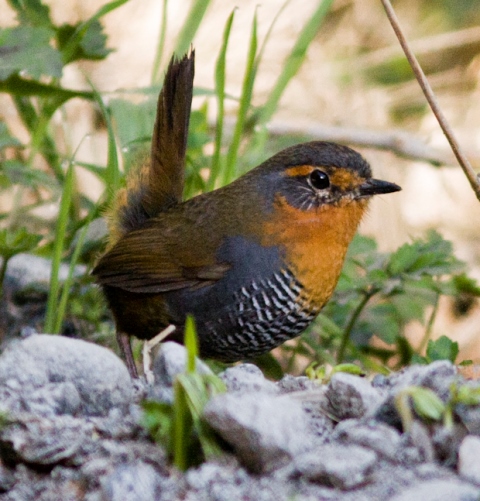
Chile is the country to actually see tapaculos, including the handsome Chucao Tapaculo of the temperate southern rain forests. Photo: Steve Howell
A fascinating collection of birds coupled with some of the most spectacular scenery on earth makes birding in Chile a superb experience. This narrow strip of territory, 150 miles wide by 2,500 miles long, is a land of immense variety and beauty: from the grandeur of wave-dashed Pacific beaches to the solitude of high Andean lakes, and from the rolling plains of Tierra del Fuego to the utterly barren Atacama, the most perfect of deserts. Traveling the length (and breadth) of the country impresses upon one the remarkable similarities of climate, vegetation and topography, not to mention convergent evolution, between the Northern and Southern Hemispheres. Our tour of Chile is the equivalent of going from southeastern Alaska to southwestern Mexico! Birders today can thank Goodall, Johnson, Millie, and Philippi, who brought to the fore our knowledge of Chile’s avifauna through their extensive field work from the 1920s through the 1950s. The triumphs and failures of this pioneering work are conveyed in Johnson’s classic Birds of Chile, now sadly out of print. Their work showed that Chile has a bird list combining high quality and high visibility. The avifauna ranges from penguins, rheas, flamingoes and a superb selection of southern waterfowl and shorebirds to 30 species of ovenbirds (furnariids), eight tapaculos (three of them endemic), nine sierra-finches, and five siskins.
Our tour coincides with the austral spring, when bird activity is at its height, and is designed to take in all the major regions of this diverse land. Chile is throughout a safe and friendly country in which to travel, and has an excellent infrastructure for tourism.
Day 1: The tour begins at 12 noon in the lobby of our Santiago hotel. If flight arrival times allow, we’ll visit some nearby areas for an introduction to the birdlife of Chile’s Central Valley. Night in Santiago.
Chile was excellent and Steve is amazingly talented when it comes to finding and pointing out birds. He applied just enough alpha-dog to keep everyone in line without causing hard feelings, and was attentive to special needs that arose. On top of that, he keep up with extremely challenging and quickly-changing situations, anticipating the effects of the daily political unrest. His fluent Spanish and talent for working around obstacles in Latin American countries came in handy more than once. If he doesn’t enjoy facing challenges, he puts on a good act. At any rate, he took good care of us while finding the birds with nearly surgical precision. It was an awesome experience.
Jo Bills, Nov 2019
Day 2: This morning we’ll take the spectacular flight south to Punta Arenas on the northern shores of the Straits of Magellan. The bleak, gray stone buildings of Punta Arenas belie its people, mainly of eastern European descent, who are as warm and hospitable as one finds anywhere, while the rocky coast and rolling grasslands, with their enclaves of European sheep farmers, suggest northern Scotland. Ancient forests of twisted, stunted Nothofagus (southern beech) trees reflect the harshness of the southern temperate climate and contribute to the distinctive flavor of Patagonia, a world apart from the rest of South America. Birding in the vicinity after our arrival will produce a taste of the wealth of waterbirds for which the area is famous, including Imperial and Rock Shags, Upland Goose, Flying Steamer-Duck, Two-banded Plover, Chilean Skua, and Dolphin Gull plus the tiny and endearing Austral Negrito and the ubiquitous Rufous-collared Sparrow. Night in Punta Arenas.
Days 3-4: We’ll have two full days to explore the vast, windswept Magellanic region. One day we’ll take the short ferry ride across to Tierra del Fuego, where we should see Magellanic Diving-Petrel, Magellanic Penguin, Southern Giant-Petrel, and perhaps the beautiful Commerson’s Dolphin. One of our main goals on Tierra del Fuego will be to find the enigmatic and dove-like Magellanic Plover (placed in its own family, Pluvianellidae), nesting at this season amid migrant Baird’s and White-rumped Sandpipers. Other breeding shorebirds include the handsome Tawny-throated and Rufous-chested Dotterels. The numerous lakes of southernmost Chile are often alive with waterfowl such as Black-necked Swan, Ashy-headed and Ruddy-headed Geese, Crested Duck, and Yellow-billed Teal. Darwin’s (Lesser) Rheas dot the landscape in many areas, and we’ll plan to visit a small but growing colony of King Penguins. Landbirds include Short-billed and Common Miners, Patagonian Yellow-Finch, and with luck the little-known Austral Canastero and the striking Chocolate-vented Tyrant. Nights in Cerro Sombrero and Punta Arenas.
Days 5-6: This morning we’ll fly north from Punta Arenas to Puerto Montt, gateway to Chile’s picturesque Lake District. After check-in and lunch at our hotel in Puerto Montt, we will visit a nearby sanctuary protecting a patch of spectacular old-growth temperate rainforest. The huge trees are in stark contrast to the open wilderness of Patagonia, and the forests ring with the calls of two striking tapaculos, the Chucao Tapaculo and the Black-throated Huet-huet. The following day we’ll spend most of our time birding in the forest of Alerce Andino National Park, seeking in particular the impressive Magellanic Woodpecker and the skulking Ochre-flanked and Magellanic Tapaculos. The supporting cast here includes Austral Parakeet, Des Murs’s Wiretail, White-throated Treerunner, and Black-chinned Siskin. Nights in Puerto Montt.
Day 7: For our last morning around Puerto Montt, we’ll visit beautiful Chiloé Island. During the ferry ride across Chacao Channel to the island, we’ll have a chance for Magellanic Penguin and Red-legged Cormorant. Pods of Dusky Dolphins will sometimes ride the bow of the ferry. Once on Chiloé, we will visit Caullin Bay, an important wintering area for Hudsonian Godwit. In addition to these boreal migrants, we can also find a great variety of local species including Flightless Steamer-Duck, Black-necked Swan, Yellow-billed Pintail and the rare Snowy-crowned Tern. In the nearby scrub we may also spot a flock of the endemic Slender-billed Parakeet. After a morning on the Island, we’ll cross the channel back to the continent and fly north to Santiago. Night in Santiago.
Day 8: Central Chile, at the same latitude as southern and central California, has a Mediterranean climate and chaparral-like vegetation known as matorral. Extensive vineyards and the introduced California Quail, California poppy, and towering eucalyptus trees cultivate the illusion that one is in the Northern Hemisphere. To dispel any doubts we’ll spend the day birding our way to the coast at Valparaiso, passing through a variety of habitats where birds include Spot-flanked Gallinule, Wren-like Rushbird, and Rufous-tailed Plantcutter. We’ll make a special effort to see the handsome Many-colored Rush-Tyrant and the endemic White-throated Tapaculo. Along the coast we should see Peruvian Booby, Peruvian Pelican, and the beautiful Inca Tern. Night in Viña del Mar.
Day 9: Today we’ll make an early departure by boat a short distance offshore into the famous Humboldt Current which, by upwelling like its northern counterpart the California Current, provides a nutrient-rich base that supports a vast seabird population. Up to seven species of albatross are possible including Salvin’s, Buller’s, and Northern Royal, while Pintado (Cape), De Filippi’s (Masatierra) and Westland Petrels, Peruvian Diving-Petrel, and others are regularly seen. To bring us back to earth, we’ll spend the afternoon birding along the coast near our hotel. Night in Viña del Mar.
Day 10: We’ll make a morning birding trip north along the coast, including a visit to view a colony of Humboldt Penguins on an inshore islet. Species we’ll be looking for in the matorral-covered valleys leading down to the coast along our drive include Giant Hummingbird, Great Shrike-Tyrant, and the endemic Dusky-tailed Canastero and Dusky Tapaculo before our afternoon drive back to Santiago. Night in Santiago.
Days 11-12: The magnificent High Andes, their snow-capped peaks dominating the eastern horizon, are only a short drive from Santiago and will be our venue for the next two days. We’ll visit two sites with slightly different avifaunas, both in spectacular rugged settings. The birdlife of this region includes the flashy White-sided Hillstar, Gray-breasted Seedsnipe, numerous ground-tyrants, sierra-finches, and ovenbirds (including the endemic Crag Chilia), the comical Moustached Turca (a roadside tapaculo!), huge Andean Condors, and with luck the ultimate shorebird – Diademed Sandpiper-Plover. Nights in Santiago.
Day 13: A morning flight will take us north, leaving the cultivated Central Valley and heading over the bleak expanses of the Atacama Desert to the coastal town of Arica in the extreme north of Chile. Most of the day will be spent on the leisurely drive from Arica through the oasis-like Lluta Valley up to Putre, a small town nestled in a relatively lush valley at about 11,500 feet. As we climb, birds range from Croaking Ground-Dove and Peruvian Meadowlark in the lowland oases, through Greenish Yellow-Finch and Straight-billed Earthcreeper in the arid, scrubby foothills, to Andean Hillstar and Band-tailed Seedeater, both nesting near our hotel. Night in Putre.
Day 14: We’ll spend the whole day in and around Putre, taking our time with the almost completely new avifauna and also acclimating to the new elevation. We’ll see that the characteristic European face of central and southern Chile is gone. The terraced alfalfa fields and herds of llamas and alpacas, tended by Indians clad in brightly-colored wool garments, reflect the close cultural ties between northern Chile and the high Andes of Peru and Bolivia. Birds we can expect to see around Putre include Bare-faced Ground-Dove, White-throated Earthcreeper, Yellow-billed Tit-Tyrant, White-browed Chat-Tyrant, Black-throated Flowerpiercer, and Blue-and-yellow Tanager, and there’s a chance for Ornate Tinamou and Golden-billed Saltator. Night in Putre.
Day 15: Today will arguably be the highlight of the tour. We’ll spend most of the day visiting Lauca, often acknowledged as the most impressive national park in the Americas. There are no adequate descriptions for the breathtaking (literally!) scenery of the puna plains and bogs below snow-capped volcanoes. The park includes Lake Chungara, at 15,000 feet the highest lake in the world and covered with thousands of birds, among them Silvery Grebe, Puna Teal and Giant Coot. Other birds here include Andean and Puna Flamingos, Puna Plover, Andean Flicker, White-winged Cinclodes, White-winged Diuca-Finch, Black Siskin, and White-throated Sierra-Finch. Common mammals in the park include the elegant Vicuña and the sleepy Vizcacha, which looks like a cross between a hare, a squirrel, and a kangaroo! After lunch we’ll leave the rarified air of the park and head back down to the oxygen-rich lowlands of Arica. Night in Arica.
Day 16: We’ll have a full day to spend birding in the lowland valleys and along the coast of northernmost Chile. We’ll especially look for the highly endangered Chilean Woodstar, a tiny hummingbird being steadily exterminated by intensive agriculture. Other species we’ll seek today include Peruvian (White-crested) Elaenia, Oasis Hummingbird, the bizarre Peruvian Thick-knee, Slender-billed Finch, and the very local Rufescent Flycatcher, and there’s always the chance for Peruvian Martin or an unexpected vagrant. The Lluta estuary usually attracts large numbers of migrant and resident waterbirds, including possibly thousands of Elegant Terns and Franklin’s Gulls, as well as Belcher’s and Gray Gulls, American Golden and Semipalmated Plovers, Little Blue Heron and many more. Night in Arica.
Day 17: Depending on flight times we may spend the last morning around Arica looking for anything we may have missed before our flight back south to Santiago, where the tour concludes in time to connect with international flights to the US.
Updated: 05 July 2023
Prices
- 2024 Tour Price : $9,390
- Single Occupancy Supplement : $990
Notes

Questions? Tour Manager: Stephanie Schaefer. Call 1-866-547-9868 (US or Canada) or (01) 520-320-9868 or click here to email.
* Tour invoices paid by check carry a 4% discount. Details here.
This tour is limited to eight participants with one leader, or up to 12 participants with two leaders.