
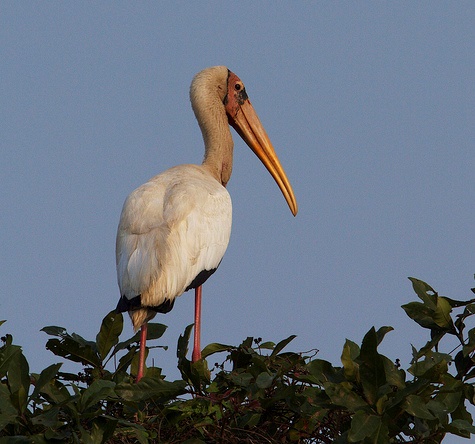
Milky Storks are rare and declining and now only seen in Java and Cambodia. Photo: Susan Myers
Cambodia’s expansive forests and untouched wetlands support some of the rarest birds and mammals in the region. In recent years there have been a number of notable discoveries, including a population of the near-mythical Giant Ibis, the Mekong Wagtail, the very recently discovered Cambodian Tailorbird, and a breeding population of the rapidly declining eastern race of Sarus Crane. The most extensive grasslands remaining in Southeast Asia are home to the splendid Bengal Florican, as well as the scarce Manchurian Reed-Warbler. And the dry forest of the northern plains hosts some very exciting, restricted range species including White-rumped Falcon, Neglected (Burmese) Nuthatch, White-shouldered Ibis, Brown Prinia and Black-headed Woodpecker. Unlike all its surrounding countries, Cambodia still has healthy populations of vultures, and we’ll visit a special “restaurant” to see these amazing and important birds.
We’ll also have the opportunity to visit some of the greatest surviving architectural monuments in Asia—the temples of the ancient city of Angkor. They represent the heart and soul of Cambodia, harking back to an era of unrivaled influence when the Khmer Empire ruled over south China, Vietnam, Thailand, Burma, and Malaysia. Built at the height of the Khmer civilization, from the eighth to the twelfth centuries. The Angkor complex is known for its extraordinary artistry, and we’ll allow ample time to explore and reflect on these architectural masterpieces, many of which have excellent birding on-site.
This tour offers an opportunity to see some of the world’s rarest birds and mammals amid some of its most celebrated cultural artifacts, with the added attraction of some wonderful food!
Day 1: Our tour begins this evening in Siem Reap, Cambodia. A highlight of our visit to Cambodia will be our wonderful hotel in Siem Reap. The Angkor Village Hotel, set in an expansive, lush tropical garden, is a charming small family-owned and operated property built in the traditional Khmer style, designed with respect for local culture and nature. One night we will visit the famous Apsara Theatre to experience a performance of Khmer (Cambodian) traditional dance. Night at Siem Reap.
Day 2: We’ll begin our explorations of the magnificent complex of Angkor. We will of course visit the temple at Angkor Wat, with an expert guide to explain some of the finer details, as well as touring Angkor Thom and other nearby temples. One of them, Ta Prohm, has been left to the elements, and strangler fig roots snake around its crumbling walls and ancient statues.
The birding in the lush forests here is a fine supplement to the cultural experience, and we can expect large congregations of Oriental Pied-Hornbills and Red-breasted and Alexandrine Parakeets, fine views of Black Bazas, numerous Asian Barred Owlets, and Hill Mynas. In the drier forests we may find Greater Flamebacks, Black-hooded Orioles, and Hainan Blue-Flycatchers. Lesser Adjutants can occasionally be seen flying overhead. Night at Siem Reap.
Day 3: We’ll visit Tonle Sap Lake, one of the fascinating geological features of Asia. It is a huge lake fed by the mighty Mekong River, and on its northern shores the flooded forests of Prek Toal host the largest breeding colonies of big waterbirds in Southeast Asia. We’ll cross the lake as the sun rises, surrounded by small fishing boats. At the floating village we may transfer to a smaller boat, depending on the water level and the size of our group, before entering the narrow watercourses and making our way to the colonies of Lesser Adjutants, Painted Storks, and Spot-billed Pelicans. As we take the time to absorb this dazzling scene, we’ll search for the rarer Greater Adjutants and the very rare Milky Storks. Night at Siem Reap.
Day 4: We’ll leave Siem Reap early this morning to visit the designated Bengal Florican Conservation Area in the seasonally flooded grasslands of Kampong Thom. These and the grasslands in Siem Reap Province support the largest known population of Bengal Florican in Cambodia (and likely the world). This charismatic species is declining rapidly due to the continuing loss of its grassland habitat and is otherwise found only in northeastern India, but we have a very good chance of finding it here. Our visit, as with the Giant Ibis in Tmatboey, will materially assist in the floricans’ conservation.
While we search for the floricans, we should also see other birds including Pied and Eastern Marsh Harriers, Australian Bushlark, Bluethroat, and Red Avadavat. We’ll also take time to track down Manchurian Reed-warbler. After lunch we’ll continue our journey to Prey Veng, a small remote village deep in the Kulen Promtep Wildlife Sanctuary. The simple community ecolodge is nestled on the banks of an Angkorian baray or reservoir which provides a permanent water source for both the community and wildlife. The whole area is a remarkable location for birdwatching, and we will hope to encounter Black-headed Woodpecker, Collared Falconet, Rufous-winged Buzzard, Indochinese Bushlark, Brown Prina, and Neglected Nuthatch, along with many others. Night at Prey Veng.
Day 5: We’ll continue our birding explorations at Prey Veng this morning, leaving after lunch for the drive to the remote village of Tmatboey. Improvements to the roads in the area mean that our destination is now only three hours away so we should arrive in the late afternoon, perhaps in time for birding before dinner. Night at Tmatboey.
Day 6: We’ll spend the next two days birding around the remote village of Tmatboey, where we’ll search for the critically endangered Giant Ibis and where there is a very good chance of finding White-shouldered Ibis and Pale-capped Pigeon, although the latter is becoming increasingly scarce. The villagers here work in conjunction with conservation organizations to protect these fabulous birds, and our presence is not only very welcome but also beneficial to the community, as our tour dollars contribute directly to the construction of clean water wells and other much-needed facilities in the village. The forests here are home to some of the most vigorous Asian populations of birds such as Rufous-winged Buzzard and Blossom-headed Parakeet, and we also hope to find Black-necked Stork, Indochinese Bushlark, Brown Prinia, and Neglected (Burmese) Nuthatch. As we rest at a trapeang (a permanent waterhole), Green Bee-eaters, Eurasian Hoopoes, Green-billed Malkohas, and Rufous Treepies may delight us as they come in for their evening drink. Night at Tmatboey.
Day 7: In the cool of the early morning, we’ll venture out of the village into the neighbouring forest. Our plan is to walk to nearby trapeangs where the ibises tend to gather during the dry season. As we walk, we’ll keep an eye out for Yellow-legged and Orange-breasted Green-pigeons, Shikra, Woolly-necked Stork, Burmese Shrike, Small Minivet, and White-shouldered Starling, among others. Chinese Francolins are moderately common and flush up noisily; if we’re lucky we may get a good view of one of these noisy but secretive ground birds. At the permanent watercourses there is often feverish activity, and we may find the impressive Brown Fish-Owl, Oriental Cuckoo, Radde’s Warbler, White-crested Laughingthrush, and Tickell’s Blue-Flycatcher. Night at Tmatboey.
Day 8: After some pre breakfast birding we’ll transfer to Boeng Toal, ready for tomorrow’s vulture adventures. The birding in this lovely forest is great for other birds, too, so we’ll spend the afternoon in search of forest birds here. In particular, we’ll hope to see the beautiful Rufous-bellied Woodpecker, but we may also encounter Burmese Shrike, Chinese Francolin, Asian Woolly-necked Stork, and Blossom-headed Parakeet, amongst many more. Night at Boeng Toal Tented Camp.
Day 9: There are three critically endangered vulture species in Cambodia: White-rumped, Red-headed, and Slender-billed. There are many causes for their rapid and dramatic decline in the region, including loss of habitat, loss of prey species, and poisoning through veterinary use of the drug diclofenac (which is highly toxic to many vulture species). Fortunately, this drug is not used in Cambodia and—combined with Cambodia’s successful conservation programs of supplementary feeding—means that the country has held on to a stable population of vultures while the species have disappeared from surrounding countries.
We’ll visit a feeding station in the Chhep Wildlife Sanctuary (Beng Toal), which has been set up as a means of supporting the vulture population and conducting research. The ‘restaurant’ attracts other birds including Greater Adjutant, as well as mammals such as jackal, dhole, and even leopard (rare). We’ll visit the hide before dawn in order to witness the feeding spectacle of up to seventy vultures. After lunch back at camp, we’ll make our way to the town of Kampong Thom. If we have time, we’ll visit the nearby grasslands for some later afternoon birding. Night at Kampong Thom.
Day 10: For those who wish to, we’ll make a very early morning birding sojourn to the grasslands near Kompong Thom. The birding here can be very good with possibilities for Pin-tailed Snipe, Pied Harrier, Striated Grassbird, Bluethroat, and Siamese Pied Starling. After breakfast we’ll start our drive toward the Mekong, the longest river in Southeast Asia, to the riverside town of Kratie. Night at Kratie.
Day 11: This morning we’ll travel by boat on the Mekong where our main target will be the recently discovered Cambodian endemic Mekong Wagtail. This highly localized and attractive species, first described in 2001, can be seen with the very rare Irrawaddy dolphin. As we travel upriver, we may encounter Small Pratincole, Kentish and Little Ringed Plovers, Blue-tailed Bee-eater, Grey-throated Martin, and White Wagtail. Exploring the wetlands near Kratie may also reveal the rare Golden Weaver and shy Chestnut-capped Babbler. In the afternoon we’ll drive on to Phnom Penh but before our arrival in the city, we’ll take a slight detour to look for the endemic and recently discovered Cambodian Tailorbird. This distinctive species was first described as recently as 2012. It occurs only in floodplain wetlands where the mighty Mekong meets the Tonle Sap and Bassac rivers. The ancient Khmers knew this area as Chaktomuk, literally “four faces,” referring to the confluence of these rivers and giving the tailorbird its scientific name, Orthotomus chaktomuk. Night at Phnom Penh.
Day 12: Departing Phnom Penh this morning we’ll drive to the floodplain grasslands of Pursat Province which support a number of birds that we won’t have encountered previously. The star of the show is Chinese Grassbird (formerly Rufous-rumped Grassbird), discovered here in 2013; it is one of only two sites in Southeast Asia where they’ve been seen in the last 80 years! With a bit of patience and an early start from the hotel, we should be able to see the grassbird relatively easily. What strikes one about the grasslands in Pursat is the abundance of seed-eating birds. All three weavers will probably be seen along with Black-headed Munia and Red Avadavat. Warblers are another feature of this site, and Lanceolated can usually be seen if one is patient. Large-flocks of Yellow-breasted Bunting can also be seen, as this is one of the few sites globally where they still thrive. Small Buttonquail is usually flushed without trying too hard, but seeing one on the ground is more of a challenge. Blue-breasted Quail are fairly common, and we will make a special effort to look for Australasian Bushlark; the Southeast Asian taxon is now extremely rare and restricted to only a few sites. Night at Pursat.
Day 13: This morning we’ll head out again to search for other grassland specialists that we may have missed yesterday. In the afternoon we’ll drive south towards the coast to the charming town of Kampot. On arrival we’ll head up the hill to the fantastic Bokor National Park to bird in the wonderful old growth rainforest. We will travel slowly with many stops as the birding along the road is excellent and, due to the different habitat, we should see many species different from those encountered thus far in Cambodia. These forests are populated by Thick-billed and Wedge-tailed Green-pigeons, Emerald Dove, Moustached and Blue-eared Barbets, spectacular Wreathed Hornbills, Racket-tailed Treepie, White-rumped Shama, Orange-headed Thrush, Ashy and Ochraceous Bulbuls, Ruby-cheeked Sunbird and Little Spiderhunter. Bokor is known as the best site to find the endemic Chestnut-headed Partridge, and although it is always difficult to find these Arbophilia partridges, we do have a good chance of finding this attractive species. In addition, we may find migratory Mugimaki Flycatchers and Siberian Blue Robins, Streaked Wren-Babbler, Orange-breasted and Red-headed Trogons, the beautiful Black-throated Sunbird, and Blue Pitta is even possible. Other birds we may find here include Rufous-bellied Eagle, Gray-faced Buzzard, Blue-bearded Bee-eater, Large and White-browed Scimitar-Babblers, Forest Wagtail, and Silver Pheasant, which sometimes forages along the roadsides. Night at Kampot.
Day 14: We will bird at an excellent roadside lookout area this morning, and in the afternoon we’ll pack our bags and head back to Phnom Penh, Cambodia’s charming capital, often described as the most beautiful city in Asia. Night at Phnom Penh.
Day 15: The tour concludes this morning in Phnom Penh with transfers to the airport.
Updated: 14 February 2024
Prices
- 2024 Tour Price Not Yet Known
- (2023 Tour Price $6,550)
Notes

Questions? Tour Manager: Stephanie Schaefer. Call 1-866-547-9868 (US or Canada) or (01) 520-320-9868 or click here to email.
* Tour invoices paid by check carry a 4% discount. Details here.
Maximum group size eight with one WINGS leader and local assistants
Single rooms may not be available at Chong Kran Roi, Okoki and Tmatboey.