
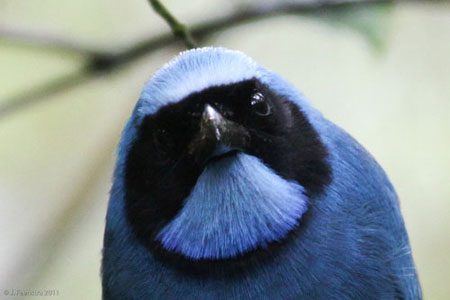
Turquoise Jay - Just another brilliant bird face from eastern Ecuador Photo: Jon Feenstra
Ecuador as a birding destination is well known and difficult to rival, and the east slope of the Andes as they plunge toward the humid lowlands of the steamy Amazon Basin is about as rich in bird species as it gets. The scenic peaks of the eastern Andes combine high páramo habitats that are home to such iconic species as Andean Condor and Rufous-bellied Seedsnipe with lush temperate, subtropical, and foothill forests that are alive with spectacular tanagers and fancy hummingbirds. This tour is designed to sample the eastern Andes’ impressive and exciting birding across multiple elevations, from the high páramo above the treeline to the cloud forests and rainforests of the Amazonian foothills, all from the comfort of the region’s best and most famous eco-lodges.
This tour can be taken in conjunction with both Ecuador: Mindo & the NW Andes and Ecuador: The Amazon Lowlands tours.
Day 1: The tour begins at 6:30 pm with a dinner meeting at our hotel in Puembo, a suburb of Quito near the airport. Night in Puembo.
John Feenstra’s leadership was invaluable. The diversity and productivity of his selected birding sites was quite impressive. He keeps a tight schedule, maximizing time in various habitats. He is also excellent with visual and audio identification of birds. In addition, John is an amiable traveling companion with a good sense of humor. Having attempted similar trips by myself in the past, I estimate that I saw twice as many species traveling with John and the group than I would have seen solo.
Douglas Holder, Feb 2019
Day 2: We’ll leave early this morning for the high mountain meadows of Antisana National Park, at the foot of the Antisana volcano. If the sky is clear, there are spectacular views of the mountaintop and glacier. The national park is most famous for its relative easy viewing of Andean Condor. These immense birds can be seen flying around over the treeless expanse. The condors are just one species, though, and the park is home to many other montane specialties such as Carunculated Caracara, Andean Ibis, Ecuadorian Hillstar, Tawny Antpitta, and Many-streaked Canastero. We’ll visit the alpine reservoir at the end of the road where there is usually a flock of Silvery Grebes, and Andean Lapwings stalk the edges. Lunch will be at a restaurant on the edge of gorge across from where the condors often come to roost, and sometimes Giant Hummingbird visits the feeders just outside. We’ll be back in Puembo for dinner and the night.
Day 3: This morning we drive for less than an hour from the hotel to the high páramo habitats of the Cayambe-Coca National Park at the Papallacta Pass, at nearly 15,000 feet of elevation. Birding at the pass and above gives us another try at some mountain specialties, most particularly Rufous-bellied Seedsnipe, but also Variable Hawk, Andean Tit-Spinetail, Chestnut-winged, and Stout-billed Cinclodes, and Plumbeous Sierra-Finch. We’ll spend some of the morning birding here before descending down the Amazonian slope to forested grounds of Guango Lodge, where we’ll have lunch and walk some trails. The big show is put on at an array of hummingbird feeders off the front porch. Such fabulous hummers as the impossibly proportioned Sword-billed Hummingbird visit occasionally. Others, such as Tourmaline Sunangel, Chestnut-breasted Coronet, Long-tailed Sylph, and Glowing Puffleg, are all possible as well. We’ll spend part of the afternoon on the grounds watching the hummingbirds and checking the adjacent river for Torrent Duck and White-capped Dipper. Then we’ll continue our journey downslope to Cabañas San Isidro, only an hour and a half away, possibly making a stop or two for such roadside attractions as Red-breasted Meadowlark and Vermilion Flycatcher. We’ll arrive at Cabañas San Isidro in the late afternoon with time to settle in before we’re treated to quite possibly the best cooking in Ecuador. Night at Cabañas San Isidro.
Day 4: We’ll have an entire day to explore the full birding potential of the grounds of San Isidro. We’ll walk on relatively level, little-traveled roads and occasionally on trails through the beautiful cloud forest. We’ll begin at first light, watching birds lured to the buffet at the lodge’s lamps, where insects have been collecting all night. It’s a great way to get those first good looks at such species as Montane Woodcreeper, Black-billed Peppershrike, and the wonderfully named Marble-faced Bristle-Tyrant. Striking off on foot to bird the access road of the lodge is excellent for fancy birds such as both Golden-headed and Crested Quetzals, Speckle-faced Parrot, Pale-eyed and Glossy-black Thrushes, and the diminutive Rufous-crowned Tody-Flycatcher. Mixed-species flocks of tanagers, including representatives of the genus Tangara such as the spectacular (and spectacularly named!) Saffron-crowned, Black-capped, Beryl-spangled, Flame-faced, and Golden-naped, are possible on the road or anywhere around the lodge.
The trails at San Isidro provide access to the interior of the forest, where we may find Andean Cock-of-the-rock, as well as bamboo thicket specialties such as Rufous Spinetail, Streak-headed Antbird, and Plain-tailed Wren. White-bellied Antpitta, which occurs in the forest around the lodge, may be coming to the nearby worm feeding station. We’ll bird all day, have both lunch and dinner at the lodge, and may very well not even get into the van once. After dinner, while walking back to our cabins, we’ll shine our lights into the trees and with luck locate the “San Isidro” Owl, a subspecies of Black-banded Owl known only from this area. Night at Cabañas San Isidro.
Day 5: This morning we may begin our birding day about 20 minutes down the main road at the Guacamayos Pass. First thing in the morning is the time to watch the swifts screaming over the pass. White-collared and Chestnut-collared make up the majority, but there is a chance for flocks of the little-known and infrequently observed White-chinned, White-chested, and Spot-fronted Swifts as well. This spot is also an excellent vantage point for the valley below and a good place to observe mixed flocks that might contain such incredible tanagers as the gaudy Grass-green, the noisy and gregarious White-capped, or the local Lacrimose Mountain-Tanager. A Black-billed Mountain-Toucan can occasionally be found on one of the treetops. The trail along the Guacamayos Ridge beginning from the parking lot can be equally exciting. We’ll walk over the cobblestones of this ancient Inca message relay route while looking for Powerful Woodpecker, Rufous-headed Pygmy-Tyrant, Dusky Piha, Barred Fruiteater, and Ocellated Tapaculo, among others.
After lunch back at the lodge, we’ll head downhill and east along the Loreto Road with a couple of quick stops to look for Cliff Flycatcher and Green-backed Hillstar near one of the waterfalls. We’ll arrive at Wildsumaco Lodge in the afternoon and settle in. Night at Wildsumaco.
Day 6: We’ll spend the day birding within walking distance of the lodge. Situated in the lower foothills at about 4,500 feet of elevation, the grounds have a mix of montane, foothill, and lowland species. Wildsumaco lies at the perfect elevation to find a number of normally difficult-to-find species. Today’s birding will be done from a seldom-traveled dirt road and along a system of forest trails. Coppery-chested Jacamar, Ecuadorian Piedtail, Ecuadorian Tyrannulet, and Gray-tailed Piha are resident species. Such rare and local foothill birds as Red-billed Tyrranulet, Ornate Stipplethroat, and Chestnut-crowned Gnateater are known from the trails, and we’ll keep a special eye out for them. The hummingbird feeders here are top-notch, and if the forest gets quiet in the afternoon or we get some rain, we’ll spend a little time on the back porch of the lodge to watch for Black-throated Brilliant, Napo Sabrewing, Wire-crested Thorntail, Gould’s Jewelfront, and Violet-headed Hummingbird. Antpitta feeding occurs here, too, and with a little luck, we could see both Plain-backed and the tiny Ochre-breasted Antpittas. After dark, Tropical Screech-Owl and Band-bellied Owl are possible. Night at Wildsumaco.
Day 7: After birding the grounds of the lodge until lunch, we’ll begin our return and our ascent. As we make the three-and-a-half-hour drive back to Guango Lodge, we may stop briefly along the way for a little birding and scenery. We’ll arrive at the lodge in time for some afternoon hummingbird watching, perhaps a quick walk around the grounds for that must-be-somewhere Gray-breasted Mountain-Toucan, and dinner. Night at Guango Lodge.
Day 8: Possibly after some sifting through mixed flocks, we’ll leave Guango for the national park above the Papallacta hot springs. In this upper temperate woodland, we have a chance for Masked Mountain-Tanager, Black-backed Bush-Tanager, and other specialties of this elevation. Though we will have seen new hummingbird species on every day of the tour, we should add a few more here, perhaps including Viridian Metaltail and Rainbow-bearded Thornbill. We’ll have a picnic lunch on the quiet roadside, keeping an eye up for the possible pass of Black-chested Buzzard-Eagle. From here the drive back to Puembo takes about an hour and a half, so we might have enough time for a few stops on the “old road” to poke around for anything we may have missed and get our last look at the rugged mountain skyline before we return to civilization. We’ll arrive back in Puembo in the afternoon with time for some last-minute feeder watching and a farewell dinner. Night in Puembo.
Day 9: The trip concludes this morning in Puembo.
Updated: 13 March 2024
Prices
- 2025 Tour Price : $3,490
- Single Occupancy Supplement : $470
Notes

Questions? Tour Manager: Greg Greene. Call 1-866-547-9868 (US or Canada) or (01) 520-320-9868 or click here to email.
* Tour invoices paid by check carry a 4% discount. Details here.
Single occupancy may not be available at Guango Lodge or at Wildsumaco.
Maximum group size seven with one leader.