Arizona and Utah
Fall Migration in the Canyonlands
-
Sep 7-19, 2027
Jake Mohlmann
Tour Price to be Determined


Tour Price to be Determined
Our tour will combine breathtaking landscapes with exciting birdwatching, especially in the desert oases. We’ll visit world-renowned canyons and monoliths sculpted from the massive Colorado Plateau, including areas near the Grand Canyon, Bryce and Zion Canyons, Monument Valley, and the Petrified Forest. We’ll also stop at a number of historic and scenic sites in Navajo country before relaxing in the boreal coolness of eastern Arizona’s White Mountains.


Day 1: The trip begins at 6:00 pm in Phoenix. Night in Phoenix.
Day 2: We’ll start this morning with a drive to Boyce Thompson Arboretum State Park east of Phoenix. Here we can expect an assortment of desert residents such as Black Phoebe, Cactus Wren, Phainopepla, Broad-billed Hummingbird, and Abert’s Towhee. Western migrants that commonly pass through the Arizona lowlands include Lazuli Bunting, Brewer’s Sparrow, MacGillivray’s Warbler, and Western Tanager. After lunch we’ll drive north, along the west side of Roosevelt Lake leaving the blazing heat behind as we climb the Mogollon Rim toward Flagstaff. Time permitting; we’ll stop at several lakes en route where we may see an assortment of ducks, Western Bluebird, American Kestrel, and possibly a herd of Elk chest deep in one of Arizona’s largest natural lakes. Night in Flagstaff.
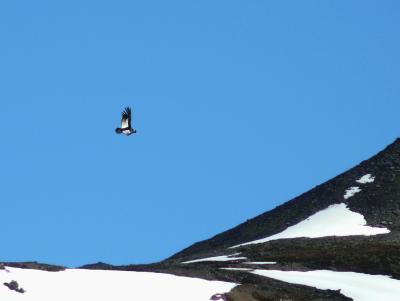
Day 3: We’ll leave early for our drive north to Kanab, UT. We will skirt the western edge of the Painted Desert and travel along the towering Vermilion Cliffs, where we’ll look for the reintroduced California Condor. We will enjoy the red rock country while we explore various birding locations along the route, including a couple migrant traps peppered amongst the barren landscape of the desert grasslands. Our drive will take us to an overlook to view the Grand Staircase of Utah where Pinyon Jay and Juniper Titmouse can occasionally be seen. Night in Kanab.
Days 4: The next morning we’ll enjoy a stroll around a reservoir near Kanab where water birds can number in the hundreds, and the rare gull or shorebird could be waiting for us. The surrounding sagebrush desert and piñon juniper habitats provide shelter for lots of birds coming in to use this critical water source. We’ll likely see a wide variety of western migrants including several Empidonax flycatchers, Western Wood-Pewee, Warbling Vireo, Black-headed Grosbeak, Green-tailed Towhee and several species of warbler possibly including Hermit, Townsend’s, and Virginia’s. Sparrow numbers here can be impressive with flocks of Brewer’s Sparrow often seen, as well as Vesper, Lark, and Sagebrush all possible. Although the western migrants will be our main concern, we may spot at least one eastern vagrant. We’ll work west perhaps stopping at a vagrant trap or two as we make our way to the mouth of the scenic Zion Canyon for the evening. Night in Springdale.
Day 5: This morning we’ll pass into southern Utah’s Zion National Park, where the willow-fringed Virgin River flows below towering red cliffs. We’ll ride the tram to various spots inside the canyon to explore Zion’s splendid terrain, and once again we’ll have the opportunity to see a wide array of migrants as well as resident Black and Say’s Phoebes, Rock and Canyon Wrens, and possibly American Dipper on the river. In the afternoon we’ll drive to Cedar Breaks National Monument on the west side of the Markagunt Plateau and pass through spruce-fir forest where we’ll look for Williamson’s Sapsucker and Clark’s Nutcracker. The overlook at Cedar Breaks is breathtaking, rivaling that of the Grand Canyon, and perhaps we’ll find Golden Eagle or Prairie Falcon soaring overhead. Night in Mt. Carmel Junction.
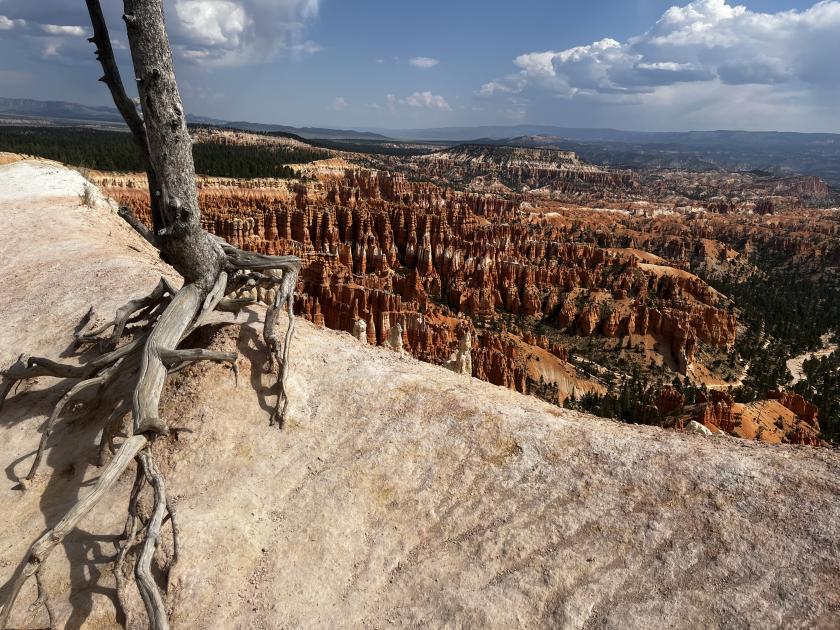
Day 6: We’ll drive along the Sevier River Valley north to Bryce Canyon National Park with stops at several lakes to search for stray migrants. Although not known for extraordinary bird diversity, Bryce Canyon more than makes up for it with astounding scenery. The fairyland quality of the landscape with its spires and spindle-like formations is one of the highlights of the tour. The surroundings might tempt us to ignore the birds, but Townsend’s Solitaire, Black-billed Magpie, and Mountain Chickadee provide welcome distractions. In the afternoon we’ll scour Panguitch Lake high on the Colorado Plateau and perhaps the only spot on our route for less common water birds like American White Pelican, various gulls, terns and if we’re extremely lucky a Greater Sage-Grouse. Night in Mt. Carmel Junction.
Day 7: This morning we’ll leave the canyons of southwestern Utah behind to begin our travels in Navajo country. The drive to Page, Arizona passes through splendid terrain as the road descends through the Grand Staircase to the barren approaches of Lake Powell. At the Page Waste-water Treatment Plant we can expect an assortment of waterbirds, perhaps including various shorebirds. Early September is an excellent time for rarities, and if we’re lucky we may spot a jaeger or Sabine’s Gull. Northern Arizona is memorable for its fantastic geology and both ancient and modern Indian culture. Just outside Page we’ll visit Antelope Canyon, a wondrous slot canyon with intricate, swirling patterns etched deep into sandstone walls. We’ll also investigate isolated clusters of trees; any patch of vegetation here, no matter how small, acts as a magnet for migrants. One such oasis near Kayenta was the site of one of the most impressive fallouts we’ve seen in Arizona, with literally hundreds of migrant warblers and vireos crammed into just 10 trees. During the late afternoon we’ll drive north of Kayenta and into the famed Monument Valley. Most of us may be familiar with the valley from television or magazines, but actually being in the presence of these huge stone monoliths as the sun sets is beyond description. Night in Kayenta.
Day 8: Some of the most exciting birdwatching in the West involves oasis-hopping in such famous areas as Death Valley or the Mojave Desert of eastern California. Oases in northeastern Arizona have proved over the years to be just as rewarding. Today we’ll begin a two-day journey from Kayenta to Springerville, stopping en route at many of the best oases in northern Arizona. Our main stops will be Many Farms and Tsaile Lakes, where we may see a variety of waterbirds. We’ll also search the sagebrush for Sage Thrasher and Sagebrush Sparrow, a recent taxonomic split. We’ll end the day at spectacular Canyon de Chelly National Monument peering down 1,000 foot cliffs at a modern Navajo agrarian society. Night in Chinle.
Day 9: We’ll start this morning at Ganado Lake and the Hubbell Trading Post. We can expect an assortment of migrants, and with luck we’ll find one or more rarities. We’ll drive through the Painted Desert and Petrified Forest National Park, where we’ll check the trees near the park headquarters before absorbing the sights within the park. Our main destination is Eagar, located at 7,000 feet at the base of the White Mountains. We’ll have the late afternoon to explore habitats around the towns of Springerville and Eagar, including St. John’s groves of cottonwoods, and agricultural fields, which act collectively as one giant migrant trap. Night in Eagar.
Days 10-11: For a change of pace, we’ll spend two full days in the Springerville area. We’ll visit South Fork, one of the prettiest parts of northern Arizona and one of the best birding localities in the state. Nesting Gray Catbirds are reminiscent of the East (South Fork is the only place they nest in the Southwest), and we may find a few lingerers. We’ll see numerous common migrants and perhaps such birds as Rufous and Calliope Hummingbirds, Williamson’s Sapsucker, American Dipper, or Olive Warbler. The combination of large numbers of migrants, resident ponderosa pine and pinyon-juniper species, and attractive surroundings makes the banks of the Little Colorado river a pleasant and worthwhile stop. We’ll have ample opportunity to birdwatch in the White Mountains at elevations up to 9,500 feet. The mountains here look like the Colorado Rockies, and the birds are similar as well. We’ll search especially for American Three-toed Woodpecker, Canada Jay, and Golden-crowned Kinglet, all of which nest locally in the spruce-fir forest. Nights in Eagar.
Day 12: After a final early morning walk in the cool temperatures of the high elevations, we’ll start our journey back to Phoenix where we’ll pass through five of the seven life zones found in the country. This gives us a chance to search for species we haven’t yet seen. We’ll break up the drive with stops in the White Mountains, and our route will take us along the Mogollon Rim to the town of Globe, where we may see Mexican Jay, Band-tailed Pigeon, and possibly Hepatic Tanager. As we descend from the rim we’ll search the chaparral for Gray Vireo and Rufous-crowned and Black-chinned Sparrows. The afternoon in Phoenix will undoubtedly be very warm, but may bring a suite of new species for the trip. Night in Phoenix.
Day 13: The tour concludes this morning in Phoenix.
Note: The information presented here is an abbreviated version of our formal General Information for this tour. Its purpose is solely to give readers a sense of what might be involved if they take this tour. Although we do our best to make sure that what follows here is completely accurate, it should not be used as a replacement for the formal document which will be sent to all tour registrants, and whose contents supersedes any information contained here.
ENTERING THE UNITED STATES: Non-United States citizens other than Canadians will need a valid passport and may need a tourist visa. Consult your nearest U.S. embassy or consulate for details. Canadian citizens will need to carry proof of citizenship in the form of a passport of birth certificate.
PACE OF TOUR: This tour is neither strenuous, nor is there the need for very early morning starts except for one day for the sunrise at the Grand Canyon. Most days will begin with breakfast between 6:00 am and 7:00 am at the hotels, or in a nearby breakfast restaurant. Lunches will be a combination of sandwich shops and picnic lunches in the field. Dinners will be in nice restaurants either at the hotel, or nearby. As we cover a fair amount of territory, some afternoons will be spent traveling to new destinations and hotels.
HEALTH: Arizona and Utah present no real hazards to the visiting birdwatcher but certain factors must be considered.
Sun: Any time of year in the desert southwest the sun can be intense. A broad-brimmed hat, proper clothing and a strong sun cream lotion are essential.
Elevation: Much of our birding is at elevations between 4000 and 9000 feet, and while we do not schedule anything even faintly strenuous at the higher altitudes, anyone with a respiratory problem should consult his or her doctor before scheduling the trip. We will stay overnight at 8,000 feet on the North Rim. At Mt. Carmel Junction, Kayenta, Chinle our hotels are situated between 5,300 – 5,700 feet. While in Eagar our hotel is at 7,000 feet. During the day we go to Cedar Breaks National Monument we will briefly be walking just above 10,000 feet. While on the North Rim and in portions of the White Mountains we will have brief walks up to 9,000 – 9,400 feet.
Spiny Plants: The most common injury results from spines penetrating light canvas shoes. Many desert plants in the southwest are armed with thorns or spines and we recommend tough canvas or leather shoes of at least ankle height and tough trousers as the best safeguards.
Dehydration: Dehydration is a constant concern in Arizona especially when birding at lower elevations in the desert. The leader will always have an ample supply of water and stop as frequently as necessary for bathroom stops. Drinking a lot of water is highly encouraged throughout the tour.
Smoking: Smoking is prohibited in the vehicles or when the group is gathered for meals, checklists, etc. If you are sharing a room with a nonsmoker, please do not smoke in the room. If you smoke in the field, do so well away and downwind from the group. If any location where the group is gathered has a stricter policy than the WINGS policy, that stricter policy will prevail.
Miscellaneous: Rattlesnakes are not a hazard but one always needs to use common sense and be alert in desert areas. We actively look for reptiles and feel lucky to see one rattlesnake per summer trip. Scorpions are nocturnal and rarely seen, and the tarantulas sometimes seen on the highways are not dangerous.
Chiggers, mosquitos, and/or other biting insects may be encountered some years but not in others. We recommend using insect repellents with a high concentration of DEET.
CLIMATE: Late summer in the mountains of northern and central Arizona can be decidedly autumnal with early morning temperatures in the high 30’s while daytime high temperatures in lower valley habitats may reach an excess of 100º F. Monsoon rain activity can last through September so rain showers are possible at any time of day or night, however most of the rain events are downpours that occur in the afternoon hours.
ACCOMMODATIONS: We stay at standard hotels throughout. Single occupancy is available throughout the tour; all rooms will have private bathroom facilities. Wireless internet is available in all our hotels except for the Grand Canyon. Some hotels we stay in do not have elevators.
FOOD: Food is North American standard. Various times during the tour we will have a chance to sample local cuisine.
Food Allergies / Requirements: We cannot guarantee that all food allergies can be accommodated at every destination. Participants with significant food allergies or special dietary requirements should bring appropriate foods with them for those times when their needs cannot be met. Announced meal times are always approximate depending on how the day unfolds. Participants who need to eat according to a fixed schedule should bring supplemental food. Please contact the WINGS office if you have any questions.
TRANSPORTATION: We will be traveling by leader-driven 12 or 15 passenger window van or minivan, depending on the group size. Participants should be able to ride in any seat in tour vehicles.
2025 Narrative
In Brief:
An amazing 1865 miles and 203 species of birds were logged on our latest Arizona and Utah adventure. This tour is designed to capture both the indescribable beauty of a vast region as well as it’s varied and abundant wildlife. With major destinations like Cedar Breaks National Monument, Monument Valley, and Zion and Bryce Canyon National Parks we were exposed to over 2 billion years of geologic history. As luck would have it our group got to witness a couple adult California Condors flying free over the towering Vermilion Cliffs. The world-famous Navajo Reservation’s wind whipped sand across our faces as we checked various migrant traps scattered throughout with highlights including Common Black Hawk, Williamson’s Sapsucker, and Juniper Titmouse. Not to be overshadowed by the famous parks were places like Arizona’s White Mountains where we were able to unwind, relax and enjoy a few days of blissful birding isolation before ending our tour in the saguaro-studded landscape of the Sonoran Desert thousands of feet below.
In Detail:
Our first morning we quickly consumed breakfast and loaded up the van to try and beat the heat of the toasty Sonoran Desert. As we headed east through the saguaro forests, we noted several Red-tailed Hawks and Common Ravens perched like sentinels on the wooden power poles. With our sights set on Boyce Thompson Arboretum, we were ready for our first taste of desert birding. Almost immediately after entering the lush grounds a few Phainopepla were spotted perched atop the tallest dead trees taking turns hawking for insects. We would watch them throughout our time here, sometimes feeding high in the sky like flocks of swallows. The constant song of the Bell’s Vireo was heard in the dense undergrowth, and Inca Doves eventually revealed their presence perched up in the trees with their mournful songs. A few Abert’s Towhees played hide and seek with us spending most of their time concealed in the low undergrowth. This riparian obligate species of the lower Colorado River drainages loves the dense habitats that the arboretum provides. Common Yellowthroats worked the vegetated shorelines of Ayers Lake, and a Black Phoebe perched on anything allowable to get a closer view of what insects were on the algae mats. A male “Desert” Purple Martin came in for a few passes expertly taking gulps of water before taking off and starting its long journey south to northeastern Brazil for the winter. A few fancy Black-throated Sparrows allowed good views as they foraged in the uplands around the lake. We took time to look through the scads of Turkey Vultures for Zone-tailed Hawk, but none were revealed. We experienced 4 species of hummingbird while here. Rufous was defending the best food sources, Anna’s were displaying vibrant red heads nicely, Black-chinned made brief visits, and a single Broad-billed made a brief visit to one of the many water features. Along Queen Creek we had a complete surprise Red-eyed Vireo that tried to blend in with the much more numerous Western Warbling Vireos. A troop of Coatimundi were a treat to watch, as several pint-sized young were feeding with full grown adults. They were focused on the Jujube, a type of Asian date tree providing an abundant supply of ripe red fruits. After our delicious local Mexican food lunch we headed up to Roosevelt Lake, a 20-mile-long wet oasis flooding the giant Tonto Basin. This area hosted a bunch of water birds including very nice comparisons of Western and Clarks Grebes. When seen alone these birds can be tough to identify, but seeing them close together in the scope made us all experts at this task. Other waders were utilizing the muddy shorelines including numerous Great Blue Herons and Great Egrets. Perched high on some dead snags were a couple of Osprey clearly at home in the water wonderland. Numerous Double-crested Cormorants were also utilizing the opportune perches. Our first Baird’s Sandpipers were seen in the muddy terminus of Tonto Creek, feeding alongside a group of White-faced Ibis and ducks including both Green-winged and Cinnamon Teal. We soon left the heat of the Sonoran Desert behind and made our way to Flagstaff perched at 7,000’ feet. On the way the views of Mormon Lake were wonderful as we watched several herds of elk resting in the grasses of the mostly dry water body. We drove through some rain showers en route to our home for the night.
The next morning, we headed north from Flagstaff with excellent views of the San Francisco Volcanic Field and some of the hundreds of cinder cones in the area. One quick stop harbored a few Acorn Woodpeckers in an oak grove coming and going to their what was likely their nesting tree. We then visited a muddy tank in the middle of the seemingly endless barren landscape that was full of birds. Right next to the road in a recently formulated puddle had a single Solitary Sandpiper working the edge showing eye ring and white-spotted back pattern satisfactorily. Just as we got there a raptor was spotted on a nearby transmission pole that turned out to be a prized Prairie Falcon. Its details were noted in the scope and as we were packing up a seemingly out of place Osprey flapped overhead, heading south to continue its migration. A distant Northern Harrier joined the raptor party, as did a swift accipiter that nabbed what we thought was the only Killdeer present on the pond, and carried it off into the grasslands to consume. We worked slowly around the tank and were rewarded with extended views of many Yellow Warblers and a very active Blue-gray Gnatcatcher. Sparrows showed well as we kept flushing Lark and Brewer’s around the soggy edges of the pond. A single Yellow-headed Blackbird posed long enough for us to see its pale face and white wing patches, implying this was a young male. After our stroll, we headed north along route 89 and checked Cameron’s wastewater ponds where Blue-winged Teal were added, as well as a spinning Wilson’s Phalarope adorned in its ghostly plumage. Travelers have been stopping at Cameron Trading Post for over 100 years as they pass through the Painted Desert on the banks of the Little Colorado River. This is still popular with tourists and the courtyard of the hotel grounds usually harbors birds that allow very close inspection. Immediately Eurasian Collared Doves were heard cooing from the large elm trees, and we were inundated with hummingbirds feeding on the orange trumpet flowers. Black-chinned Hummingbirds were politely taking turns at the flowers, but the Rufous Hummingbirds kept stirring the pot chasing any intruder away with gusto. Western Tanager and Black-headed Grosbeak were seen extremely well and as we were enjoying these, a Northern Waterthrush walked right into view seemingly out of nowhere. The same thing happened with a MacGillivray’s Warbler as it popped out of a hedgerow and worked its way through the courtyard. A group of Lazuli Buntings gave us good looks before we hopped back into the van and continued on our way. We skirted the western edge of the Painted Desert and drove by the Echo Cliffs as we headed north towards the burnt Vermilion Cliffs and our next target bird. We checked Marble Canyon cut by the mighty Colorado River but didn’t find anything of note besides a White-throated Swift that shot by at high speed. After lunch we navigated the southern edge of the Paria Plateau and over to the Condor viewing area in hopes of finding a big target for the trip. As soon as we exited the van, we spotted a huge California Condor perched up on the towering cliffs and watched as it was joined by another condor. It was very special to see these birds that were on the brink of extinction in all their glory. We noticed another raptor that was being mobbed by a pair of bullying Common Ravens. The raptor was huge compared to the corvids and turned out to be a sub-adult Golden Eagle taking a beating as it flew south along the cliff. The Ravens got their turn being harassed too, when a Peregrine Falcon came out of nowhere an began its aerial dog fight taking turns dive bombing the previous attackers. After this, we began climbing the Kaibab Plateau and made a stop by Jacob Lake where we tracked down an impressive mixed species flock. Both Pygmy and White-breasted Nuthatches worked down the massive pine tree trunks, while a Brown Creeper worked up the same trees. A pair of Plumbous Vireos sang loudly and allowed close inspection of their white underparts and bright spectacles. It was nice to see them so well, because we had to compare it to the similarly-plumaged Cassin’s Vireo foraging in the same flock. A single Western Bluebird perched high in a Ponderosa Pine, and in the same strata a Grace’s Warbler foraged slowly through the tree’s needles. We watched a Steller’s Jay work its way across the parking lot and, as we were leaving, a male Cassin’s Finch was expertly spotted feeding in the roadside grit. Unfortunately, the lodge at the North Rim of the Grand Canyon had 60 structures burn to the ground recently in a huge forest fire, so we couldn’t run our normal program. Instead, we made our way over to Kanab Utah, which sits amongst the red rock landscape surrounded by geologic beauty. The van headed north ascending the Grand Staircase and as we descended the plateau we were witness to millions of years of geologic history in layer cake fashion with the Gray, White, Pink, and Red levels on display many miles in the distance.
The following morning, we scoured Jackson Flats Reservoir just south of town and it was ripe with birds. As soon as we pulled up to the boat launch, we spotted a couple Killdeer running around the beach, as well as Spotted Sandpipers chasing flies along the shore. A single Yellow-headed Blackbird sat boldly atop a cottonwood tree, and a flock of Great-tailed Grackles were spotted working out on the playground equipment. Across the water a tree was filled with Turkey Vulture ornaments, all waiting for the thermals to pick up soon to help with their journey south. A very confiding Rock Wren perched on top of the largest rock nearby, bobbing its body up and down with each call and head turn. A gull flew by that gave us a thrill, but turned out to be one of the more common Ring-billed Gulls, an expected species here. A small flock of Pied-billed Grebes tried to blend in with the hundreds of American Coots dabbling about and several Ruddy Ducks were actively diving. A pair of Hooded Mergansers were eventually spotted by us all as they stayed mostly underwater along the edge amongst emergent tree stumps. Although not an uncommon bird in certain areas, this species was new to the overall trip list. We had a good study of Western Grebes with their dark faces and greenish/yellow bills. The swallow show was constant with several species seen including Bank, Barn, Northern Rough-winged, and Violet-green all feeding low over the reservoir. We saw lots of sparrows along the brushy verges of the lake. Several sizeable flocks of Brewer’s Sparrows gave a close study of their seemingly featureless wardrobes. There were a couple dapper Vesper Sparrows in the mix, as well as scattered Lark Sparrows joining the party. A couple Sharp-shinned Hawks came in silently and disappeared in the cottonwood groves. The Merlin that shot past at high speed caused more of a ruckus as it chased several birds around like a fighter pilot. A nice comparison of Double-crested and Neotropic Cormorants was utilized as they sat on some of the small islands. Several Great Blue Herons were scattered along the muddy edge, as were some Black-crowned Night Herons of various ages. An adorable flock of Bushtits came in to inspect us, and several Blue-gray Gnatcatchers were easy to keep track of with their wheezy calls and song. Our first Loggerhead Shrike allowed extended study as it hunted the sagebrush flats and just before leaving several groups of Canada Geese honked overhead as they came in to rest on the water’s edge. We ended up leaving this location with 50 species seen, not bad for the desert.
We then headed over to Pipe Springs National Monument. This place showcases a long history of a valuable spring changing hands over the years from the Kaibab Paiute to the Mormons, and eventually becoming a National Monument in the early 1900s. A sizeable flock of Western Scrub-Jays did some touch and goes through the treetops upon our arrival. A Say’s Phoebe was working the horse corrals picking bugs off the manure piles. In addition to Yellow and MacGillivray’s Warblers, a Virginia’s Warbler made a brief appearance over our heads before ducking into the dense undergrowth and out of sight for good. At least a half dozen Western Wood-Pewees were hawking insects around the recently manicured spring-filled ponds. We took a spin through Windsor Castle, a fortified structure built by the Mormons right over the spring to protect this valuable resource from intruders. A non-bird highlight here was a five-foot-long Gopher Snake that slowly worked its way around the castle walls. At one point it met face-to-face with a surprised Rock Squirrel. The squirrel was quite stern and started throwing dirt in the face of the snake. It worked as the snake changed its course and went to look for prey elsewhere. We then headed back into Utah, following the Virgin River course and right into the heart of one of the most beautiful places in the country.
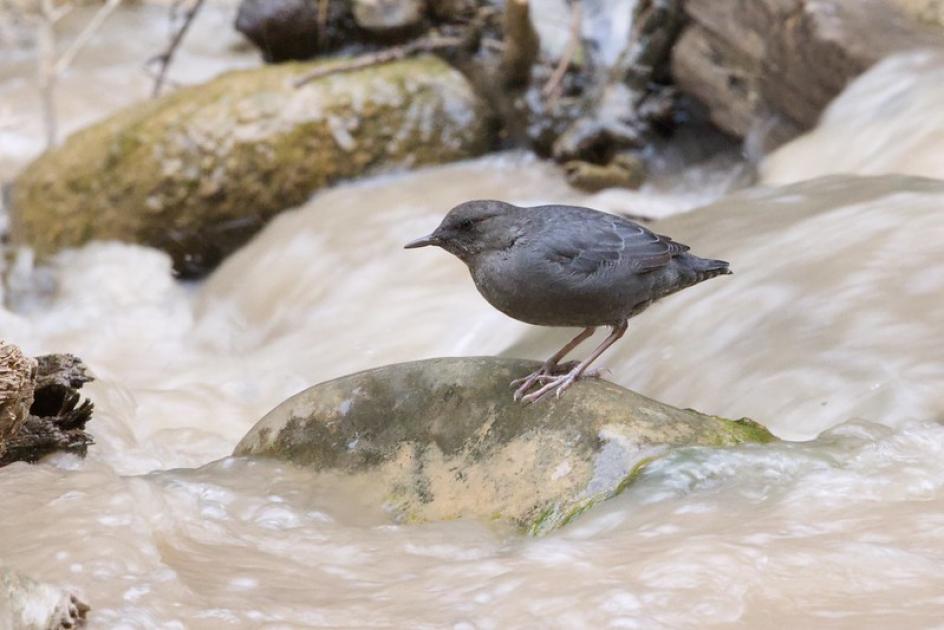
Zion National Park with its towering thousand-foot rusty sandstone cliffs was a joy for us all. We meandered along the river walk enjoying the scarlet monkey flower and fireweed in bloom held precariously from the cliff sides in lush hanging gardens. It was hard to keep our heads down focusing on the river’s edge as we walked in awe with eyes up high admiring this stunning scenery. Eventually we did find several American Dippers that slowly worked their way downstream nearly at our feet, slowly checking the boulders and ripples for larval morsels to feed on. The water was very turbid this year, which caused the dippers to focus more on food that was on the surface of the water instead of diving, allowing a unique opportunity to study seven different birds on our walk. Along one of the rocky abutments along the trail an extremely confiding Canyon Wren searched for insects in the moist rock piles. We headed east through a well-constructed Zion Tunnel and all of a sudden came out right in the middle of the pale Navajo Sandstone formation. Ancient sand dunes weaved through the landscape and yielded a large group of ‘Desert’ Big Horned Sheep climbing up the geological jungle gym around Checkerboard Mesa. While observing these desert denizens, a Juniper Titmouse was observed flying back and forth across the landscape perhaps looking for juniper seeds for later consumption. At lunch a gorgeous Two Tailed Swallowtail butterfly came to join us feeding on nectar-producing Rocky Mountain Bee Plants and a Spotted Towhee picked around the edges of the manicured lawn. We left the scenic wonderland at Zion and made our way north up the Markagunt Plateau to its western terminus. Cedar Breaks National Monument finally appeared as we gained elevation to over 10,000 feet and struck us all with its colorful beauty. One particular 1,400-year-old Pine Tree is still hanging on atop the gigantic amphitheater of red, orange, purple, and white endless cliffs on this western edge of the Colorado Plateau. Just behind the visitor’s center a portly Yellow-bellied Marmot sat on its haunches curiously watching us as we admired its pale face and chunky belly. After taking it all in we descended the plateau to Mt. Carmel, our home for the next couple nights. Here we learned why the restaurant’s ho-made pies are world famous.
The habitat around our next hotel in Mt. Carmel often produces several bird species not encountered at this point of the tour. A short walk down a 2-track through the oaks and junipers was our post breakfast prescription. Here we studied Black Phoebe in the scope, and had a very vocal Bewick’s Wren that made us keep spinning around as it circumnavigated the group a couple times. Swallows were taking a flight break and resting on the wires above. Violet-Green Swallows of all ages were inspected, and we picked out a couple of Northern Rough-winged for a nice comparison. We then headed north up the Sevier Valley which not only continued the stunning scenery of the region, but gave us some unforgettable birds as well. Fleeting from the roadside was an enormous showy corvid which we turned the van around for. Several long-tailed Black-billed Magpies slowly floated off posts and across the verdant valley. One waited long enough for us to put in the scope and admire the oily blue sheen of its wings and tail. Near the town of Hatch, we quickly pulled over to check out an enormous raptor on a roadside transmission tower. It was not one, but two sub-adult Golden Eagles who were strategically placed right next to a thriving Utah Prairie Dog colony. This mammal is endemic to the high plateaus of southwestern Utah. We learned why one always turns around and checks behind you while birding here. When we did, we noticed an adult Bald Eagle perched just across the road. We were thrilled to have both eagle species so close and in view for such a long period of time. Other birds produced here was a vocal Western Meadowlark on top of a juniper tree, and small flock of Horned Larks feeding in the short grass of the prairie dog colony. Bryce Canyon National Park protects some of the world’s most amazing rock structures. It’s easy to admire the 200-foot tall hoodoo arrangements resembling the world’s largest organ in opulent display. While checking out some overlooks a foraging flock was followed that got us up close and personal with some Mountain Chickadees. They were joined by a querulous flock of Bushtits that actually weren’t moving around, allowing us to have extended study of these long-tailed balls of cute. In Bryce Canyon City we scanned the agricultural fields and were rewarded with a vibrant sky-blue male Mountain Bluebird that landed on the fence mere feet from our excited group. This color blue is amazing to see, much different than other the other species of bluebird in the US. At Panguitch Lake in the afternoon hundreds of birds were gathered at the mudflats on the western edge. Waterfowl numbers were high including groups of Canada Geese, Ruddy Ducks, and dozens of Eared Grebes in every plumage one could want. The sleek Western Grebes were chasing each other around, and smaller Eared Grebes had young of the year close behind still begging for food. There were more American Coots present than one could count with nearly 1,000 seen. Over 100 American White Pelicans were scattered about. Most of them were loafing on the shoreline taking a break, but a group of 20 were feeding together in a white mass seemingly orchestrating a choreographed dance as they corralled fish to scoop up with their massive orange bills. Other duck species added to our list here were a single male Redhead, a pair of Lesser Scaup, and lone male Gadwall picking through the floating vegetation. A covey of California Gulls was huddled on the shoreline, attempting to hide several Ring-billed Gull in the mix. Eventually we had a representative of each species land right in front of us for a nice comparative view. There were at least a dozen Forster’s Terns actively feeding dawned in black masks of the season. A complete surprise juvenile Sabine’s Gull landed right before our eyes at the last spot we checked. While studying the unique wing pattern of this normally pelagic species, another Sabine’s Gulls came in and landed right next to it! It’s rare enough to see even one of these birds on an inland water body, let alone two. On the way back south, we skirted the impressive Marysvale Lava Flow as the road followed its course for miles.
After appreciating the sunrise against the pink cliffs of Mt. Carmel, we headed back east along the shore of the massive Lake Powell to Page. A quick stop at the wastewater treatment plant here had a nice assortment of ducks. We added a pair of Ring-necked Ducks to the list, as well as a dainty Bufflehead that was clearly the smallest fowl in the flock. A very large comfortable 4x4 van whisked us away up a sandy wash and ultimately to the famed Antelope Canyon where water has etched perfectly smooth flowing walls of sandstone into an amazing array of geologic wonder. After a delicious Texas-style barbeque lunch we continued deeper into Navajo Country. Being in Kayenta put us in close proximity to enjoy the sunset at Monument Valley in the evening. The sun setting here provided all with fantastic pictures as the shadows of the mesas and spires became long as the sun was calling it a day. The finale was seeing the shadow of the west Mitten creeping slowly up the sheer face of the east Mitten looking like hands clapping high five for a truly memorable experience.
There are several water spots peppered throughout the Navajo Reservation and one such place we normally check is Many Farms Lake. As soon as we pulled up to the overlook, we noticed large shorebirds feeding with sweeping motion through the mud flats. These were dozens of American Avocets clothed in their non-breeding plumages lacking their orange heads and necks. Over 60 White-faced Ibis were feeding in the mud flats, joining the many peeps and a Killdeer weaving amongst them. Some close peeps gave a good study comparing the differences between Least and Western Sandpipers. We also saw a Gray Fox running along the hillside, its presence first alerted by some alert Rock Squirrels giving their alarm calls. A spring on the eastern end of the lake produced 37 species of birds, some of which were new for the tour. Upon arrival to the small pond here we noticed a Solitary Sandpiper that was flying laps around the edges of the reeds. It never did find a good place to land so kept on heading south off into the sky. Right where we parked a blooming Rocky Mountain Bee Plant had a hummingbird perched in its middle. This tiny hummer was easy to identify as Calliope for its overall small size and dainty bill. There were lots of other hummingbirds around feeding on this resource. All the rest were Rufous Hummingbirds, including a stunning male with rusty body and orange gorget that glistened in the sun. A large flock of Yellow-headed Blackbirds took time between feeding in the ripe cornfields and then heading over to the spring for quick drinks. Warblers were coming into bath in the understory and included several Wilson’s, a couple Nashville, and Northern Waterthrush. We hadn’t even seen an Empidonax flycatcher on the tour up to this point, so we were excited to get quick consecutive looks at Gray, Hammond’s, and Dusky all feeding in their appropriate styles and showing key field marks well. We then headed south to the town on Chinle. At the Cottonwood Campground we strolled through endless trees. A confiding pair of Hairy Woodpeckers fed within feet of us, with the female being the boldest wood borer. Flocks of Western Bluebirds flew from perches to the ground repeatedly. Small groups of Chipping Sparrows fed in the leaf litter, right alongside several Audubon’s Yellow-rumped Warblers. Wester Wood-Pewees were scattered throughout, repeatedly shooting across the open understory in hot pursuit of flying insects. Several White-breasted Nuthatches also joined the party feeding down the tree trunks in their typical fashion. Canyon de Chelly allowed us a look at ancient ruins long inhabited by the Anasazi, or ‘ancient ones’. Their descendants, the Navajo Indians, are still farming the canyon today. At one point a couple White-throated Swifts were shooting by, at times close enough to our heads to hear the feathered bullets whoosh by. Lastly, we took time to soak in the incredible Spider Rock, the most famous feature of the canyon, before calling it a day.
We set our compass south to explore the birding hotspots around Ganado. First we checked out Ganado Lake. A large Prairie Falcon took off from a juniper on the hill as soon as we pulled off the pavement. The lake water levels were low exposing extensive mudflats. As soon as we parked, we heard the harsh chipping of a mobbing group of passerines. We thought it might be some type of predator they were interested in so walked over to see what the fuss was about. We quickly realized when the Sharp-shinned Hawk took off from the tamarisk grove why they were so upset. Several species were taking part in the mob, including several Wilson’s and Yellow Warblers, a few MacGillivray’s, single Orange-crowned Warbler, as well as a couple Western Warbling Vireos. Although amazingly only nine individual shorebirds were seen, one of them was quite rare. A gorgeous Black-bellied Plover was standing tall amongst its Western Sandpiper cousins. The plover was still retaining a lot of its breeding plumage showing pale head and black belly nicely. We also added a small group of Red-necked Phalaropes sitting in the middle of the lake with their black masks showing well. Waterfowl was abundant here with most common species being new for the list American Wigeon, scads of American Coot and many Ruddy Ducks sprinkled throughout. Flocks of teal were occasionally taking flight. Most of them were Cinnamon with bright blue wing patches glowing in the sun. Amongst them were a couple Blue and Green-winged Teal. Canada Geese were in good supply, as well as several long-necked Northern Pintail. Mallards were showing in good numbers. We took time to track down one particular interesting individual that turned out to be a male Mexican Duck. This was the furthest north we’d recorded this species on the tour, however not a surprise given its general northward expansion across its range. While scanning a surprise juvenile Franklin’s Gull flew right by us and foraged for the next 30 minutes as we slowly walked the lakeshore. The lake’s lush edges here were full of birds and the trees peppering the shoreline gave great looks at several species. Say’s Phoebe’s were using the dead branches as perches, taking turns chasing each other from the best foraging areas. Chipping Sparrows were constantly flushing from the short grass as we walked, as did a few Brewer’s, Vesper, and single Lark Sparrow all giving great looks. Western Tanagers were in the fruiting Russian Olive trees picking off fruits. A Lazuli Bunting sat long enough to enjoy its burnt chest and bluish tail. Swallows were in constant supply with Barn being the most common, but a single Cliff Swallow in the mix was new for the trip list. At a marshy area along the wash we heard Sora, Virginia Rail and a Marsh Wren all call from its bowels. The vegetation here was choking any viewing potential we had at these birds, but the calls were nice to hear. Just before leaving a young Peregrine Falcon came in for a pass over the dam, undoubtedly taking a look at the buffet of ducks awaiting just over the berm. We checked out nearby Hubbell Trading post that’s been in constant business since the 1860s. En route to the White Mountains we drove through the Petrified Forest National Park. The Visitor’s Center here just off old route 66 was harbor from the windy conditions for several migrants. In an hour of slowly walking the grounds we gained extremely good views at a couple skulky species. Highlights included unusually good views of MacGillivray’s Warbler, a bird we’d mostly seen briefly as it shot from bush to bush up to this point. Also here a Green-tailed Towhee was working the edge of the parking lot allowing extended views of this gorgeous sparrow. It was in this park that a Pileated Woodpecker had been reported a day ago, and there were many people out searching for it before we arrived. They hadn’t had any luck, so we decided to forego the effort to see what would be Arizona’s first record of this species and continued along our regularly scheduled program.
Wenima Wildlife Management Area sits astride the lush Little Colorado River stuffed with trees and shrubs full of food and a nice assortment of birds. On the entrance road we had a close flock of Horned Larks that were feeding amongst the herd of Angus Cattle. At one point, the cattle surrounded our van and started licking the sides. Perhaps we looked like a giant cow with our black high-top vehicle? As soon as we got out of the vehicle we started hearing birds. A Yellow-breasted Chat gave a few bursts of its song. Spotted Towhees started meowing from the bushes and a Gray Catbird gave a few ‘chuck’ calls. This is one of the few spots in Arizona this species breeds. A particularly confiding Woodhouse’s Scrub-Jay flicked through the dirt long enough for us all to get satisfying scope views. A bright male Summer Tanager popped into view in one of the large Arizona Walnut trees along the path. His tail was the appropriate red color, but his body still looked a shade of orange indicating it’s a young bird from this year’s hatching. On the way out we spotted a Greater Roadrunner slowly stalking its way through the sparse grassland. We observed it run in short bursts, while waving its tail like a rudder through the air, as it darted after insects and lizards. Sipe Wildlife Area is a great place to sit down and relax while watching the hummingbird feeders. Great comparisons of Black-chinned, Broad-tailed, Rufous and even a diminutive Calliope Hummingbird were enjoyed amid the Juniper-studded grasslands surrounding this location. We had a good woodpecker show here as well. A couple Acorn Woodpeckers were hiding in the elm trees, higher up in elevation than normal. A group of three young Lewis’s Woodpeckers were traveling together, fighting the wind as they crossed the open grasslands to perch on top of a juniper tree. Also, a surprise male Williamson’s Sapsucker was spotted at eye level and quite close, but quickly disappeared into the undergrowth where it remained unfound the rest of the time. Spotted and Green-tailed Towhees were taking turns scratching in the grit along the small stream and a good number of American Robins were flying in overhead. A small empid turned out to be a Willow Flycatcher, this likely of the endangered southwest subspecies that breeds in this region. We relaxed at Luna Lake near the New Mexico border while we enjoyed our picnic lunch. Rafts of mostly Coots, Mallards, and Ruddy Ducks huddled at the west end and ten Double-crested Cormorants sat like statues on the emergent rocks. A striking male Mountain Bluebird added a welcome blast of color to the brown landscape as it hopped between mullein stalks keeping an eye on the ground for prey. A single Pine Siskin perched above our table, allowing the only good views of the trip of this high elevation finch. We then headed up the slopes of Escudilla Mountain where we picked through a couple flocks comprised of many Pygmy Nuthatches, some Mountain Chickadees, and Ruby-crowned Kinglets. The highlight warbler was a male Townsend’s displaying bright yellow colors overlaid with dark black mask and flank streaks. On the way back to town we stopped at Nelson Reservoir. The water levels here were as low as they have ever been on this tour. Waterfowl were the only thing utilizing it today with Canada Geese, Gadwall, Ruddy Ducks and Green-winged Teal all poking around in the mud. To end the day, we rolled through some back roads around Springerville. We lucked into a few Chihuahuan Meadowlarks as they walked through some of the yards here, as well as a couple Loggerhead Shrikes, one without a tail. At one weedy field a large flock of sparrows were mostly Brewer’s, but dozens of Lazuli Buntings were also feeding on the seedheads of the ripe grass clumps. At one point we looked down a fenceline and counted 15 Savannah Sparrows all perched on top wondering where to go next. A swirling group of blackbirds were mostly European Starlings, but a few male Yellow-headed Blackbirds were in the mix, easily spotted with their contrasting bright white wing patches.
When meeting at the van the next morning, a male Williamson’s Sapsucker landed in the tree next to us and slowly worked its way around the parking lot checking trees for any easy meals. What a way to start the day! We then had our sights set on another portion of the Little Colorado River. We explored its South Fork, a gorgeous area with oak juniper woodlands spread across lava flows and a fertile valley filled with birds. Upon our arrival to the banks of the river a high rising whistle immediately caught our attention. It led to several Townsend’s Solitaires perched on the taller trees, some of which were in full song. A huge flocks of Pinyon Jays worked its way through the hillside close by, allowing a chance to see how this species feeds together in such large numbers. Dozens of Turkey Vultures lifted off from their nighttime roost coming in to the thermal brewing upslope. A Peregrine Falcon joined the initial lift-off of the day, as did a completely unexpected Common Black Hawk. After taking in the broad black wings and single white-banded tail of this species, we made our way to the bridge over the river. Immediatley we noticed a dark raptor perched just over the river staring down at the clear waters below. It was yet another Common Black Hawk. This individual sat there for the rest of our time here, completely calm and likely waiting for an appropriate updraft for it to jump into for its continued migration south. This was the first, and second, Black Hawk that I’ve seen on this tour in the 15 years I’ve been leading it. At Sheep’s Crossing we strolled along the banks of the west fork of the Little Colorado River. Some owl tooting got a response from a large flock of birds, some we hadn’t seen yet. Joining the numerous Pygmy Nuthatches at this elevation were a group of Red-breasted Nuthatches, expressing their tin trumpet-like calls constantly. Also in the mix were a couple Golden-crowned Kinglets, residents in the Spruce/Fur forests of this area. It was around this point that the skies started pouring with rain. We hastened our pace to the van and spent the next several hours birding in the downpours. The parched landscape was in need of this event, so although we were moist it was a positive experience overall considering the severe drought Arizona has been in. Later on we came back to this area and at the bridge, a pair of Canada Jays dropped in out of nowhere and perched prominently on top of some lofty spruce trees. Despite our best efforts we could not track these secretive birds down beyond that. We made a quick stop to Big Lake where we added 17 Common Mergansers slowly making their way through the water with eyes just below the surface, constantly scanning for fish to chase. An Osprey gave us a good show when it came in and smashed into the water, emerging with a fish in its talons, head first of course. American Crows were interspersed with Common Ravens walking along the shore allowing nice comparative views, and Brewer’s Blackbirds foraged in flocks on the weedy hillsides. We at our picnic lunch under the shelter of a perfectly sized cover, which kept us completely dry and out of the pelting rain. The scope was set up so we got to watch Ring-necked Ducks, Redheads, and White-faced Ibis all feeding in the marshy wetland below. When the rain did stop, we took a stroll along the beautiful East Baldy trail and into the depths of the forest. Up close Steller’s Jays displayed their showy white eye brows and long crests nicely. All three expected nuthatch species were foraging in flocks, and a Hammond’s Flycatcher gave us a study of its long primary projection. Before leaving the lake-studded high elevation grasslands we made one last stop at an overlook that let us take in the vast landscape to the north. This was an amazing look at the immense cinder cone field laid out before us. With a short drive we were back at our home base before we knew it, and started the drying out process of our remaining damp clothes.
We said goodbye to the high elevations of the White Mountains and made our way back to Phoenix where another suite of birds would be waiting. A quick stop in the Salt River Gorge revealed yet another wide-open landscape where water has spent eons shaping countless canyons. Up on the hillside a Virginia’s Warbler called, and eventually came in to a shrub right next to us. The same thing happened with a Gray Vireo that was singing non-stop from the slopes below. A surprise Dickcissel made a brief stop on top of an acacia, just long enough for us to note what species it was, before taking off and heading to parts unknown. A stop at Timber Camp was quite fruitful for us. As soon as we got out of the van three Red Crossbills came in to drink from the only remaining puddle at the campground. Mexican Jays were downright numerous, feeding in the litter under oak trees, as was a family of Acorn Woodpeckers constantly flying over the parking area with obvious black-and-white wings. We added a showy Painted Redstart replete with red belly, white eye arc, and fanned tail staying busy while hunting in its unique way. A nice-sized foraging flock here was mainly comprised of Bushtits, but Western Flycatcher, yellow-faced Hermit Warbler and all gray Juniper Titmouse joined the event. We noticed a warbler high in the pines that turned out to be a young Olive Warbler, a lifer for several of the participants and an exciting species to see anywhere in its limited range. We left the oak zone and soon found ourselves surrounded by towering saguaro cactus once again. We made a stop at the Picketpost Trailhead where we were immediately greeted by a raucous Black-tailed Gnatcatcher, a male with black cap. Here a Zone-tailed Hawk made regular passes overhead with dihedral wings and wavering flight. We’d been checking every Turkey Vulture the entire trip to pick one of these out, and were excited to finally have one materialize right above our heads. Just as we were leaving, a woodpecker with yellow shafts shot by in front of the van. It turned out to be a Gilded Flicker, a species tied to this cactus-laden landscape. Our final stop was at the Gilbert Water Ranch where we added shorebirds including Greater and Lesser Yellowlegs and great looks at Least Sandpipers and Black-necked Stilts. We managed to pick out a Lucy’s Warbler amongst the salt bushes and mesquite trees lining the path. A wader party included a bunch of Great and Snowy Egrets, as well as an adult Black-crowned Night Heron tucked into the shrubs. A total of 44 species was found here strewn amongst the mud flats, dense shrubs and shade trees. Not too bad considering the 95-degree temperatures we were experiencing. This was such a wonderful way to wrap up our 2 weeks of birding bliss through northern Arizona and southern Utah’s most scenic spots.
Jake Mohlmann 2025
Jake really knows the birds, their behavior, their habitat and where to find them. He is outstanding, and patient, making sure everyone gets to have a good look at each and every bird. Jake knows birds through long personal experience, and helps us begin to do the same. Jake also knows a lot about the unique geology of the places we traveled, and helped us to appreciate it.
- Maureen L. on Arizona and Utah
This is not only the best tour but our best vacation taken. Jake was an outstanding all-purpose guide. The trip offered off-the-beaten path places to bird plus several scenic scenic national parks and national forests in AZ and UT. Even non-birders would enjoy this trip and if you were not a good birder, Jake would “put you on the bird”. He has a keen ear for bird calls and is an awesome interpreter for the geology and natural history the area has to offer. Jake, well done! We can’t wait to bird/sightsee with you again.
- Jean A. on Arizona and Utah
This was an excellent tour, the perfect mix of sightseeing and bird watching. It was the fastest 12 days I’ve ever spent. It was as well my third tour with Jake and he was, as always, sensitive to everyone’s abilities, capabilities and desires.
- Kristi S. on Arizona and Utah
Group size limited to seven participants with one leader.
More Tours with these Leaders