
Steve Howell
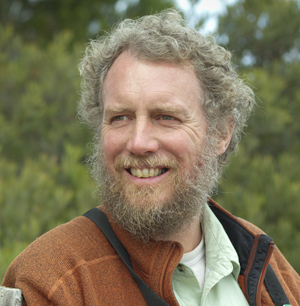
Steve Howell has been birding for as long as he can remember: of course, this may simply mean that his memory isn’t very good. But the many who have traveled with him over his 40 years of leading tours around the world soon learn that birding can be great fun, as well as being a way to enjoy and learn, to see new birds and new worlds.
Steve was born in Cardiff, the capital city of Wales, and spent his formative years birding throughout Britain before venturing farther afield. After university he planned a couple of years of travel before settling down, but by a series of coincidences ended up in Mexico. And so began a 14-year venture culminating in the publication of A Guide to the Birds of Mexico and Northern Central America, co-authored with Sophie Webb. Steve recently celebrated 40 years of birding and travel in Mexico, a truly magical country full of amazing birds. Away from land, he is a world-renowned expert on seabirds, and has spent over four years of his life at sea and encountered over 97% of the world’s tubenoses.
Concurrent with researching the Mexico guide, writing became a habit. Steve has authored and co-authored several other books, including the Peterson Reference Guide to Molt in North American Birds (2010), the Petrels, Albatrosses & Storm-Petrels of North America (2012), Rare Birds of North America (2014, co-authored with Will Russell and Ian Lewington), and most recently Oceanic Birds of the World: A Photo Guide (2019, co-authored with Kirk Zufelt), and field guides to Birds of Costa Rica and Birds of Belize (both 2023, co-authored with Dale Dyer). He has also written many scientific and popular articles, ranging from the identification of petrels and frigatebirds to the taxonomy of tapaculos and hummingbirds and molt in woodpeckers and skuas. His ‘chronic’ writing habit was recognized in 2005, when the American Birding Association presented him with the Robert Ridgway Award for publications in field ornithology. Steve serves on the editorial board of Cotinga (the journal of the Neotropical Bird Club) and is a Research Associate at the California Academy of Sciences and at Point Blue Conservation Science, former book review editor for Western Birds, and a former member of the California Bird Records Committee.
Interests beyond birds include butterflies, tequila, and chocolate (the last two come originally from Mexico, which may be no coincidence).
Tours
- Cruise: The Subantarctic Islands of New Zealand and Australia (3-19 December 2024)NEW
- Mexico: San Blas - Mangroves and Forests (6-14 January 2025) Waitlist only
- Honduras - The Hidden Gem of Central America (6-15 February 2025)
- Mexico: San Blas - Mangroves and Forests (Feb 24 to Mar 4, 2025)
- Cruise: Santiago to Los Angeles (Mar 21 to Apr 8, 2025 with extension from 18 Mar)
- Ecuador: The Amazon Lowlands 2 - A Week at Sani Lodge (Aug 2025)
- Mexico: Veracruz - Migration is a Moving Experience (Sep to Oct 2025)
- Cruise: Antarctic Peninsula and Around Cape Horn (Jan 2026)
- Mexico: Oaxaca and Western Chiapas (Mar 2026)
Testimonials
"Steve Howell is exceptional in his knowledge of birds and his efforts to find them and make sure that participants see them and learn about them. His knowledge is formidable. He is far and away the best birding tour leader I have ever experienced. Great sense of humor."
- a participant on Mexico: The Lacandon Rainforest and Maya Ruins
"Steve is an excellent birding guide and a fine person. He made the trip very easy and enjoyable."
- Phil U. on Mexico: San Blas - Mangroves and Forests
"Steve was amazing! His in depth knowledge of birds was off the charts. He was very serious about making sure all levels of birders got what they came for. He knew where to find the rare birds, how long and where to wait. His quirky humor and easy nature were an added bonus. I am very happy to have had such a great guide on my first WINGS tour."
- Cheryl L. on Mexico: San Blas - Mangroves and Forests
"Steve is everything you want in a guide...so brilliant, energetic, funny, attentive and intellectually engaging. His approach to birding is refreshing and holistic. I appreciated our conversation immensely."
- Jean-Christophe B. on Cruise: New Zealand, the Tasman Sea and Australia
"One could not hope for a guide with more knowledge about the birds of Mexico than Steve Howell. He is especially knowledgeable about species distributions, geographic variation within species and the associated plumage and vocal field characters. He is also talented in making birds appear by road or trailside by mainly natural means of pishing and whistling, plus patience. He encourages an attitude of appreciating what comes on each birding day. He doles out information in a way that is easy to absorb while you are birding. The days are well organized, full but not exhausting, and no time is wasted waiting for food service. The staff at places where we lodged and ate have been trained."
- Peter S. on Mexico: San Blas - Mangroves and Forests
"This was the best group tour we have participated. The travel was easy, lodge was convenient, birds and habitats were diverse, a best way to be introduced to the birds of Mexico. We enjoyed Steve and his style of birding, easy going yet firm about proper birding etiquette."
- Lisa L. on Mexico: San Blas - Mangroves and Forests
"Steve is so knowledgeable, patient and entertaining. I learned something every day, whether it was about birds or waves, Welsh humor or poetry. He explained the logistics of the tour clearly and treated everyone with respect...and always made sure everyone could see the birds and were clear about guidelines and expectations."
- Hannah T. on Cruise: Antarctic Peninsula and Around Cape Horn
"Steve - what can I say, a great tour leader full of valuable information, freely given; I learnt much and I hope what I learnt sticks with me. Great conversation and sense of humour."
- Mike M. on Chile: Tierra del Fuego to the Atacama Desert
"Steve insured each tour participant was able to a view each bird as well as possible. When we arrived at an area with a number of species to see, he pointed birds out in a very systematic manner. Prior to the start of the tour he asked me about birds and places I was looking forward to seeing and he very thoughtfully remembered my comments. He shared his knowledge with us. Due to events in Chile, our schedule had to be adjusted and he did so carefully and thoughtfully."
- Jane S. on Chile: Tierra del Fuego to the Atacama Desert
Updated: February 2024