Vietnam
-
Apr 17 to May 9 2027
Susan Myers
-
Mar 16 to Apr 7 2028
Susan Myers
2027
Single Room Supplement $830
2028
Tour Price to be Determined


2027
Single Room Supplement $830
2028
Tour Price to be Determined
Stretching a thousand miles down the east coast of Southeast Asia, Vietnam supports a vast array of habitats. Between the mighty deltas of the Red River in the north and the Mekong in the south are endless beaches, fertile plains, lush rainforests, and high plateaus with rhododendron-covered peaks rising to over 9,000 feet. It’s no wonder that Vietnam is home to over 850 species of birds, among them more endemics than any other country in mainland Southeast Asia. We’ll visit both the north and the south, in the process combining avifaunal influences from the Himalayas, the Palearctic, and Malaysia, including a large number of Indochinese specialties that are difficult to find elsewhere in the region. With the ravages of the past well and truly behind it, Vietnam has emerged as one of Asia’s thriving economies and one of its most popular tourist destinations thanks to an excellent infrastructure and a welcoming spirit.

Day 1: Participants should arrive in Hanoi no later than 5 p.m. Night in Hanoi.
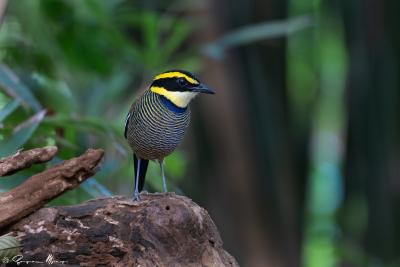
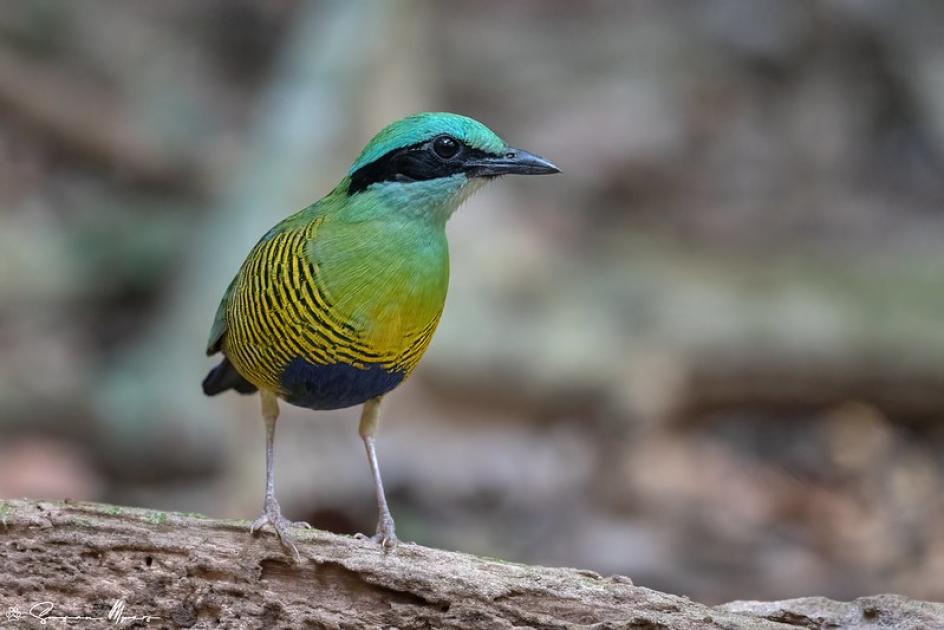
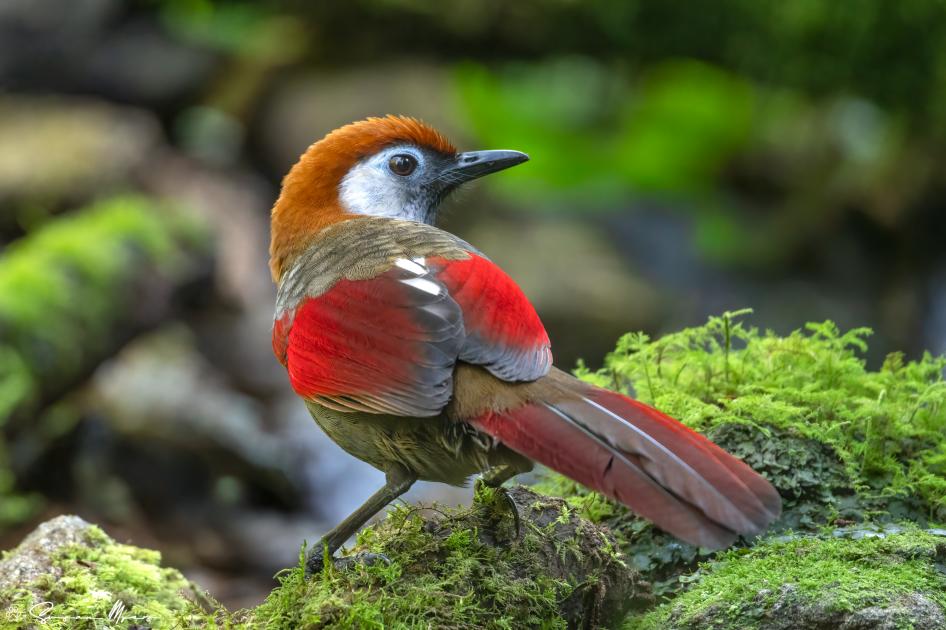
Days 2-3: After an early breakfast on Day 2 we’ll depart Hanoi for Cuc Phuong National Park, an area of limestone hills covered in primary rainforest and the first national park to be established in Vietnam. We’ll have two full days to explore the park, where we hope to see such special birds as Bar-bellied and Blue-rumped Pittas, Silver-breasted Broadbill, White-tailed Flycatcher, White-winged Magpie, Ratchet-tailed Treepie, Rufous-throated Fulvetta, Annam Limestone Wren-Babbler, Fujian Niltava, and Pied Falconet. At some stage we’ll visit Van Long Nature Reserve where we’ll take a sampan to the dramatic limestone cliffs that are home to the largest population of one of Vietnam’s most beautiful of its many endangered primates, the Delacour Langur. Various waders, herons, bitterns, and raptors are often seen here as well. Nights at the Park Headquarters guesthouse.
Day 4: We’ll have a bit of time for early morning birding at Cuc Phuong before heading south overland to the small central Vietnam town of Phong Nha. The town is the jumping off point for access to the scenically stunning Phong Nha-Ke Bang National Park, a UNESCO World Heritage Site renowned for its extensive cave systems and rugged limestone karsts. Night at Phong Nha-Ke Bang National Park.
Day 5-6: We’ll have a full day to explore Phong Nha-Ke Bang National Park in search of such limestone specialists as the near-endemic Sooty Babbler and Limestone Leaf-warbler. The scarce and rarely seen Red-collared Woodpecker is also possible, as is another scarce endemic primate, Ha Tinh Langur. The birdlife is active and exciting, and the large mixed flocks often contain some very glamorous species: Sultan Tit is common, and the elusive Short-tailed Scimitar-Babbler and Purple Cochoa are sometimes seen. This afternoon we’ll visit the world-renowned cave system; Phong Nha Cave is the second largest in the world (the first and third largest are found deeper within Phong Nha National Park) and a short boat trip and walk deep inside the cave is an unforgettable experience. Night in Phong Nha.
Day 7: After early morning birding back at Phong Nha National Park, we’ll depart for the long drive south to the Sa Mu Pass located in the Bac Huong Hoa Natural Area. We’ll have the afternoon and full day tomorrow to explore this little-known site, located right on the Laos border and in the narrowest part of Vietnam. This lovely, forested area in the center of the Annamite Mountains range is home to several Vietnamese and regional endemics, including Red-vented Barbet, White-winged Magpie, and Blyth’s Kingfisher (very rare). But our most wanted birds will be range-restricted Central Vietnam specialities: Red-collared Woodpecker, Black-crowned Barwing, and Rufous and White-cheeked Laughingthrushes. Night in Khe San.
Day 8: Other spectacular birds here include Golden Babbler, Silver-eared Mesia, Ratchet-tailed Treepie, Indochinese Green Magpie, Black-throated and Lesser-necklaced Laughingthrushes, and a distinctive subspecies, and possible future split, of Sultan Tit with a glossy blue-black crown. Red-shanked Douc Langur, a beautiful and endangered primate, is sometimes seen in the treetops below the summit trails. Later, we’ll drive further south to Lang Co on the coast where, after lunch, we’ll look for the recently described White-faced Plover. Night in Lang Co.
Day 9: After more birding and breakfast, we’ll leave Lang Co for the drive south to Ngoc Linh on the newly constructed Ho Chi Minh Highway. We’ll make birding stops en route and should arrive in the Ngoc Linh area in late afternoon. Night in Tu Mo Rông.
Day 10: Ngoc Linh Nature Reserve provides some of the best birding in Central Vietnam. It’s in the second highest mountain range in Viet Nam and is recognized as a Key Biodiversity Area, an Important Bird Area, and a Global Endemic Bird Area! There are many birding highlights here, among them the endemic Golden-winged and Red-tailed Laughingthrushes and more chances for Black-crowned Barwing, as well as Indochinese and Annam Golden-breasted Fulvettas, Coral-billed Scimitar-Babbler, Red-tailed Minla, and Ferruginous Flycatcher. Night in Tu Mo Rông.
Day 11: After a final morning’s birding in Ngoc Linh we’ll continue south down the Ho Chi Minh Highway to Mang Den, a quiet town located in Vietnam’s central highlands. A stop en route at a small wetland should be quite productive with possible sightings including Wire-tailed Swallow, Grey-breasted Prinia, or White-browed Crake. Night in Mang Den.
Day 12: We’ll have a full day at Mang Den, where the seldom-seen and exceptionally shy endemic Chestnut-eared Laughingthrush, discovered in 1999 and seen by only a handful of birders, will be our main quarry. Just a few kilometers from the town, we’ll explore a large area of excellent montane forest, the most reliable site in Vietnam for four other scarce birds: Indochinese Barbet, Clicking Shrike-Babbler, Yellow-billed Nuthatch, and Black-hooded Laughingthrush. In the evening, we may find Grey Nightjar right outside our hotel! Night in Mang Den.
Day 13-14: We’ll have a second morning’s birding at Mang Den before taking the scenic drive further west to Yok Don National Park, arriving in time for a late lunch and afternoon birding. This recently declared national park borders the Mondulkiri Protected Area in Cambodia and constitutes one of the largest areas of protected lowland forest in Southeast Asia. The habitat is a mosaic of deciduous and semi-evergreen forest interspersed with small patches of rainforest. Specialties here include the scarce White-rumped Falcon, Collared Falconet, several woodpeckers including the beautiful Black-headed, Rufous Treepie and the curiously named Neglected (Burmese) Nuthatch. Not surprisingly, it’s considered one of the most biodiverse areas of Vietnam, and a number of species that have disappeared elsewhere in the region can still be found here. Nights at Yok Don National Park HQ.
Day 15: After an early breakfast we’ll cross the Srepok River to bird in and around the Yok Don Botanical Gardens. We’ll leave Yok Don mid-morning for the drive to Da Lat, stopping en route for lunch and, if time permits, some birding. Night in Da Lat.
Days 16–17: We have two full days to explore the excellent birding sites around Da Lat. In the Ta Nung Valley, a small but bird-filled area of remnant evergreen forest about 6 miles (10 km) from Da Lat, we’ll look for the rare and endemic Grey-crowned Crocia as well as White-cheeked Laughingthrush. The distinctive subspecies of Blue-winged Minla, Rufous-backed and Black-headed Sibias, and Black-throated Sunbird can also be found here.
In addition to the wonderful Ta Nung Valley, two other sites around Da Lat are well worth visiting: Mount Lang Bian and Bi Doup National Park. Mount Lang Bian is a 6700-foot peak about 20 minutes by road from Da Lat, and we’ll spend a day exploring its pine and montane evergreen forests. Our target species here include wintering Mugimaki Flycatcher, Grey-crowned Tit, Vietnamese Cutia, Black-crowned Fulvetta, and Vietnamese Greenfinch. Bi Doup National Park is another wonderful birding area where we might find Burmese Shrike, Slender-billed Oriole, Indochinese Cuckooshrike, and Vietnamese Crossbill, among many others. The evergreen forests here hold one of the most sought-after species on the Da Lat Plateau, the beautiful, endemic and very secretive Collared Laughingthrush. We’ll also appreciate Da Lat’s cooler climes, its old French colonial architecture, and the numerous outdoor cafes, restaurants, and markets. Nights in Da Lat.
Day 18: This morning we’ll make the two hour drive to Di Linh. Descending from the plateau, we’ll pass by a virtual mosaic of rubber, teak, tea, and coffee plantations, as well as fascinating Vietnamese architecture. The forested mountain pass known as Deo Suoi Lanh is an ideal site to look for several Da Lat Plateau specialties, including Black-hooded and White-cheeked Laughingthrushes and the near-endemic Black-crowned Parrotbill. We may also find the gorgeous Blue Pitta. We’ll continue onward from the pass to arrive at Cat Tien National Park in the late afternoon. Night at Cat Tien headquarters.
Days 19-21: Cat Tien National Park contains the largest remaining area of lowland tropical forest in southern Vietnam. We’ll have an amazing three full days around the park. More than 330 bird species have been recorded here, including the endangered Germain’s Peacock-Pheasant, Green Peafowl, and the very elusive Orange-necked Partridge. The list of mammals includes Eurasian Wild Pig, Sambar, Red Muntjac, and Gaur (very scarce, although increasing in numbers) as well as two endangered primates, Black-shanked Douc Langur and Buff-cheeked Gibbon.
Over the next three days we’ll take jeeps to visit areas around the park such as Heavens Rapids and Crocodile Lakes, where Grey-headed Fish-Eagle and Lesser Adjutant may be seen. We’ll visit two hides, one of which is great for Blue-rumped and Bar-bellied Pittas while the other offers the best opportunity to see and photograph two spectacular pheasants: Germain’s Peacock-Pheasant and Siamese Fireback, as well as Scaly-breasted (Green-legged) Partridge. We’ll spend much of our time birding along the quiet park road (only park vehicles and bicycles are allowed), which is always excellent for birds. We should find Red-and-Black and Banded Broadbills, Orange-breasted Trogon, White-bellied, Great Slaty, and Black-and-buff Woodpeckers, Red-vented Barbet, and Grey-faced Tit-Babbler among many others. Nights at Cat Tien headquarters.
Day 22: We’ll have a last morning of birding in Cat Tien National Park before driving back to Ho Chi Minh City for our final dinner. Night in Ho Chi Minh City.
Day 23: The tour concludes this morning in Ho Chi Minh City with transfers to Tan Son Nhat International Airport for flights home.
Note: The information presented here is an abbreviated version of our formal General Information for this tour. Its purpose is solely to give readers a sense of what might be involved if they take this tour. Although we do our best to make sure that what follows here is completely accurate, it should not be used as a replacement for the formal document which will be sent to all tour registrants, and whose contents supersedes any information contained here.
ENTERING VIETNAM: A passport valid for at least six months beyond your date of entry and with at least one blank page for an entry stamp. A Vietnamese visa is required and it can be obtained either online via E-visa, or a Vietnamese Embassy or Consulate prior to traveling to Vietnam. As of writing, UK travelers can enter Vietnam visa-free for up to 45 days.
Citizens of other countries may need a visa and should check with the nearest Vietnam embassy. If required by the embassy or visa-granting entity, WINGS can provide a letter for you to use regarding your participation in the tour.
COUNTRY INFORMATION: You can review the U.S. Department of State Country Specific Travel Information for Vietnam at https://travel.state.gov/content/travel.html. Review foreign travel advice from the UK government here: https://www.gov.uk/foreign-travel-advice and travel advice and advisories from the Government of Canada here: https://travel.gc.ca/travelling/advisories.
PACE OF TOUR AND DAILY ROUTINE: The tour is a relatively strenuous one and requires a good degree of fitness due to the high temperatures in the south, some longish walks and a moderate amount of ascent and descent. Some days may involve some longer walks, however most walking is fairly easy and will include plenty of stops for birding. Some uphill and cross-country walking is required in the sites around Da Lat, as well as Ngoc Linh in the center.
Our birding days will normally begin around 6:00 a.m. with a quick early breakfast before birding. Some days we might take a light, packed breakfast. Bird activity usually drops off by 11:00 a.m. and lunch would normally be taken at the park headquarters, hotel or nearby restaurant followed by a short break before resuming birding around 2:30-3:00 p.m. until 6:00 p.m. or dusk (depending on weather conditions). There are some three/four hour drives and one long drive of around six to eight hours, depending on road conditions.
HEALTH: The Centers for Disease Control and Prevention (CDC) recommends that all travelers be up to date on routine vaccinations. These include measles-mumps-rubella (MMR) vaccine, diphtheria-tetanus-pertussis vaccine, varicella (chickenpox) vaccine, polio vaccine, and your yearly flu shot.
They further recommend that most travelers have protection against Hepatitis A and Typhoid. Please contact your doctor well in advance of your tour’s departure as some medications must be initiated weeks before the period of possible exposure.
The most current information about travelers’ health recommendations can be found on the CDC’s Travel Health website at http://wwwnc.cdc.gov/travel/destinations/traveler/none/vietnam.
Malaria: The CDC recommends a malaria preventative. Please consult your physician.
Elevation: Our highest elevation will be at Tam Dao where we will be birding at 930 m/3050 ft. Elsewhere our birding will be in the lowlands or foothills.
Smoking: Smoking is prohibited in the vehicles or when the group is gathered for meals, checklists, etc. If you are sharing a room with a nonsmoker, please do not smoke in the room. If you smoke in the field, do so well away and downwind from the group. If any location where the group is gathered has a stricter policy than the WINGS policy, that stricter policy will prevail.
Insects: The abundance of biting insects varies from year to year and place to place. Generally biting insects are not numerous although mosquitoes and leeches occur locally. A can of spray repellent should provide adequate protection.
Miscellaneous: At the time of our visit there should not be any terrestrial leeches present but there is always a small risk we could encounter a few.
CLIMATE: Unlike much of Southeast Asia, Vietnam’s climate is complex and varied. It is a mix of humid tropical, sub-tropical, and cool at the respective locations. Our tour takes place during the spring in North Vietnam and during what is the dry season in South Vietnam. Daytime temperatures are likely to be in the range 30-35°C (86-95°F) in the south and 20°C-25°C (68-77°F) around Da Lat. At Tam Dao, situated at 930 metres, and Cuc Phuong, night time temperatures may drop to 5°C (40°F), whilst daytime temperatures are likely to be around 8°C-14°C (47-57°F). In the north we may encounter some rain at times and colder temperatures.
ACCOMMODATION: In the north we stay at national park accommodations at Cuc Phuong. The accommodation is in simple rooms at the park headquarters with air-conditioning, private bathroom facilities and hot water, while at Phong Nha, Khe Sanh, Mang Den and Da Lat we use comfortable hotels in the respective towns. The accommodations at Tu Mo Rung and Yok Don are basic but clean with private bathrooms. At Cat Tien National Park the accommodations are similar to those at Cuc Phuong National Park.
WiFi, Internet and Cell Phones: Internet access is generally available in almost every corner of the world, and Wi-Fi is increasingly common in hotels, airports, restaurants and cafes. In the hotels in the main towns free Wi-Fi is generally available. Most require a password, which we’ll receive on check-in.
Cell phones can be useful while on tour but keep in mind that many countries operate on a different cellular technology than US or Canadian carriers. Your phone may be incompatible with the local system, so please check with your local carrier.
FOOD: Vietnam is rightly famous for its delicious and healthy cuisine. Rice is, of course, the staple, and most Vietnamese eat it at every meal. Breakfasts often consist of bread or noodles, though. Our meals will vary from quite fancy to fairly simple, depending on our location, but always tasty. As is the custom throughout much of Asia, a variety of dishes will be placed on our table by our hosts, and the group will share the meal. Usually, we will have two or three vegetable dishes and one or two meat dishes, generally chicken or pork. Meals are eaten with chopsticks in Vietnam, but a fork and spoon can usually be provided if preferred. In the cities, Western food can be found for variety, and the French-style Vietnamese bread is delicious and ubiquitous.
Food Allergies / Requirements: We cannot guarantee that all food allergies can be accommodated at every destination. Participants with significant food allergies or special dietary requirements should bring appropriate foods with them for those times when their needs cannot be met. Announced meal times are always approximate depending on how the day unfolds. Participants who need to eat according to a fixed schedule should bring supplemental food. Please contact the WINGS office if you have any questions.
Drinks: Bottled water and/or a soft drink or a beer is provided at lunch and dinner, as is coffee or tea. Bottled water is provided in our vehicle during the day. Personal drinking water for use in your room is the responsibility of the individual.
TRANSPORTATION: Ground transportation is by air-conditioned bus. We will take a short boat trip in shallow waters at one site near Cuc Phuong. Participants should be able to ride in any seat in tour vehicles and are expected to change seats with others daily.
Vietnam Tour Routing
We can't render google maps without your cookie consent. To see the map, please reset your cookies, then accept all, then reload this page.
2026 Narrative
Our Vietnam adventure began with a group assembly at our hotel, followed by a welcome briefing and delicious dinner. Spirits were high as participants settled in, ready for the diverse avifauna and rich landscapes that lay ahead.
Our first full day of birding took us to Van Long Wetland Reserve, a scenic site characterized by dramatic limestone karsts and tranquil wetlands. At 3,000 hectares, this is the largest wetland reserve in northern Vietnam, and in 2017, it was designated as Vietnam’s ninth Ramsar site. While our primary target here was the endangered Delacour’s Langur, birding from traditional sampans with two to a boat, also produced sightings of Asian Openbills, Cinnamon Bittern, and the first of many handsome Chinese Pond-Herons. Our close-up sighting of the endangered primate was without doubt the highlight of our morning, though!
Following lunch, we transferred to Cuc Phuong National Park. Vietnam’s oldest national park, Cúc Phương National Park, established in 1962, is Vietnam’s first and one of its most significant national parks. Officially recognized by President Hồ Chí Minh himself, he visited the park and emphasized the importance of forest conservation for future generations. It is also the home to several key conservation facilities: the Endangered Primate Rescue Center (est. 1993), the Turtle Conservation Center and the Carnivore and Pangolin Conservation Program. On arrival, we began birding along the entrance road, where highlights included Green-eared Barbet, Rufescent Prinia, and plentiful Plain Flowerpeckers and Crimson Sunbirds.
The next two days were focused on the forests around Bong Substation. Roadside birding and trail walks were productive, with Red-vented Barbet, Streaked Spiderhunter, and, albeit not the best view, our hoped-for Annam Limestone Babbler added to our growing list. One morning, as we were driving up to Bong, we were delighted to spot an elusive Malayan Night-Heron. We also had excellent looks at the regionally restricted Fork-tailed Sunbird, Rufous-throated Fulvetta, and Hainain Blue-Flycatcher among other specialties.
Given how slow the birding was (due to the El Niño affected heatwave), we decided to cut our stay short by a day and move up our visit to our next destination, Phong Nha. On our final morning in Cuc Phuong, we explored the Botanic Gardens near the park headquarters. Birding was slow, but we did turn up a few notable sightings, including Spot-necked Babbler. We then departed on the long journey to Phong Nha, arriving late in the day.
The spectacular Phong Nha National Park offers a blend of karst forest and hill country habitats. The reserve is a UNESCO World Heritage Site located in central Vietnam; covering over 123,000 hectares, the park is renowned for its extensive limestone karst landscapes and vast cave systems, as well as its outstanding biodiversity. Sadly, during the Vietnam War, Phong Nha-Kẻ Bàng National Park was subjected to extensive bombing and defoliation, including the use of Agent Orange. The ecological impact of Agent Orange was profound, and the effects are still clearly visible to this day. Nevertheless, our birding was excellent! Our main target, the localized Sooty Babbler, initially eluded us, although we did enjoy excellent views of the fascinating Square-tailed Drongo-Cuckoo, many Black-winged Cuckooshrikes, gorgeous Sultan Tits, and a host of different varieties of bulbul feeding on a feast of figs.
A boat excursion to the astounding Phong Nha Cave, one of the longest caves in the world, stretching for 8 kilometers boasting spectacular limestone formations, including stalactites and stalagmites, added scenic interest. We returned the next morning and successfully located the Sooty Babbler, alongside the charismatic White-winged Magpie, Ratchet-tailed Treepie and others.
Our journey continued northward with a stop at Sa Mu Pass, where Necklaced and Moustached Barbet, Silver-eared Mesia, Golden Babbler and Orange-bellied Leafbird were among the highlights. The best sighting, however, was our much hoped-for group of Rufous-cheeked Laughingthrushes. The following day at the pass was equally productive with views of White-browed Shrike-Babbler, Yellow-bellied Warbler and Collared Owlet.
Our next destination was the Lang Co area for coastal birding. And the next morning on the beach near our hotel, we successfully found a distinctive White-faced Plover at a quieter stretch of shoreline, as well as Masked Laughingthrush in the coastal scrubland.
Inland travel resumed with a full day’s drive to Tu Mo Rong, punctuated by a productive birding stops for Plumbeous Redstart, House Swifts and others.
The remote reserve of Ngoc Linh, recognized as one of Vietnam's four most important biodiversity hotspots, was a major highlight of the tour. After a steep and challenging hike, we reached the hide and were rewarded with outstanding views of the highly sought-after Red-tailed Laughingthrushes, not to mention Brown-crowned Scimitar-Babblers (the gangsters), Black-headed Sibias and the handsome Rufous-gorgeted Flycatcher and Rufous-capped Fulvetta. A walk to a nearby bridge was very rewarding as we spotted beautiful Yellow-cheeked Tits, the endemic Black-crowned Barwings we’d been hoping for, and Green-tailed Sunbirds. The afternoon birding at nearby Ngoc Lay was a little slower but did produce Indochinese Barbet, Mountain Bulbul, and the very cute Black-throated Tit.
From Tu Mo Rong, we proceeded to Mang Den, which is located in Kon Tum Province, and at an altitude of approximately 1,200 meters above sea level, it boasts a cool, temperate climate year-round, earning it the nickname "the second Da Lat". Thanks to its pleasant climate and scenic vistas it is a popular destination among domestic travelers but is yet to be discovered by international tourists. On arrival, we soon headed to Ba Xi Waterfall for our afternoon birding where we found plentiful Indochinese Barbets, White-winged Magpies, Kloss’s Leaf Warblers, and Blue-winged Minlas.
A targeted search for Chestnut-eared Laughingthrush in Mang Den was unsuccessful—likely due to nearby roadworks—but we made up for it with sightings of Clicking Shrike-Babbler, Yellow-billed Nuthatch, and Black-hooded Laughingthrush. We were very pleased to find cooperative Pale-blue Flycatchers and Indochinese Cuckooshrike. Finally, a brief return visit to the nearby Dak Ke Bridge was rewarded with sighting of the scarce Pin-tailed Green-Pigeon, Bay Woodpecker and Black-eared Shrike-Babbler.
We made a brief stop at Dak Ke Bridge, spotting Black-collared Starling and Vinous-breasted Starling, before continuing to Yok Don National Park.
Despite the high heat, the birding at Yok Don, with its unique dipterocarp forest ecosystem was fruitful indeed!
The reserve is characterized by lowland dry forest studded with seasonal pools as well as semi-evergreen forest along watercourses. From our park accommodation we crossed the Srepok River, a major tributary of the Mekong and entering the forest we enjoyed some of our best birding of the trip. Over two days we encountered some fantastic birds including Burmese (Neglected) Nuthatch, Coppersmith and Lineated Barbets, Crested Treeswift, Asian Barred Owlet, Eurasian Hoopoe, Rufous Treepie, and Common Woodshrike. Woodpeckers abound here and we found seven species in this reserve alone – Black-headed and Great Slaty Woodpeckers were the undoubted stars of the show!
The journey to Da Lat included a successful stop for Grey-crowned Crocias at Dam Rong. This Da Lat Plateau endemic was thought to be extinct until it was rediscovered in 1994 by a Birdlife International team, so this was indeed a significant sighting for us! Later, we were to enjoy even better views in the nearby Ta Nung Valley.
Da Lat, often dubbed “the City of Eternal Spring,” is a charming hill station city in Vietnam’s Central Highlands, known for its cool climate, pine forests, colonial architecture, and flower gardens. A very popular destination for locals and overseas visitors alike, it’s especially popular during summer as a cool escape from the heat of the lowlands. Located on the Đà Lạt Plateau, part of Vietnam’s Central Highlands, is one of the country’s most important regions for avian biodiversity. Stretching across Lâm Đồng Province and into neighboring areas, the plateau features high-elevation pine forests, montane evergreen forests, and misty valleys — habitats that support a suite of endemic and near-endemic bird species.
Located just north of Da Lat, we headed to Bi Doup National Park, with a short stop for the fabulous Vietnamese Cutia, before heading to a pair of strategically located forest hides. To our delight, immediately upon our arrival at the hide a family of spectacular Silver Pheasants appeared, along with White-browed Scimitar-Babblers, White-tailed Robins, and Large Niltavas. We were even more delighted when our patience was rewarded with a visit from a truly stunning Blue Pitta, soon followed by an exceptionally cute Grey-bellied Tesia! Later, we relocated to another hide where we were immediately greeted by a raucous group of Collared Laughingthrushes, to cap off one of our best mornings of the trip.
After a delicious lunch at a small café operated by the local indigenous K’ho and Chiru people (and surprisingly good coffee!) we returned to a different hide in the Bi Doup area, which was a little quieter, given the time of day, but still rewarded us with sightings of Lesser Shortwing amongst others.
The following day we headed to nearby Ta Nung Valley where we added Hill Prinia, White-cheeked Laughingthrush, Long-tailed Broadbill and Vietnamese Greenfinch to our ever-growing list. We also visited a known site for Dalat Bush Warbler, which was seen very briefly. A brief stop in the pine forest at our lunch spot at Datan La Waterfall was worthwhile with sightings of Orange-headed Thrush, Chestnut-vented Nuthatch and Green-backed Tit.
The final leg of the tour brought us to the fabulous Cat Tien National Park. This UNESCO Biosphere Reserve has an area of about 720 km² and protects one of the largest areas of lowland tropical forests left in Vietnam. Although large swathes of the park were damaged by defoliants during the war, much of the forest in the park is still in (or close to) pristine condition. Almost immediately on arrival we set out birding and it quickly became apparent how great this park is, with some very high-quality sightings – Viole(n)t Cuckoo, Heart-spotted Woodpecker, and Golden-fronted Leafbird were all very exciting finds.
We utilised two hides that are managed by the park authorities – one is known as the pitta hide, the other as the pheasant hide. Our visits to the pitta hide were a huge success with appearances by stunningly colorful Bar-bellied Pitta and its drabber, but equally exciting, cousin, the Blue-rumped Pitta. In between pittas, plenty of other forest denizens put in appearances; amongst them Puff-throated Babbler, Indochinese Blue-Flycatcher and Greater Racket-tailed Drongo. At the pheasant hide, a handsome Siamese Fireback almost immediately made an appearance – we couldn’t believe our luck given the bird had not been seen for many days before our visit. Not to be outdone, a pair of Germain’s Peacock-Pheasants also graced us with their presence.
One afternoon we did a safari drive to the grasslands in the south of the park where we were thrilled to find a family group of the wonderful Green Peafowl with chicks, as well as some adult males; we also spotted White-throated Kingfisher, Blue-winged Pitta, and Large Woodshrike. Further explorations along the main road and the Heaven Rapids Road turned up more excitement with Orange-breasted Trogon, Blue-bearded Bee-eater, Green-billed Malkoha and Great Slaty Woodpecker being particularly memorable.
This extensive birding expedition through Vietnam encompassed a wide array of habitats, including wetlands, coastal plains, montane forests, and tropical lowlands, resulting in the observation of many of the country's most sought-after species. We recorded over 300 species, which is an excellent outcome for this region. I extend my sincere gratitude to everyone who participated in this remarkable journey. Special thanks are due to Trong for his exceptional company, organizational skills, and keen birding eye. Additionally, I appreciate Thú for his exemplary driving abilities and sharp observational skills.
Some more of my photos of birds and other wildlife can be seen here: https://flic.kr/s/aHBqjCSJQK
- Susan Myers
Maximum group size eight with one leader and a local guide.
More Tours with these Leaders