Mexico: Oaxaca and Western Chiapas
-
Feb - Mar, 2028
Steve Howell
Tour Price to be Determined


Tour Price to be Determined
Oaxaca and Western Chiapas comprises one of the richest areas of bird endemism in Mexico: the Isthmus of Tehuantepec. The region’s unique blend of species are a reflection of its location at the point where the Nearctic faunal realm meets the Neotropics. South of the Isthmus, for example, there are no more chickadees or nuthatches, two bird families very much part of the temperate northern avifauna, but diversity shoots up in terms of antbirds and tyrant flycatchers, two families centered in the Neotropics.
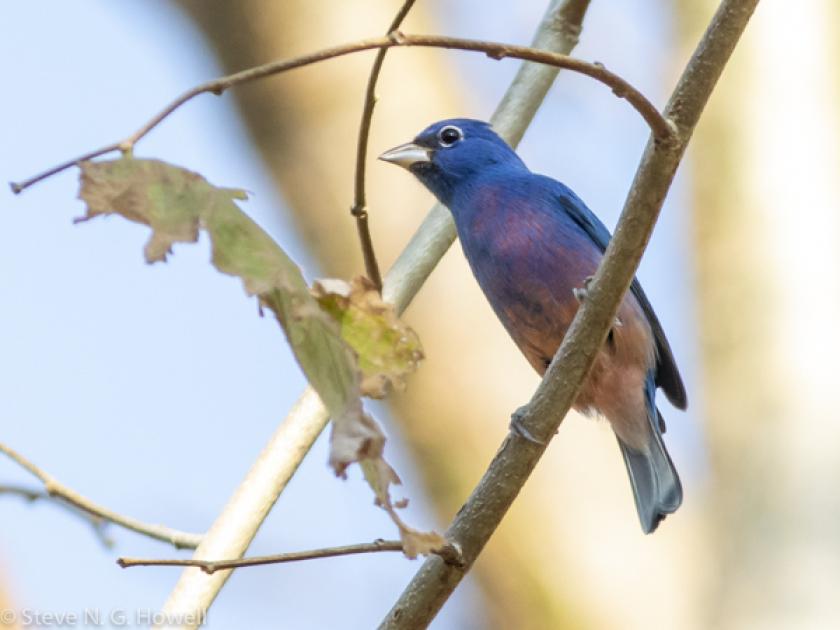
We’ll start in Tuxtla Gutiérrez, a modern city and the state capital of Chiapas, which lies within easy driving distance of habitats ranging from arid scrub to rain forest and the humid pine-oak highlands. We’ll head next to Arriaga, on the Pacific side of the Isthmus, and then move west and north to end in Oaxaca City, a time-honored favorite of birders and travelers. Within a short distance of Oaxaca City, we’ll explore habitats ranging from cool montane forest to arid scrub, each with its own suite of birds. Birds along the route run the gamut from the elusive Lesser Ground-Cuckoo and Giant Wren (as big as a Dwarf Jay!) to the electrically colored Rosita’s Bunting and the little-known Nava’s Wren.


Day 1: The trip begins at 6 p.m. this evening in the lobby of our Tuxtla Gutiérrez hotel. Night in Tuxtla Gutiérrez.
Days 2-4: Sumidero Canyon National Park, just north of Tuxtla, is where the Grijalva River dramatically cuts its exit from the central valley of Chiapas to drain eventually into the Gulf of Mexico. We’ll devote most of two days to this superb area, whose birds include Lesser Roadrunner, a variety of hummingbirds, Ash-throated, Nutting’s, Brown-crested, and Belted Flycatchers, Blue-and-white Mockingbird, Red-breasted Chat, Yellow Grosbeak, the rare bamboo specialist Blue Seedeater, and the poorly known Bar-winged Oriole. We’ll explore as well other areas in the vicinity of Tuxtla, among them Atlantic Slope rainforest where we may find the very local Nava’s Wren, and highland pine-oak forest, home to birds such as Unicolored Jay, Golden-browed Warbler, Garnet-throated Hummingbird, and the sometimes elusive Pink-headed Warbler. We’ll also visit the world-famous Tuxtla Gutiérrez zoo, where many of the region’s birds and mammals roam freely in a large native forest enclosure. Nights in Tuxtla Gutiérrez.
Day 5: We’ll drive inland to Arriaga, on the Pacific slope of the Isthmus, beginning in Atlantic Slope rainforest before winding down through foothills that are home to one of Mexico’s most localized endemics: the stunning Rosita’s Bunting, named in honor of the wife of François Sumichrast, the pioneering Swiss naturalist who resided on the Isthmus for many years in the late 1800s. Other birds in the area include Canivet’s Emerald, Orange-breasted Bunting, and Stripe-headed Sparrow. Night in Arriaga.
Day 6: We’ll explore nearby coastal lowlands, where birds can include a variety of wintering migrants as well as a suite of resident species such as the amazing Giant Wren, bounding flocks of Orange-chinned Parakeets, and the handsome Spot-breasted Oriole. Numbers of waterbirds vary from year to year, but we expect to see a good range of herons, Magnificent Frigatebird, and at least a few shorebirds and terns. Night in Arriaga.
Day 7: We’ll spend another morning birding near Arriaga or Puerto Arista, depending on what species we’re missing. After lunch we’ll head to Tehuantepec and look for Sumichrast’s (or Cinnamon-tailed) Sparrow, the secretive Lesser Ground-Cuckoo, and the spectacular White-throated Magpie-Jay. At dusk we may offer an owling option. Night in Tehuantepec.
Day 8: It’s a travel day but a spectacular one, driving through diverse cactus desert from the heat of Tehuantepec up to the temperate Oaxaca Valley. Birds change accordingly, from Ferruginous Pygmy-Owl and Russet-naped Wren to Gray-breasted Woodpecker and White-throated Towhee. The drive is often good for hummingbirds, and we’ll look especially for the endemic Turquoise-crowned (Doubleday’s) Hummingbird. Night in Oaxaca.
Days 9-11: We’ll spend three days visiting habitats within an easy drive of our hotel, investigating the avifauna in a range of habitats at the southern end of the Nearctic region. In cool, bromeliad-laden pine forests we’ll seek the increasingly scarce Dwarf Jay and the stunning Red Warbler, while in oak and desert scrub we’ll look for species ranging from Beautiful Hummingbird to Ocellated Thrasher. Other species around Oaxaca include Pileated Flycatcher, Mexican Chickadee, Brown-backed Solitaire, Gray-barred and Boucard’s Wrens, Slaty and Dwarf Vireos, and, of course, the very local Oaxaca Sparrow. Nights in Oaxaca City.
Day 12: The trip concludes this morning in Oaxaca City.
Note: The information presented below has been extracted from our formal General Information for this tour. It covers topics we feel potential registrants may wish to consider before booking space. The complete General Information for this tour will be sent to all tour registrants and of course supplemental information, if needed, is available from the WINGS office.
ENTERING MEXICO: U.S. citizens traveling to and from Mexico must have a passport, valid for at least six months after the date the tour ends, or another secure, accepted document to re-enter the United States. Citizens of other countries may need a visa and should check their nearest Mexican embassy.
COUNTRY INFORMATION: You can review the U.S. Department of State Country Specific Travel Information here: https://travel.state.gov/content/travel.html and the CIA World Factbook here: https://www.cia.gov/the-world-factbook/. Review foreign travel advice from the UK government here: https://www.gov.uk/foreign-travel-advice and travel advice and advisories from the Government of Canada here: https://travel.gc.ca/travelling/advisories.
PACE OF THE TOUR: We will try to be in the field at dawn or shortly afterward. Most birding sites are about 30 to 60 minutes from the hotels; the longest day is our drive from Tehuantepec to Oaxaca City, which takes most of the day (with birding stops and lunch en route). Most or all breakfasts will be picnic-style in the hotel parking lot or in the field, usually between 5:00 and 6:00am. Some lunches will be picnic and most will be in restaurants. All dinners, except perhaps one when we may go owling in the mountains near Oaxaca City, will be in restaurants. On several days we plan an afternoon break (siesta) after lunch, when it will be too hot for enjoyable or productive birding.
Birding in and around the Valley of Oaxaca is at 5,000 feet elevation and, other than uneven ground and a few narrow, scrubby trails, the walking presents no particular problem. We will also venture up to over 9,000 feet in the mountains of Chiapas and Oaxaca, where we will be birding on dirt roads and not in any rush. Near Tehuantepec and Arriaga we may be on narrow trails in thorn forest and at El Sumidero we will be birding mostly from a paved road.
We spend a good amount of time on our feet, although most distances are relatively short. We may walk up to 2 miles at a time, but at a slow birding pace with plenty of stopping and standing. Most of the terrain is relatively flat, with a couple exceptions: we will likely walk up several stretches of steeper roads near San Cristobal and Oaxaca. Some participants might find a folding stool useful to take a quick break while we’re birding.
HEALTH: The Centers for Disease Control and Prevention (CDC) recommends that all travelers be up to date on routine vaccinations. These include measles-mumps-rubella (MMR) vaccine, diphtheria-tetanus-pertussis vaccine, varicella (chickenpox) vaccine, polio vaccine, and your yearly flu shot.
They further recommend that most travelers have protection against Hepatitis A and Typhoid. Please contact your doctor well in advance of your tour’s departure as some medications must be initiated weeks before the period of possible exposure.
The most current information about travelers’ health recommendations can be found on the CDC’s Travel Health website here: https://wwwnc.cdc.gov/travel/destinations/list
Malaria: It is the opinion of the Centers for Disease Control that travelers to the Mexican states of Oaxaca and Chiapas are at low risk for malaria. You should consult further with your doctor about the CDC’s recommendation and what action you should take.
Altitude: We reach maximum elevations of about 9,000 feet in the mountains of Chiapas and Oaxaca. The Valley of Oaxaca is everywhere about 5,000 feet.
Smoking: Smoking is prohibited in the vehicles or when the group is gathered for meals, checklists, etc. If you are sharing a room with a nonsmoker, please do not smoke in the room. If you smoke in the field, do so well away and downwind from the group. If any location where the group is gathered has a stricter policy than the WINGS policy, that stricter policy will prevail.
Miscellaneous: Insects and arachnids are seldom a major nuisance although chiggers and biting gnats can be locally numerous.
We have found that with careful eating habits, intestinal problems can be largely avoided. In most of Mexico, it is unwise to drink untreated water. Bottled water and soft drinks are reliable and widely available.
CLIMATE: Overall the weather should be warm (70s to 90s F) and dry (inland) to humid (near the coast), although often cool (40s F) in the early mornings, especially around Oaxaca City. For our one morning near San Cristobal, it can be very cold to start (sometimes near freezing!), but usually warming up to comfortable temperatures by mid-morning. If you’re sensitive to cold, it is worth packing a hat and gloves for this morning. The high temperatures near Puerto Arista and Arriaga could reach close to 100 F during the middle of the day. We rarely encounter rain except at El Ocote (which is rain forest), but light rain or mist is possible in some areas, especially at Cerro San Felipe.
ACCOMMODATIONS: We stay in comfortable hotels throughout the tour, with private bathroom facilities and restaurants. Wi-fi is available at all hotels but is often intermittent and, when it does work, not very fast, so it shouldn’t be relied upon for important communications.
FOOD: Food is of good quality with standard “Mexican” fare.
Food Allergies / Requirements: We cannot guarantee that all food allergies can be accommodated at every destination. Participants with significant food allergies or special dietary requirements should bring appropriate foods with them for those times when their needs cannot be met. Announced meal times are always approximate depending on how the day unfolds. Participants who need to eat according to a fixed schedule should bring supplemental food. Please contact the WINGS office if you have any questions.
TRANSPORTATION: Transportation is by 12-passenger or 15-passenger vans. Those who suffer from motion sickness should bring their preferred medication, as some drives involve distinctly winding roads. Tour participants should be able to ride in any seat in our tour vehicle(s).
We can't render google maps without your cookie consent. To see the map, please reset your cookies, then accept all, then reload this page.
2026 Narrative
From frosty-shawled Pink-headed Warblers to brilliant Red Warblers and from a confiding Nava’s Wren to garrulous Giant Wrens we traveled through southern Mexico on this remarkable tour. Migrants ranged from Golden-winged and Red-faced Warblers to streams of Swainson’s Hawks, exemplifying the diversity of species and habitats, while cryptic taxa such as the recently split Salvadoran Flycatcher showed that there is still much to learn in this region. One day we were in tropical scrub with White-throated Magpie-Jay and Russet-crowned Motmot, the next in humid montane forest with Garnet-throated Hummingbird and Bearded Screech Owl, the next in elfin oak forest with Belted Flycatcher and Blue Seedeater—and that afternoon in relict rainforest with Ornate Hawk-Eagle and Slate-colored Solitaire! Among many other highlights were those gaudy male Rosita’s and Orange-breasted Buntings, an amazing Lesser Ground Cuckoo, and a Fulvous Owl being mobbed by Mountain Trogons and Dwarf Jays. Our ten days of birding in southern Mexico produced well over 300 species, including 30 Mexican endemics and another 30 or so regional endemics, plus a great time with a fun group.
Our first morning we headed out to the spectacular Sumidero Canyon north of Tuxtla Gutierrez, and were joined by local biologist and guide Alberto Martinez. The day started with a classic near-silent dry season ‘dawn chorus’ but then awoke with spectacular White-throated Magpie-Jays, a perched Plain-capped Starthroat, and a flame-headed Streak-backed Oriole. Very hot and sunny weather meant we really had to work for the birds, which included several hummingbirds, a low-flying Zone-tailed Hawk, Peregrine Falcons in the chasm of the canyon, a handsome male Blue Bunting, and a female Bar-winged Oriole. After a picnic lunch and siesta we headed to the world famous Tuxtla Zoo, displaying only regional fauna and emphasizing environmental education. There were also plenty of birds outside the cages, notably Great Curassows, a Crested Guan, interacting Ferruginous Pygmy Owls, brilliant Altamira Orioles, and unbelievable views of numerous Russet-crowned Motmots.
The next day we headed east to San Cristobal, and a very different environment from Tuxtla, with humid pine-evergreen forest laden with bromeliads. The morning started with Rufous-collared Thrushes, Rufous-collared Sparrows, and a showy MacGillivray’s Warbler leaf-bathing, continued with a pair of huddling Bearded Screech Owls and noisy Unicolored Jays, and—finally, at the 11th hour —climaxed with the much sought-after Pink-headed Warbler. After a pleasant lunch in town we found a few more species, including Band-backed Wren, and an impressive mixed flock with Red-faced, Hermit, and Olive Warblers.
Our third day of birding featured another morning at Sumidero, then an afternoon in some Atlantic Slope rainforest now accessible ‘thanks’ to the building of a big new toll highway to Mexico City. Very different weather made for very different birding, starting with a bang in the form of a stunning male Red-breasted Chat, and then a very productive spot with Belted and Flammulated Flycatchers plus the poorly known Blue Seedeater. Continuing with a Blue-and-white Mockingbird, an elusive Highland Guan, a Middle American (née Vermiculated) Screech Owl at roost, and a streaming flight of Broad-winged Hawks emphasized how different two days can be at the same site! The afternoon was quite a contrast, starting with a screaming mob of Brown Jays harassing a spectacular Ornate Hawk-Eagle, which perched for scope views! New birds seemed to be everywhere, including a flock of Blue Ground Doves and—with no little effort—an amazing Nava’s Wren (described to science as recently as 1973).
After four days based out of Tuxtla we headed for the coast, via a very birdy morning at El Ocote, where the cloudy conditions kept things active. We started with the world’s most obliging Rufous-breasted Spinetails, and scope views of a Slate-colored Solitaire that poured forth his amazing song, followed by flocks swirling around in the roadside trees and cut-over edges. A Green Shrike-Vireo feeding alongside a male Golden-winged Warbler was memorable, along with Smoky-brown Woodpeckers, Barred Antshrikes, White-winged Tanagers... and it’s difficult to think of anywhere else in the world where one can find 7 wren species of 7 different genera in such a small area! After lunch and a siesta we headed into the dry forest foothills where we found some truly gorgeous Rosita’s (aka Rose-bellied) Buntings, along with a distant Great Swallow-tailed Swift and our only Collared Aracaris of the trip.
The next day we headed to the coastal lowlands near Puerto Arista, where birds kept coming thick and fast, starting with raucous feeding groups of Orange-fronted and Orange-chinned Parakeets, numerous colorful orioles, and an obliging pair of Giant Wrens collecting silk cotton from a huge kapok tree. The morning continued with Turquoise-browed and Russet-crowned Motmots, the recently split Salvadoran Flycatcher, and sundry flyover migrants including Scissor-tailed Flycatchers. After lunch and a siesta we headed back into the foothills above town where birds included Green-fronted Hummingbird, a nest-building pair of Great Black Hawks, more Rosita’s Buntings, and Nutting’s Flycatcher—making for five species of Myiarchus flycatchers in one day! A pre-dinner walk in town revealed the spectacle of thousands of Barn Swallows roosting on the wires, along with hundreds of Green Parakeets (among which we found a single Pacific Parakeet) and a roost of Gray-breasted Martins (among which we found a single male Purple Martin). All in all, quite the varied day!
A morning near the coast provided good diversity and very pleasant birding that featured point-blank nest-building Scrub Euphonias, distant White-bellied Chachalacas, a singing Stripe-headed Sparrow, a male Citreoline Trogon, very visible Painted Buntings, and a nesting pair of Double-striped Thick-knees. After lunch we loaded up and drove to Tehuantepec—or tried to... Our progress was halted (for 5+ hours!) in Santo Domingo Zanatepec by a local protest and road block (which had started at 8 am and ended at 5.15 pm, although backed-up traffic didn’t unclog till 6 pm....). Happiness is Plan B when traveling, however, and at least we were in the shade, in an air-conditioned vehicle (vs. 95 degrees outside!), plus next to a gas station with baños—and there was even a creek with some birds, including our first Sclater’s (aka Russet-naped) Wrens and a male Hooded Warbler. Finally freed from our plight, we made good time to the hotel in Tehuantepec, despite impressive buffeting winds through the wind-farm-infested isthmus of the same name.
An early start the next morning found us out in the thorn forest again, where birds included the very local Sumichrast’s (aka Cinnamon-tailed) Sparrow and Doubleday’s (aka Turquoise-capped) Hummingbird, plus stunning male Orange-breasted Buntings and that superb Lesser Ground Cuckoo! We then made the long, winding, and spectacular drive up to the Oaxaca Valley, lunching at a colorful restaurant with obliging Gray-breasted Woodpeckers and Boucard’s Wrens, followed by a detour to successfully find a vagrant Aplomado Falcon, seemingly the first record for Oaxaca Valley. Unlike last night, we reached our hotel with good time to check in and relax a little in our new home for the last four nights.
Our first full day in new surroundings revealed how much the birds had changed from those of the Chiapas highlands: Blue Mockingbird instead of Blue-and-white, Red Warblers instead of Pink-headed, plus the very local Oaxaca Sparrow and Oaxaca [Blue-gray] Gnatcatcher, colorful Elegant Euphonias nest-building, Gray Silkies bathing, and sundry ‘North American’ species that don’t make it across the Isthmus, such as Blue-throated Mountain-gem and Bewick’s Wren. Our morning at Yagul was a striking contrast, amid beautiful cactus desert and spectacular vistas from the ruins. Bird activity picked up as the sun hit, and species included Beautiful Hummingbird, handsome Bridled Sparrows, the understated Pileated Flycatcher and overstated Vermilion Flycatcher, plus the haunting songs of Canyon Wren. A stop in dry oak woodland produced a singing Ocellated Thrasher, plus a flashy Painted Whitestart (aka Redstart), before a delightful lunch along with good views of Berylline and Dusky Hummingbirds. After siesta we headed up to La Cumbre again, this time for a picnic dinner and some owling. A day’s end chorus of Brown-backed Solitaires, Black Thrushes, and Long-tailed Wood Partridges merged with the first Mexican Whip-poor-wills as night fell and the cold seeped in. First try—no luck with owls. Then, at the second stop, a Fulvous Owl called and flew in to show well over our heads—a great way to end another day of diverse Mexico birding.
The last full day we made another transect from the oak scrub slopes up into the high-elevation pine forest at around 9800 feet—and what a day it was, with numerous flocks and numerous great birds! We started with Audubon’s Orioles and Red-headed Tanagers; then Golden, Slaty, and Dwarf Vireos (of 8 vireo species during the day); migrant Red-faced, Black-throated Gray, and Grace’s Warblers; a tooting Mountain [Northern] Pygmy Owl; graceful but fleeting Great Swallow-tailed Swifts; a roosting Fulvous Owl being mobbed by Dwarf Jays and Mountain Trogons; that last-minute Chestnut-sided Shrike-Vireo; oh, and of course, those ‘pesky’ Red Warblers!
We then headed back to Oaxaca in time to rest and pack before a fine last night dinner. All in all a remarkable range of habitats and a great selection of birds—thanks to all for coming, and I’m sure we’ll meet again somewhere along the long and winding road of birding.
- Steve Howell
This is a superbly conceived and executed tour with an itinerary that provides an outstanding introduction to the birds and biogeography of this region. The pace was brisk, but the leaders succeeded in making sure that as many clients as possible saw (and heard) most of the key endemic and cryptic taxa that we encountered. This was achieved without the schedule becoming tiring or burdensome.
- Nick W. on Mexico: Oaxaca and Western Chiapas
Maximum group size seven participants with one leader; 10 participants with two leaders.
More Tours with these Leaders
Mexico: Veracruz
Migration is a Moving Experience
Migration is a Moving Experience
Sep 29 to Oct 7 2026 • Steve Howell and Roland Rumm