Brian Finch
Upcoming Tours with Brian
-
Kenya in November
Nov 15 to Dec 2 2026
3 spaces remain -
Uganda: Shoebills to Gorillas
Jun 14 to Jul 3 2027
2 spaces remain -
Madagascar
Sep 2027
-
Uganda: Shoebills to Gorillas
Jun - Jul, 2028
Brian Finch was born in the U.K., virtually popping out into the world with the binoculars already around his neck. During his early teens, while at Battersea Grammar School in London, he joined the Beddington Sewage Farm ringing group. The kindness of the older members (some of them as old as their mid- to late twenties) meant that he was taken under their wing and shown the wonders of birds a little farther afield. Schooling suffered badly, with truancy at too regular an interval when rare migrants turned up in southern England, and the hitchhiking thumb took over from the normal curricula. On weekends, he and a couple of other teenage neophytes would wash the car of the sadly missed Peter Grant, who was a true inspiration, for free lifts to Dungeness. Schooling suffered very badly; even during the “O” levels, the Swifts nesting under the eaves of the examination room were vastly more entertaining than the question paper in front of him. The results, not surprisingly, were a dismal failure, and it was decided that Brian would leave school at the early age of fifteen. This he did in familial disgrace, and took a job as a clerk in the civil service. This was not so easy to play truant from, but every week there was a day for further education—this was spent on a local common, and on Brian’s being discovered, sacking was the employer’s only option!
Next followed a career in banking and a move to Sussex, with Beachy Head on the doorstep. While here, Brian had a holiday in Canada, his first overseas trip, and became friends with another teenager in Hamilton, Ontario. In a rapid blue Mini (the family owned one red, one white, and one blue … very patriotic), he and Alan Wormington would tear about southern Ontario from one rarity to the next. The U.K. was not the same on his return, and wanderlust set in in a bad way; emigration to the “rels” in Australia was the only way out.
A £10 assisted-passage refugee left the shores of Old Blighty in April, making final landfall in Sydney in May. By a wonderful coincidence, this was the spring passage in the Northern Hemisphere and the autumnal passage in the Southern. This 30-day sea-watch, covering the greatest percentage of the world’s seabirds, was an amazing experience—finding Sabine’s Gulls all the way from Bay of Biscay to the Cape well before their wintering grounds were known, and seeing Barau’s Petrels at sea off the southwest Indian Ocean before the species was formally described some time later. Australia proved a great change, and as Brian fell in with the few but very competent Australian birders at the time. Out of this gang of four, one became chairperson of the Royal Australian Ornithological Union, and another discovered a new species in Australia (Eungella Honeyeater…. and it was also he who found a dead Night Parrot by his car!). So they were a good influence and his life changed, and a new career, credit management, was adopted. Success in this field led to becoming the credit manager of the largest plastics organization in the Southern Hemisphere, but after a trip to Papua New Guinea, more wanderlust set in on the return, this time for PNG.
An ad seeking a credit manager in a small company in Port Moresby was the stepping-stone to becoming the credit controller of the largest company in the country; in fact, it owned virtually half of it! All this time, the birding was so exciting, with so many discoveries in a country of endless wonder. Along with success in business, Brian became president of the Papua New Guinea Bird Society, a position he held for five years, all the while serving as editor and major contributor of the PNG Bird Society Newsletter, which blossomed from a double-sided monthly news sheet to a monthly 40-page journal, still retaining its modest title of Newsletter, prior to the launch of the journal Muruk.
Here another change was to step in: Peter Kaestner introduced Brian to windsurfing, which became an obsession, and a median had to be found between birding and boarding. In the same period, while scouting for the BBC’s World of Birds, finding and organizing the filming of that most famous of aired sequences, the display of the Black Sicklebill… (recorded for the first time), Brian met Jeffrey and Jorie Kent, owners of the worldwide Abercrombie & Kent. They became firm friends, and after twelve years of life in PNG, Brian left this life for an unknown one on the African continent. The irony was that his family had originated here, but he had never seen the country. Another irony being that the Princeton Field Guide "Birds of New Guinea," of which he was co-author, was not published until he was in Kenya, and the first copy he ever saw was given to him by Jorie Kent!
Starting out as a safari guide, Brian’s taking tourists out for a mammal experience became punctuated with cisticolas, not everyone’s cup of tea; but living in the Maasai Mara was idyllic. During this time he found himself birding and mammaling with many extremely well-known people, but it was not until the great Kenya Bird Safari Rally that he met Will Russell, who arrived with Dale Zimmermann, whom he already knew from their jointly being authors the Birds of New Guinea field guide. From this point, WINGS groups came to be shown the birds of Kenya, and later Sunbird joined the flock.
Now a citizen of Kenya, Brian lives in Nairobi, having left the Maasai Mara twenty years ago. He co-authored the Field Guide to the Birds of East Africa, and has recently been able to share with the world another passion of his, and that relates to bird vocalizations. Long known as an authority in this field, he has just released all his recordings on an app, eGuide to the Birds of East Africa, and whilst not all of the calls are on this as yet, the final product should contain all but 10 (excluding non-breeding seabirds) of the 1350 forms known to inhabit this incredible region. Preparations are currently being made for an app that will contain many of Brian’s recordings from Ethiopia to accompany the field guide to the Horn of Africa. Another major work has also been undertaken, this being a photographic guide to all the Birds of East Africa (1400 species), co-authored by Adam Scott Kennedy for release in 2020.
From a professional standpoint, Brian was a director of the Kenya Professional Safari Guides Association for ten years, created to improve the standards of guiding in the country. He was also chairman of the Examination Committee, which set the examinations for membership at Bronze and Silver levels, the elite levels for Kenya in-country guides. The results have already been far-reaching, and these efforts now receive support from various government offices; the Association will likely become the official examining body for the industry nationwide.
As a scientist, Brian has produced several scientific papers published in the leading peer reviewed journals from taxonomic revisions to launching of new species. In a recent guide to the reptiles of East Africa, the author went overboard with the patronyms, not only naming an Agama Lizard he discovered as Agama finchi, but went on to include it in the common name, Brian Finch's Agama!
Departing from the birds and reptiles, Brian’s interest has trespassed the boundaries of other natural history fields. A digital camera brought to Kenya by Will Russell has opened a whole new world, resulting in eight new butterfly species for the country being photographed in 12 months, with no fewer than 520 species being photographed in the same period (and another 200 Kenyan species over the next few years). In late 2004, Brian photographed a small canopy species of blue that was written up as a new species. The close relatives of this form are called Dot's, but Brian baulks at the butterfly being called Finch’s Dots!
Even though Nairobi may seem a little tame, Brian has discovered a new pipit resident in Nairobi National Park; the bird has been subjected to DNA analysis, and it has shown itself to be a new species. Just another 30 km down his road he discovered what is an undescribed race of Pringle’s Puffback, which may turn out to be more than just that, as it is so markedly different. Another great find was that of an undiscovered species of black Boubou (Bush-shrike) on Manda Island, next to the most visited tourist destination on the Kenya coast!
Although Brian has birded on six continents, his other love is another large island, Madagascar, where he spends a couple of months each year. For the past fifteen years he has been studying the birds, but his interest in the fascinating mammals as well extends further to a familiarity with the herpefauna, including the frogs, and the butterflies of the island continent, along with more than a passing interest in the unique flora.
It would seem that there is no time for leading bird tours, but every trip reveals something new and exciting, and with so many interests it is not that difficult to find something extraordinary in every one of them.
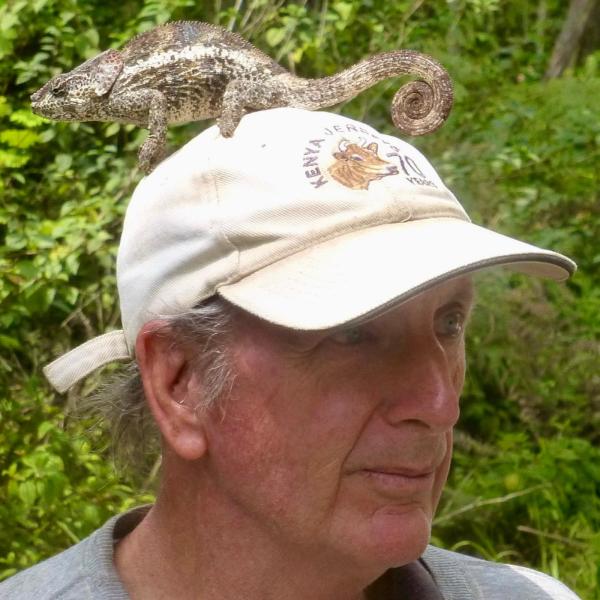
Photo: David Holberton-Jones
Upcoming Tours with Brian
-
Kenya in November
Nov 15 to Dec 2 2026
3 spaces remain -
Uganda: Shoebills to Gorillas
Jun 14 to Jul 3 2027
2 spaces remain -
Madagascar
Sep 2027
-
Uganda: Shoebills to Gorillas
Jun - Jul, 2028
Testimonials for Brian
Brian Finch has a gentle way about him and is very easy to get along with. He never seems to be giving orders, yet participants fall in line and do the right thing.
- Charles H. on Madagascar
The Madagascar tour was just fantastic. Brian and Bruno were as good as tour leaders get - just wonderful. The itinerary was well-planned, our local guides were superb, and WINGS office assistance was excellent. I have no recommendation on how to improve this great tour.
- Kent V. on Madagascar
Brian was wonderful. He was so knowledgable and engaging. He was a delight to bird with. I really hope I get to bird with him again someday. He was patient with everything including when problems arose beyond his control.
- Vicki S. on Madagascar
Brian's deep knowledge on so many dimensions of natural history, complemented by his keen eyesight and hearing, easy-going nature, and sharp wit, kept us informed, laughing, and engaged.
- Paul M.