
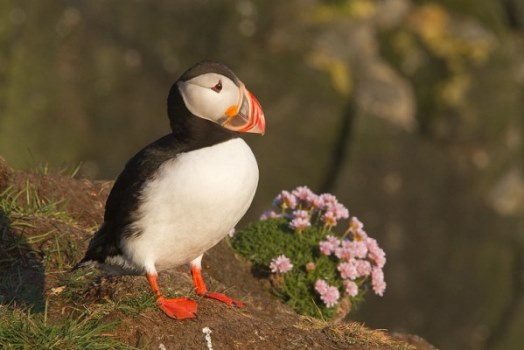
Iceland has millions of breeding Atlantic Puffins and a vast array of other seabirds as well. Photo: James Lidster
Lying in the cold, gray waters of the North Atlantic, Iceland is a country that has long fired the imagination of travelers and birdwatchers alike. This is the land of ice and fire and of ancient sagas, where the mighty Gyrfalcon drifts over a dramatic volcanic landscape dotted with glaciers, gushing geysers, hot springs, mighty waterfalls, and endless emerald-green vistas. Iceland is almost too beautiful to be believed.
The birdlife is equally dramatic and varied, with such special species as Barrow’s Goldeneye and Harlequin Duck, and the massive spectacle of thousands of breeding alcids and waterfowl and lakes literally covered in Red-necked Phalaropes. In recent years, the waters of northern Iceland have become famous as a place to see Blue Whales and Orcas; although it can never be guaranteed, a boat trip offers arguably the best chance of seeing this legendary mammal anywhere in the world.
Day 1: The tour begins mid-morning at the Reykjavík-Keflavík airport. If time allows there will be morning birding in the vicinity of Sandgerði, before driving west to Borgarnes, where we should see our first European Golden Plovers and Arctic Terns. The latter may be attracting a Parasitic Jaeger or two, offering unrivalled views as they give chase to the terns, perhaps with the local Common Redshanks or Eurasian Oystercatchers tagging along for good measure! In the late evening we’ll make an attempt to observe displaying Eurasian Woodcocks over a nearby forest. On the way we’ll search for that most impressive of raptors, the White-tailed Eagle. Iceland supports a healthy population of this species and careful scanning of rocky islets should prove successful. Nearby we will scan local mudflats for waders, which will undoubtedly include Dunlin, Common Ringed Plover and Black-tailed Godwit of the islandica race, all in smart breeding plumage. Night in Borgarnes.
Days 2-3: We’ll spend the two days birding around the Snæfellsnes peninsula. On our way towards the peninsula we’ll stop to admire Horned Grebes in their breeding finery as well as roadside Red-throated Loons. This area holds particularly high numbers of loons, and we should see family parties and hear their strange calls. The shallow pools at Rif attract large numbers of gulls, terns and waders and we’ll scan through the flocks of Glaucous and Herring Gulls in the hope of finding a more neatly proportioned Iceland Gull, as well as appreciating the variation in some of the local hybrid gulls. The Arctic Terns here are just a small percentage of the nearby breeding colony where over 5,000 pairs occur. For those that wish they provide an amazing photographic opportunity, and even when seemingly no threat to them, they insist on letting you know who is boss! Red-necked Phalarope are equally accommodating if not more so with many so close, even spinning around at our feet. Careful scanning through the flocks of Dunlin may produce a Red Knot, or maybe an American vagrant, few of which haven’t yet occurred in Iceland. On the second day here we’ll go on a whale-watching trip out from Snæfellsnes National Park. Time will also be spent checking out small seabird colonies on the western end of the peninsula, as well as scanning through flocks of moulting eiders, which in the past has produced both King Eiders and White-winged Scoter. Nights at Grundarfjörður.
Day 4: If the ferry schedule allows, we’ll depart from Grundarfjörður after breakfast and take the ferry across Breiðafjörður Bay towards Brjánslækur. Halfway across we’ll stop on the small island of Flatey. We’ll need to stay on the island until early evening to catch the next ferry, which will give us plenty of time to enjoy the breeding Atlantic Puffins, Black Guillemots, Red-necked Phalaropes, and Snow Buntings in some beautiful surroundings. If we are really lucky, we may even spot a Red Phalarope. We’ll have lunch on the island and in the evening continue our ferry journey to Brjánslækur.
Sometimes the ferry schedule does not allow a visit to Flatey. If that’s the case, we’ll instead take the scenic driving route around Breiðafjörður Bay, which offers fantastic views and usually some White-tailed Eagles in their preferred habitat.
Once on the other side of the bay, we‘ll drive along the winding fjords and past the unusual native Icelandic birch scrub on the southern side of the aptly named Westfjords. We should reach our hotel in Patreksfjörður with time for a late-evening visit to the spectacular bird cliffs at Latrabjarg. If timing and weather are on our side, we may see countless thousands of alcids, including puffins at arm’s length. Night in Patreksfjörður.
Day 5: We’ll begin on the highland roads of the Westfjords. At first glance the highlands appear barren and deprived of life but a closer look will reveal impressive patterns of rocks which have been formed by seasonal frost. We hope to come across Purple Sandpiper or Rock Ptarmigans both of which inhabit this alien landscape, although they can be tricky to find. Whooper Swans and Long-tailed Ducks spend their summers on the few lakes that are found here. Flocks of molting Common Eiders will be seen throughout the day as we drive by the seemingly endless coastline. Night near Hvammstangi.
Day 6: We’ll spend most of the morning driving to Húsavík, where we’ll spend the next two nights. Although mainly a travelling day we‘ll look for Iceland Gulls at several locations, as well as Common and Red-throated Loons. The small areas of conifer woodland around here hold breeding Eurasian Wren, Redwing and Common Redpoll, each belonging to their own Icelandic races, with the latter being highly variable. In recent years these areas also support breeding Fieldfare, a recent colonist to the country. One of the real specialities is Pink-footed Geese and we‘ll make a stop to admire these birds close to the road, perhaps with their attendant youngsters. Arctic Foxes are secretive animals, and are particularly wary of people having been heavily persecuted in the country, but we’ll keep our eyes open for any that may have been lured by the presence of the goslings. A secret location has nesting Long-tailed Jaegers and we’ll make a detour to see this rare breeder. We’ll also stop at the magnificent Goðafoss waterfall, and have a scan of the wildfowl close to our hotel. Night near Húsavík.
Day 7: After breakfast we’ll head to the northern coast. Flocks of Common Eiders, which sometimes hold the occasional King Eider, will be thoroughly scanned while also keeping an eye out for Common Scoter. Seawatching from the cliffs can produce White-beaked Dolphins and Great Skuas. The latter breeds nearby and we’ll plan to make a stop to see them on their breeding grounds. This is an excellent area for Gyrfalcon and we’ll certainly keep our eyes open for this iconic species. This area also hosts a lot of scarce species with Arctic Loon, Common Crane, Black Tern, Common Wood-Pigeon, and Eurasian Coot being seen during previous tours. If time permits, we will drive towards the Dettifoss waterfall, the most powerful and one of the most impressive in Europe. If the birding has been productive, we’ll save the waterfall for the following morning. Night near Húsavík.
Day 8: Mývatn, or Lake of Midges, is one of the world’s great birding spots and we’ll spend all day here. This shallow lake teems with invertebrate life, which in turn attracts thousands of duck. Red-breasted Merganser, Eurasian Wigeon, Gadwall, Tufted Duck, are all common. Greater Scaup are also common and provide a great opportunity to examine the differences between them and their Tufted cousins while every now and then our attention will be drawn to a beautiful Long-tailed Duck or a flock of Common Scoter, hiding among the hundreds of diving ducks. Careful scanning may produce a semi-resident American Wigeon, Ring-necked Duck or a fly past by the Icelandic race of Merlin. However the real stars here are the striking Barrow’s Goldeneye and the mythical Gyrfalcon, and time spent watching flocks of the former at one of their only Western Palearctic breeding sites may well lead to an encounter with a Gyr. Few things in birding are as viscerally exciting as seeing one of these powerful falcons instill panic in the myriads of ducks and waders. The river here is another great area for Harlequin Ducks, although many of the males will be on the coasts, we can watch the females negotiating the areas of white water as if it were easy! This region is also surrounded by stunning scenery and the bubbling mud and sulphur pools, lava fields and an explosion crater are all an indication of the island’s volcanic nature. Night near Mývatn.
Day 9: Most of today will be spent on the long drive back to Reykjavík. We’ll take the ring road (Road 1) through the north and west of the country and just before entering Reykjavík we’ll head east and visit Þingvellir National Park if time permits. This is the site of the historical parliament, chosen for its location, acoustics, and topography. It is also one of the best places to witness the cracks and fissures caused by the tectonic plates of America and Europe pulling away from each other. Birds may not be plentiful, although we could bump into Harlequin Ducks chilling at the base of a small waterfall, Red-throated Loons breeding on small islands in the river, or even a Rock Ptarmigan or Merlin, but the scenery is breathtaking. Night in Keflavik.
Day 10: We’ll spend our last morning on the Reykjanes peninsula, searching for any birds that may have eluded us and keeping an eye open for vagrants before we transfer to Reykjavík-Keflavík airport, where the tour concludes.
Updated: 15 March 2024
Prices
- 2024 Tour Price : $4,790
- Single Occupancy Supplement : $690
Notes

Questions? Tour Manager: Stephanie Schaefer. Call 1-866-547-9868 (US or Canada) or (01) 520-320-9868 or click here to email.
* Tour invoices paid by check carry a 4% discount. Details here.
Maximum group size eight with one leader.