
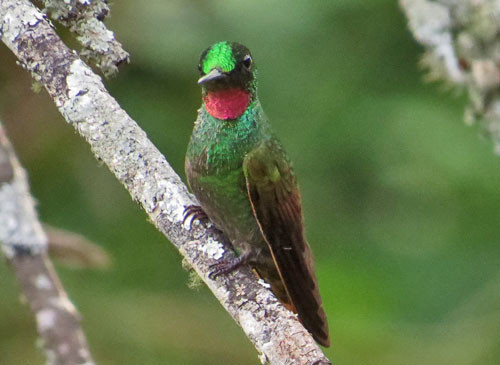
 A Brazilian Ruby waits its turn at the feeders in Itatiaia National Park.
Photo: Rich Hoyer
A Brazilian Ruby waits its turn at the feeders in Itatiaia National Park.
Photo: Rich Hoyer -
A Brazilian Ruby waits its turn at the feeders in Itatiaia National Park. Photo: Rich Hoyer
-
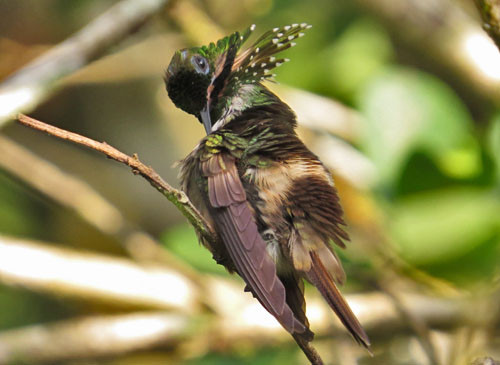
A male Festive Coquette preens between visits to hummingbird feeders in the rainforest near Ubatuba. Photo: Rich Hoyer
-
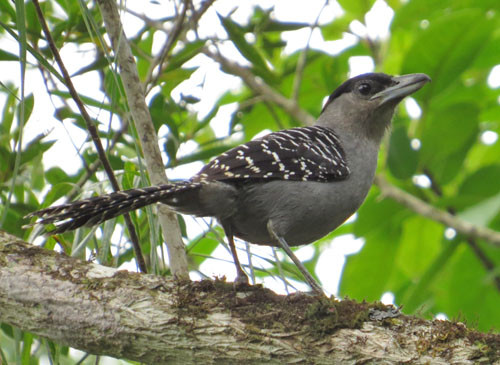
Surprisingly difficult to see well is the appropriately named Giant Anthsrike. Photo: Rich Hoyer
-
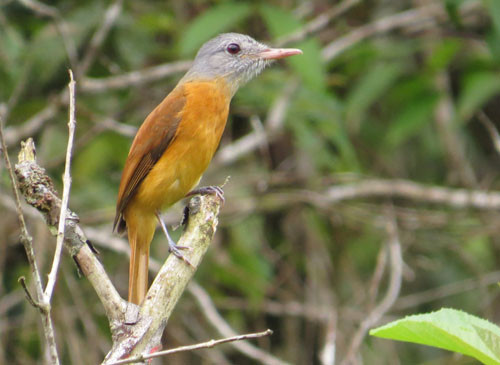
We’re in southeastern Brazil during the spring when the song of Gray-hooded Attila rings through the forest. Photo: Rich Hoyer
-
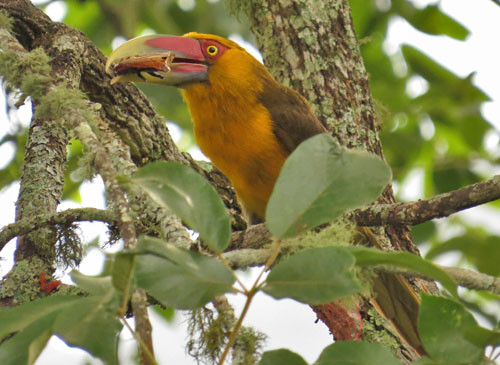
We have a good chance of seeing Saffron Toucanet at our Itatiaia Hotel. Photo: Rich Hoyer
-
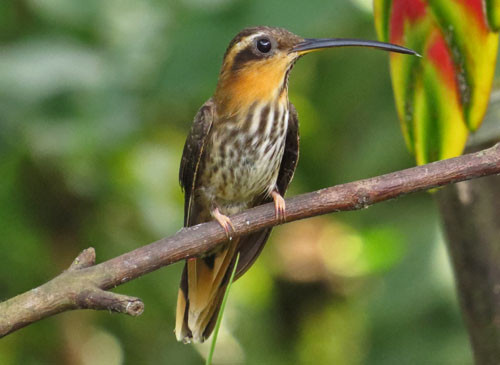
The unusual Saw-billed Hermit is endemic to Southeastern Brazil. Photo: Rich Hoyer
-
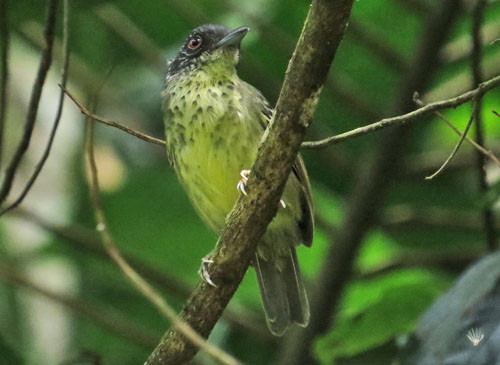
The distinctive Spot-breasted Antvireo likes to join mixed understory flocks. Photo: Rich Hoyer
-
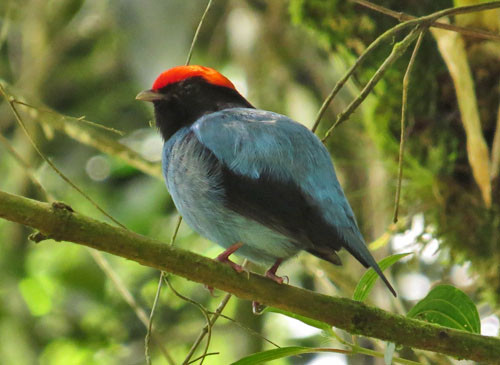
We hear Swallow-tailed Manakins in many places, and with some luck we’ll have views like this. Photo: Rich Hoyer
-
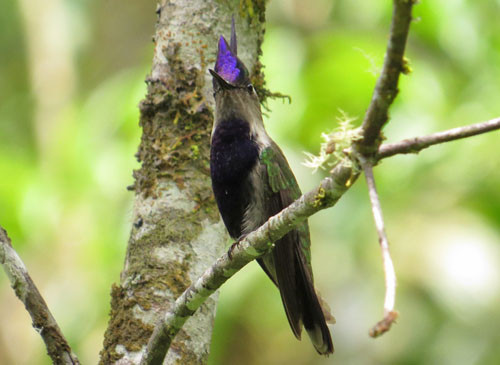
The stunning Violet-crested Plovercrest sings on a lek that we visit at Intervales State Park. Photo: Rich Hoyer
Locally known as the Mata Atlântica in eastern Brazil, the wet forests stretching along the Atlantic coast are home to the typical Neotropical bird families familiar to those who have birded elsewhere in South America: woodcreepers, foliage-gleaners, antbirds, antpittas, cotingas, tapaculos, manakins, and tanagers. But imagine that these rainforest-cloaked mountains have been isolated from the vast forests of the Amazon Basin and the Andes off and on for millions of years, separated by savannas, deserts, and brushland. The bird life has been allowed to evolve in such isolation, producing an utterly different and often colorful mix of species that can be seen nowhere else on earth. Much of this once extensive rainforest has long been cleared, as this is where Europeans first settled and where the large cities of São Paulo and Rio de Janeiro are located. We’ll use these two cities as our ports of entry and departure, but we’ll visit national parks, a state park, and private lodges and reserves where sizable chunks of habitat have been preserved and where a huge number of Brazil’s endemic birds can still be found.
Note: In 2026 it’s possible to do this tour back to back with Brazil: Minas Gerais.
Day 1: Our tour begins at 6 pm this evening in São Paulo. Night in São Paulo.
Days 2–4: Leaving Sao Paulo early we should arrive at Intervalles State Park around mid-day. We’ll spend the rest of the afternoon and the following two full days at and near Intervales State Park, one of the loveliest remaining patches of Mata Atlântica forest. Once a private logging property, it is now well protected and visited by tourists, who mostly want to see the various waterfalls and caves and are oblivious to the marvelous biodiversity. We’ll find many species here, and because our lodge is located amid the rich forest we’ll have a chance for Rusty-barred Owl and Long-trained Nightjar right on the grounds. The electric pings of Bare-throated Bellbirds and the jerky whistles of Hooded Berryeaters ring across the valleys, and the downward tinklings of White-browed Warblers give this enchanting forest a character unlike no other. The numerous other specialties here could include Chestnut-backed Tanager, Red-ruffed Fruitcrow, Red-and-white Crake, Giant Antshrike, and Violet-crowned Plovercrest. If we’re very lucky, we’ll at least hear the elusive Spotted Bamboowren, an extremely secretive little bird. Nights near Intervales State Park.
Day 5: We will need a few hours’ drive to reach the coastal little village of Cananeia. The coastal habitats at the southern end of São Paulo state are very different from the tropical forest of Intervales and from the habitats we will see letter on the tour; the sandy soils and lower hills do not trap as much moisture, resulting in a shorter, denser forest. Some special birds are found here, such as Azure Jay, Restinga Tyrannulet, and Red-tailed Parrot, and we’ll spend the afternoon in search of them. Night in Cananeia.
Day 6: After some early morning time looking for restinga specialties near Cananeia, we’ll spend much of today in our vehicle, though there will certainly be some roadside stops on the northward drive along the entire coastline of São Paulo state. Night in Ubatuba.
Day 7: The Serra do Mar is a coastal range of hills still largely cloaked in a gorgeous wet forest, in many places dropping right down to the sea. It teems with regional and Brazilian endemics, and we’ll visit a couple of private conservation areas that are perhaps the best locations to find Buff-throated Purpletuft, a little treetop percher related to tityras and found only in this part of Brazil. Ferruginous, Scaled, and Squamate Antbirds live in the understory, along with Gray-hooded Flycatcher, Pin-tailed Manakin, and Spot-backed Antshrike. One scheduled stop is a private home open to birders wanting to see an incredible display of hundreds of hummingbirds. Festive Coquette is one of the highlights, and we may be lucky enough to see Frilled Coquette as well. Night in Ubatuba.
Day 8: After a second morning birding around Ubatuba, looking for the species we might have missed earlier, we’ll drive along the scenic coast of Rio de Janeiro state. Night in Parque Mambucaba.
Day 9: Very few roads pass through habitat within the miniscule range of the Black-hooded Antwren, and one is just down the street from our hotel. We’ll bird here for a few hours, perhaps also seeing Gray-headed Tody-Flycatcher, Long-tailed Tyrant, Chestnut-crowned Becard, Lemon-chested Greenlet, and Green-headed Tanager, among many others. After lunch we will continue to our base for the next three nights, a comfortable lodge nestled in Itatiaia National Park, an extensive protected forest and the oldest national park in the country. Our first walk this afternoon might result in more of Brazil’s attractive endemics, perhaps a White-collared Foliage-gleaner or Golden-chevroned or Gilt-edged Tanager, among more widespread birds such as Yellow-legged Thrush and Swallow-tailed Manakin. Night in Itatiaia National Park.
Days 10–11: Itatiaia National Park covers a large section of the Serra da Mantiqueira, a mountainous spine in the interior of Rio de Janeiro state whose lush fern and bamboo forests are home to many endemic species. The stands of bamboo host secretive Fork-tailed Pygmy-Tyrants, moist draws have skulking Slaty Bristlefronts with their odd pinging call, and fruiting trees attract guans, tanagers, and cotingas. On one day we’ll drive to the higher elevations of the park to look for the adorable Green-crowned Plovercrest and very local Itatiaia Spinetail, as well as the sometimes-difficult Black-capped Piprites, here near the edge of its range. There will be more relaxed birding at the lodge feeders, where we should see Saffron Toucanet, Brazilian Ruby, and many others. Nights in Itatiaia National Park.
Day 12: According to the weather forecast and the species we may still be looking for in the area, we can decide to spend an extra morning at Itatiaia, or to start our drive to Reserva Ecologica de Guapiaçu (REGUA) to enjoy some nice afternoon birding there. Night in REGUA.
Day 13: REGUA is a private reserve established in 2001 protecting 15,000 of tropical forest from almost sea level up to 2,000 meters elevation. We’ll walk around these bird-filled areas looking for Rufous-sided Crake, White-barred Piculet, Blond-crested Woodpecker, Sooretama Slaty-Antshrike, White-flanked (Silvery-flanked) Antwren, White-headed Marsh-Tyrant, and so many more! After a lunch in REGUA, it will be now time to head towards our last destination, the beautiful Itororó Lodge. Night Itororó Lodge near Nova Friburgo.
Days 14–15: The feeders at Itororó will be hard to leave—the Red-necked Tanagers, Black Jacobins, White-throated Hummingbirds, and Maroon-bellied Parakeets are great fun to watch—but there are several areas harboring species with very small ranges that will draw us away from the lodge. One area is home to the very local Three-toed Jacamar, whose neighbors might include Crescent-chested Puffbird, Crested Black-Tyrant, Gray-bellied Spinetail, and Biscutate Swift. Another is Pico da Caledônia, an impressive granite dome with a strange flora dominated by cliff-hugging bromeliads and a forest below that supports Black-and-gold Cotinga, the very rare Gray-winged Cotinga, the endearing Serra do Mar Tyrannulet, Spix’s Spinetail, and Sharp-tailed Streamcreeper, among others. Nights in Nova Friburgo.
Day 16: After a final relaxing morning and a farewell lunch on the grounds of our lodge we’ll leave for the Rio de Janeiro International Airport, arriving in time for late afternoon/evening flights homeward.
Updated: 07 February 2024
Prices
- 2024 Tour Price : $6,390
- Single Occupancy Supplement : $1,090
- 2026 Tour Price Not Yet Known
Notes

Questions? Tour Manager: Matt Brooks. Call 1-866-547-9868 (US or Canada) or (01) 520-320-9868 or click here to email.
* Tour invoices paid by check carry a 4% discount. Details here.
Maximum group size eight with one leader.
Note: In 2026 it’s possible to do this tour back to back with Brazil: Minas Gerais.