
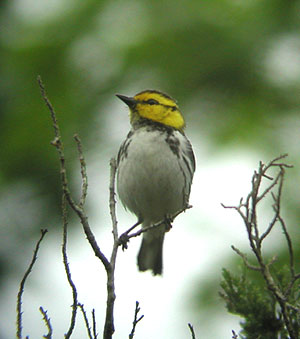
A male Golden-cheeked Warbler pauses briefly in the Edwards Plateau near Concan. Photo: Rich Hoyer
The oaks and limestone hills of the Edwards Plateau form a cool, green boundary between east and westTexas. Here amid a profusion of spring wildflowers and a varied array of eastern and western birds, we’ll look especially for the region’s two special summer residents, Golden-cheeked Warbler and Black-capped Vireo. After a day and a bit on the Edwards Plateau we’ll travel west to Big Bend National Park, where tall mountains rise out of the arid west Texas plains. In this scenic region birds from Mexico and the Rocky Mountains converge and include some highly sought-after species such as Lucifer Hummingbird, Gray Vireo, and Colima Warbler.
Day 1: The trip begins by 5:00 p.m. at the San Antonio International Airport. Night in Kerrville.
Day 2: This morning we will look for satisfying views of Black-capped Vireo or Golden-cheeked Warbler (Black-capped Vireo is possible at Big Bend National Park as well.) Alternatively, we’ll visit Park Chalk Bluff near Uvalde, where we might see either Green or Ringed Kingfisher. Some south Texas species such as White-tipped Dove, Couch’s Kingbird, and Olive Sparrow reach the northern limit of their range about here, and the birding overall is excellent. During recent springs a Rufous-capped Warbler bred here, and if one is present we’ll likely search for it, unless we are still missing Golden-cheeked Warbler. Black-bellied Whistling Ducks are numerous in Uvalde, and Chimney Swifts breed here. In 2017 we found Northern Bobwhites along a lightly traveled road near Uvdale. Night in Uvalde.
Day 3: We may have a second chance to look for those two most celebrated plateau summer residents, Black-capped Vireo and Golden-cheeked Warbler. The region provides many delightful east-west contrasts: for example, we can stand along a cypress-fringed stream and listen to Eastern Wood Pewee, Great Crested Flycatcher, Carolina Wren, Yellow-throated Vireo, Yellow-throated Warbler, Field Sparrow, and Indigo Bunting, their voices mingling with those of Ash-throated and Brown-crested Flycatchers, Woodhouse’s Scrub-Jay, Canyon Wren, and Rufous-crowned Sparrow filtering down from the adjacent dry hillsides and rocky outcroppings. Migrants such as Orange-crowned and Nashville Warblers and Clay-colored Sparrow can be fairly common. We also have a chance of seeing Louisiana Waterthrush. TheTexas hill country seems anything but Texan in its cool lushness, and some of the areas we’ll visit, such as Lost Maples State Park, are very beautiful. Late in the day we’ll have a picnic dinner at a roadside table in Concan. Nearby is the Frio Bat Cave, where we’ll witness the mind-boggling exodus at dusk of literally over a million Mexican Free-tailed Bats. Cave Swallows, Black-throated Sparrows, and maybe Black-tailed Gnatcatchers and Scott’s Orioles will be present too, and as darkness settles we may well hear Common Poorwill and Chuck-will’s-widow if the night is calm and warm. Night in Uvalde.
Day 4: We’ll begin the long drive to the Chisos Mountains. Perhaps the most notable feature of the day will be the dramatic change to the arid landscapes of west Texas. En route we’ll stop to admire any Crested Caracaras, Harris’s Hawks, or Lark Buntings we come across, and we’ll scan through the ever-present Turkey Vultures for Zone-tailed Hawk. North of Brackettville is a site that sometimes has Gray Vireo and in 2017 we had a pair of Least Grebes at a pond near the ranch entrance where they filmed the first movie with John Wayne about the events of the Alamo in the late winter of 1836. We’ll stop briefly at Langtry, the location of Judge Roy Bean’s tavern, where he dispensed frontier justice near the turn of the last century. Here we usually see Cactus Wren and the very localized and intensely orange nominate race of Hooded Oriole. Night in Big Bend National Park.
Days 5–7: Bordering the sculpted canyons of the Rio Grande, the Chisos Mountains rise out of Big Bend National Park in a broken mass of colored sandstone reaching to almost 8000 feet. The range supports a variety of interesting birds including Lucifer and Blue-throated Hummingbirds, Gray Vireo, Varied Bunting, and Black-chinned Sparrow, but Colima Warbler is the major attraction since it can be seen nowhere else in the United States. We must make a long climb to find the warbler, but the scenery is dramatic and our pace will be slow, punctuated by Acorn Woodpeckers and parties of Mexican Jays and perhaps a few migrants. Sometimes a territorial Painted Redstart or two is present. All of one day will be devoted to this objective.
Big Bend provides delightfully varied birdwatching, and in addition to the mountains and high desert we’ll visit the Rio Grande floodplain, where cottonwoods and giant mesquites attract an entirely different set of birds. Vermilion Flycatcher,Bell’s Vireo, Summer Tanager, and Painted Bunting are common, and a pair of Common Black-Hawks and pair of Gray Hawks have nested in recent years. Other scarce species we may encounter include Cordilleran Flycatcher, Tropical Kingbird, Crissal Thrasher, and Lucy’s Warbler. In some years Black-capped Vireos are present in the Chisos Basin and very occasionally in Blue Creek Canyon too and they are usually easier to see here than in the more densely wooded hill country. At this season there may be a fine collection of migrants, perhaps including something quite unexpected. In the past we have encountered Tropical Parula and Flame-colored Tanager, and there are a handful of Slate-throated Redstart records from near Boot Spring. On at least one evening we’ll search for Lesser Nighthawk and Elf Owl, both fairly common. Nights inBig BendNational Park.
Day 8: After a final morning in Big Bend we’ll drive to Fort Davis, Texas, arriving in the mid-afternoon with time to do a little birding in Davis Mountains State Park. Migrants can be numerous at times in the flowering oaks, and there is at least a chance for Virginia’s Warbler. Breeders like Cassin’s Kingbird and Black-headed Grosbeak are common, and if we’re very lucky we may see Montezuma Quail. Night in Fort Davis,Texas.
Day 9: We’ll spend the morning in a reserve owned by the Nature Conservancy on the north side of Mt. Livermore, at over 8300 feet the highest mountain in the Davis Mountains. Here we should find new species, including Gray Flycatcher, Western Bluebird, Grace’s Warbler, and Hepatic Tanager. Steller’s Jay and Mountain Chickadee are possible too, as is Montezuma Quail. Much of the habitat was burned over in 2012, but as in many fire-prone areas, the habitat is recovering. We’ll plan to stop at Lake Balmorhea, a magnet for waterbirds in this parched land. Western and Clark’s Grebes are likely to be present, along with a number of shorebirds, and rarities in the past have included Pacific Loon and Reddish Egret. Small to moderate sized flocks of Franklin’s Gulls sometimes drop in, too. Late in the afternoon we’ll drive east to Fort Stockton. Night in Fort Stockton.
Day 10: We’ll leave quite early this morning for the 300-mile drive to San Antonio and stop along the way at Fort Lancaster if we are still missing Gray or Black-capped Vireo, both of which often nest near here. Varied Buntings are often present here, too, at about the east end of their range. We’ll plan to arrive at the San Antonio airport just past noon.
Updated: 03 December 2019
Prices
- 2025 Price Not Yet Available
- (2023 Tour Price $3,600)
Notes

Questions? Tour Manager: Greg Greene. Call 1-866-547-9868 (US or Canada) or (01) 520-320-9868 or click here to email.
* Tour invoices paid by check carry a 4% discount. Details here.
This tour is limited to seven participants with one leader.