
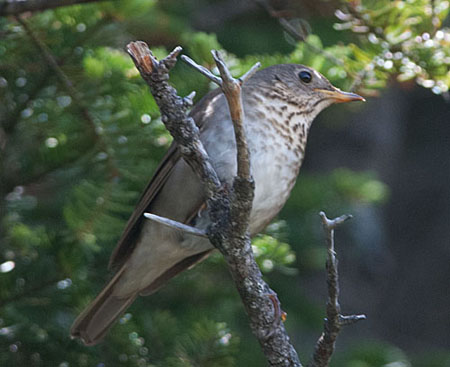
Bicknell’s Thrush is one of the prizes on the Maine and New Hampshire tour Photo: Derek Lovitch
This tour visits one of the most beautiful and sparsely populated areas in North America near the peak of breeding bird activity. Maine and New Hampshire are an avifaunal crossroads, as many species reach their northernmost or southernmost breeding ranges here. We’ll spend time with both of these groups, focusing on the boreal specialties that are mostly found farther north.
Off the coast, tiny rock islands teem with life as thousands of seabirds begin their nesting season. During our visit to Machias Seal Island, we’ll see terns and alcids, including Razorbill and Atlantic Puffins, literally at arm’s length.
In all, we hope to see at least 20 species of warbler, thirteen sparrows, nine flycatchers, seven thrushes including Bicknell’s, five vireos and four alcids. Although the avian spectacle is reason enough to visit New England, the rugged coastline, picturesque lighthouses, quaint fishing towns, classic New England villages, tallest mountains in the Northeast, and excellent cuisine (the lobster doesn’t get any fresher than this!) are a significant part of the tour.
Day 1: The tour begins at 6:00 p.m. in South Portland. Night in South Portland.
Day 2: We’ll begin at Scarborough Marsh, the largest salt marsh north of Massachusetts and well known for its healthy population of both Nelson’s and Saltmarsh Sparrows. In addition to studying the differences between the two “sharp-tailed” (and hybrids thereof) sparrows, we’ll search for other marsh and coastal species, including herons, “Eastern” Willet, Roseate and Least Terns, Piping Plover, and lingering spring or early fall migrants. We’ll have some flexibility today, giving us the opportunity to change course for lingering shorebirds and waterbirds and for possible rarities, while seeking more southern Maine species, from Fish Crows to Blue-gray Gnatcatchers. We’ll probably start our indulgence in lobster at some point today as well. Night in South Portland.
Day 3: Our first stop will be the Kennebunk Plains, the largest remaining area of sand-plain grassland in New England and home to sparrows such as Grasshopper, Vesper, Field, and perhaps Clay-colored, as well as Upland Sandpiper and Prairie Warbler.
We’ll then have some flexible time to play clean-up on and near the coast before heading north towards Bar Harbor. We’ll visit Messalonskee Lake, which hosts a Black Tern colony and one of the few Purple Martin colonies remaining in the state. We’ll look for Sandhill Crane and other marsh denizens as well. We’ll then head further “Downeast”, ending up in Bar Harbor for the night.
Day 4: After savoring some famous blueberry pancakes, we’ll board a boat for Petit Manan, part of the Maine Coastal Islands National Wildlife Refuge. Atlantic Puffins, Razorbills, Common Murres, Black Guillemots, and Common, Arctic, and Roseate Terns can all be seen here, a useful backup (front-up?) if our Machias Seal Island day is scrubbed for bad weather. After we’ve had our fill, we’ll explore the nooks and crannies of Frenchman’s Bay, with Osprey, Bald Eagles, and more Black Guillemots to keep us company.
After a delicious lunch at the iconic Jordan Pond House, we’ll likely visit a few local birding patches as well as the summit of Cadillac Mountain, where we’ll take in the stunning landscapes of Mount Desert Island. Night in Bar Harbor.
Day 5: We’ll continue our time in Acadia National Park at the gardens of Sieur de Monts, where we’ll brush up on our New England botany and on our deciduous forest warblers. This can be a good spot to search for Blackburnian Warbler, Barred Owl, Winter Wren, Alder Flycatcher, and a host of other species. The Park Loop Road takes us through postcard-worthy scenery and should also yield Peregrine Falcons and such deciduous-loving passerines as Black-throated Blue Warbler and Wood Thrush. We’ll start heading north mid-morning, probably with a stop at the Hollingsworth Trail for our first chance at Spruce Grouse, and lunch in the town of Millbridge. We’ll stop at the blueberry barrens in Columbia Falls to look for Upland Sandpiper before making it to Machias in the afternoon.
Day 6: They don’t call this the Bold Coast for nothing, and this marvelous region will provide some of the trip’s biggest prizes. Depending on our boat’s departure time (this may change based on tides and weather), we may do some morning birding to search of Spruce Grouse (if needed), among other species. We’ll then meet up with our captain for a one-hour boat ride to the legendary Machias Seal Island. If we’re very lucky and the sea conditions are calm enough, we’ll even get the chance to land here and walk on raised pathways to blinds, where we’ll find ourselves face to beak with Atlantic Puffins, Common Murres, and Razorbills. After several years absence, Arctic and Common Terns are recolonizing the island. Even if we can’t land, our small boat will circle the island and get us amazing close-up views of all the alcids. It should be a day to remember!
Depending on our return time, we may visit West Quoddy Head State Park, the easternmost point in the United States and home to Palm Warbler, Lincoln’s Sparrow, and perhaps a lingering Great Cormorant. Night in Machias.
Day 7: If we haven’t yet encountered a Spruce Grouse, we’ll focus on that this morning. Depending on our other needs, we may return to Quoddy Head State Park or other Bold Coast locales, or possibly the Lubec mudflats—which are extensive, as the tide here is more than 15 feet—for lingering shorebirds and more Nelson’s Sparrows. We’ll likely then head to Moosehorn National Wildlife Refuge in search of Bay-breasted and perhaps Cape May Warblers. Other short stops around Lubec and Machias will help us find any missing boreal specialties before we embark on the long drive west. Night in Rangeley.
Day 8: Our primary destination in the Rangeley area is the famous “Boy Scout Road,” a flat dirt road that passes through fine boreal and riparian habitat. We’ll look especially for Canada Jay and Yellow-bellied, Olive-sided, and Alder Flycatchers, along with a variety of warblers. We’ll likely explore a number of other small “hotspots” as we head west into New Hampshire.
After an early dinner we’ll head uphill on our special after-hours charter up the Mount Washington Auto Road in order to enter the realm of Bicknell’s Thrush. If time permits, we’ll visit the summit of Mount Washington for breeding American Pipits and take in the sunset from the “windiest place on earth.” Night in Gorham, New Hampshire.
Day 9: In the morning we’ll visit a number of locations around the White Mountain National Forest for local breeders such as Philadelphia Vireo. We’ll likely take another trip to see Bicknell’s Thrush (unless we had unbeatable views the night before), weather permitting, and likely via a sky tram up another mountain with a short walk once at the summit. After a picnic lunch, we’ll return to Portland, making a stop at Brownfield Bog on the way. This may give us the opportunity to fill some gaps on our list, with targets including Willow Flycatcher, Yellow-throated Vireo, both cuckoos, and various other wetland and edge birds. Night in South Portland.
Day 10: The tour concludes this morning in South Portland.
Updated: 03 January 2024
Prices
- 2025 Price To Be Determined
Notes

Questions? Tour Manager: Sara Pike. Call 1-866-547-9868 (US or Canada) or (01) 520-320-9868 or click here to email.
* Tour invoices paid by check carry a 4% discount. Details here.
Maximum group size seven with one leader.