
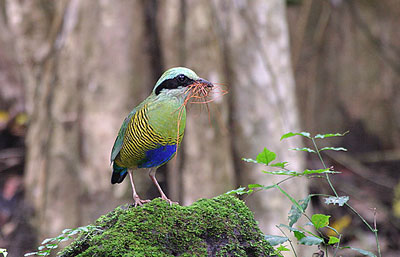
Bar-bellied Pitta is one of the special birds in Cuc Phuong National Park. Photo: Suppalak Klabdee
Stretching a thousand miles down the east coast of Southeast Asia, Vietnam supports a vast array of habitats. Between the mighty deltas of the Red River in the north and the Mekong in the south are endless beaches, fertile plains, lush rainforests, and high plateaus with rhododendron-covered peaks rising to over 9,000 feet.It’s no wonder that Vietnam is home to over 850 species of birds, among them more endemics than any other country in mainland Southeast Asia. By visiting both the north and the south we’ll see a great variety of Vietnam’s distinctive birdlife, which combines influences from the Himalayas, the Palearctic, and Malaysia, including a large number of Indochinese specialties that are difficult to find elsewhere in the regionWith the ravages of the past well and truly behind it, Vietnam has emerged as one of Asia’s thriving economies and one of its most popular tourist destinations. It has an infrastructure to match this popularity, and we’re assured of a warm welcome everywhere we travel in this fascinating country.
Day 1: Participants should arrive in Hanoi no later than 5 p.m. Night in Hanoi.
Days 2-4: After an early breakfast we’ll depart Hanoi for Cuc Phuong National Park, an area of limestone hills covered in primary rainforest and the first national park to be established in Vietnam. We’ll have two full days to explore the park, where we’ll hope to see such special birds as Bar-bellied and Blue-rumped Pittas, Silver-breasted Broadbill, White-tailed Flycatcher, White-winged Magpie, Ratchet-tailed Treepie, Rufous-throated Fulvetta, Limestone Wren-Babbler, Fujian Niltava, and Pied Falconet. One afternoon we’ll visit Van Long Nature Reserve. Here we’ll take a sampan to the dramatic limestone cliffs that are home to the largest population of one of Vietnam’s most beautiful of its many endangered primates, the Delacour Langur. Various waders, herons, bitterns, and a breeding pair of Bonelli’s Eagles are often seen here. Nights at the Park Headquarters guesthouse.
Day 5: We’ll have a bit of time for early morning birding at Cuc Phuong before transferring to Hanoi’s Noi Bai Airport for the short flight to Hue, in central Vietnam. On arrival we’ll drive to the scenically stunning Phong Nha-Ke Bang National Park, a UNESCO World Heritage Site renowned for its extensive cave systems and rugged limestone karsts. Night at Phong Nha-Ke Bang National Park.
Day 6: We’ll have a full day to explore Phong Nha-Ke Bang National Park in search of such limestone specialists as the near-endemic Sooty Babbler and Limestone Leaf-warbler. The scarce and rarely seen Red-collared Woodpecker is also possible, as is another scarce endemic primate, Ha Tinh Langur. The birdlife is active and exciting, and large mixed flocks often contain some very glamorous species: Sultan Tit is common and Purple Cochoa is sometimes seen. This afternoon we’ll visit the world-renowned cave system of this remarkable area. The Phong Nha Cave is the second largest in the world (the first and third largest are found deeper within Phong Nha National Park) and a short boat trip and walk deep inside the cave is an unforgettable experience. Night in Phong Nha.
Day 7: After an early morning birding session back at Phong Nha National Park, we’ll depart for the long drive south to the Sa Mu Pass located in the Bac Huong Hoa Natural Area. We will bird at various spots along the way including a break for lunch at Lang Co on the coast to look for the recently described White-faced Plover. If we have time we’ll bird at our destination before checking in to our hotel. Night in Khe San.
Day 8: We’ll have a full day to explore this little-known area, which is located right on the Laos border in the narrowest part of Vietnam in the centre of the Annamite Mountains range. This lovely, forested area is home to several Vietnamese and regional endemics, including Red-vented Barbet, White-winged Magpie, and Blyth’s Kingfisher. But our most wanted birds will be the range restricted Central Vietnam specialities – Red-collared Woodpecker, Black-crowned Barwing, Rufous and White-cheeked Laughingthrushes and the elusive Short-tailed Scimitar-Babbler. Other spectacular birds here include Ratchet-tailed Treepie, Indochinese Green Magpie, Black-throated and Lesser-necklaced Laughingthrushes, and a distinctive subspecies of Sultan Tit with a glossy blue-black crown—a possible future split. Red-shanked Douc Langur, a beautiful and endangered primate, is sometimes seen in the treetops below the summit trails. Night in Khe San.
Day 9: After some more birding, we’ll leave the Sa Mu area in the mid-morning when the birding activity drops for the five-hour drive south to Ngoc Linh on the newly constructed Ho Chi Minh Highway. We should arrive in the Ngoc Linh area in the late afternoon. Night at Tu Mo Rông.
Day 10: Ngoc Linh Nature Reserve is one of the best birding hotspots in Central Vietnam; the area is the second highest mountain range in Viet Nam and is recognised as a Key Biodiversity Area, Important Bird Area, and a Global Endemic Bird Area. There are many birding highlights here, amongst them the endemic Golden-winged and Red-tailed Laughingthrushes, more chances for Black-crowned Barwing, as well as Indochinese Fulvetta, Annam Golden-breasted Fulvetta, Coral-billed Scimitar-Babbler, Red-tailed Minla, and Ferruginous Flycatcher. Night at Tu Mo Rông.
Day 11: After a final morning birding in Ngoc Linh we’ll continue south down the Ho Chi Minh Highway to Mang Den, a quiet town located in Vietnam’s central highlands. Night at Mang Den.
Day 12: We’ll have a full day at Mang Den, where the seldom-seen and exceptionally shy endemic Chestnut-eared Laughingthrush, discovered in 1999 and seen by only a handful of birders, will be our main quarry. Just a few kilometers from the town we’ll explore a large area of excellent montane forest, the most reliable site in Vietnam for three other scarce birds: Pale-capped Pigeon, Yellow-billed Nuthatch, and Black-hooded Laughingthrush. Night at Mang Den.
Day 13-14: We’ll have a second morning’s birding at Mang Den before taking the scenic drive north to Yok Don National Park, arriving in time for a late lunch and some afternoon birding. This recently declared national park borders the Mondulkiri Protected Area in Cambodia and constitutes one of the largest areas of protected lowland forest in Southeast Asia. The habitat is characterized as a mosaic of deciduous and semi-evergreen forest interspersed with areas of rainforest. Specialties here include the scarce White-rumped Pygmy-falcon, Collared Falconet, several woodpeckers including the beautiful Black-headed, Rufous Treepie and the curiously-named Neglected Nuthatch. Not surprisingly, it’s considered one of the most biodiverse areas of Vietnam and a number of species that have disappeared elsewhere in the region can still be found here. Nights at Yok Don National Park HQ.
Day 15: After an early breakfast we’ll cross the Srepok River to bird in and around the Yok Don Botanical Gardens. We’ll leave Yok Don mid-morning for the drive to Da Lat, stopping en route for lunch. Night at Da Lat.
Days 16–17: We have two full days to explore the excellent birding sites around Da Lat. In the Ta Nung Valley, a small but bird-filled area of remnant evergreen forest about 6 miles (10 km) from Da Lat, we’ll look for the rare and endemic Grey-crowned Crocia as well as White-cheeked Laughingthrush. The distinctive subspecies of Blue-winged Minla, Rufous-backed and Black-headed Sibias, and Black-throated Sunbird can also be found here.
In addition to the wonderful Ta Nung Valley two other sites around Da Lat are well worth visiting: Mount Lang Bian and Bi Doup National Park. Mount Lang Bian is a 6700-foot peak about 20 minutes by road from Da Lat, and we’ll spend a day exploring its pine and montane evergreen forests. Our target species here include wintering Mugimaki Flycatcher, Grey-crowned Tit, Vietnamese Cutia, Black-crowned Fulvetta, and Vietnamese Greenfinch. Bi Doup National Park is a wonderful birding area where we might find birds such as Burmese Shrike, Slender-billed Oriole, Indochinese Cuckooshrike, and Vietnamese Crossbill, among many other species in the coniferous forests, while the evergreen forests hold one of the most sought-after species on the Da Lat Plateau, the beautiful and very secretive endemic Collared Laughingthrush. We’ll also appreciate Da Lat’s cooler climes and its old French colonial buildings and numerous outdoor cafes, restaurants, and markets. Nights at Da Lat.
Day 18: This morning we’ll head to Di Linh, a two-hour drive from Da Lat. Descending from the plateau, we’ll pass by a virtual mosaic of rubber, teak, tea, and coffee plantations, as well as fascinating Vietnamese architecture. The forested mountain pass known as Deo Suoi Lanh is an ideal site to look for several Da Lat Plateau specialties, including Black-hooded, White-cheeked, and Orange-breasted Laughingthrushes and the near-endemic Black-crowned Parrotbill. We may also find the gorgeous Blue Pitta. We’ll continue onward from the pass to arrive at Cat Tien National Park in the late afternoon. Night at Cat Tien headquarters.
Days 19-21: Cat Tien National Park contains the largest remaining area of lowland tropical forest in southern Vietnam. We’ll have an amazing three full days around the park. There are more than 330 bird species here, including the endangered Germain’s Peacock-Pheasant, Green Peafowl, and the very elusive Orange-necked Partridge. The list of mammals includes Eurasian Wild Pig, Sambar, Red Muntjac, and Gaur (very scarce, although increasing in numbers) as well as two endangered primates, Black-shanked Douc Langur and Buff-cheeked Gibbon.
Over the next three days we’ll take jeeps to visit areas around the park such as Heavens Rapids and Crocodile Lakes, where Grey-headed Fish-Eagle and Lesser Adjutant may be seen. The three-mile walk through the forest to Crocodile Lake is an excellent place to look for Germain’s Peacock-Pheasant and Blue-rumped and Bar-bellied Pittas, as well as Red-and-Black and Banded Broadbills and Orange-breasted Trogon, among many others. Other Cat Tien specialties include Scaly-breasted (Green-legged) Partridge, Siamese Fireback, White-bellied, Great Slaty, and Black-and-buff Woodpeckers, Red-vented Barbet, Woolly-necked Stork, and Grey-faced Tit-Babbler. Nights at Cat Tien headquarters.
Day 22: We’ll have a last morning of birding in Cat Tien National Park before driving back to Ho Chi Minh City for our final dinner. Night at Ho Chi Minh City.
Day 23: The tour concludes this morning in Ho Chi Minh City with transfers to Tan Son Nhat International Airport for flights home.
Created: 23 February 2024
Prices
- 2025 Tour Price Not Yet Known
- (2024 Tour Price $7,090)
Notes

Questions? Tour Manager: Stephanie Schaefer. Call 1-866-547-9868 (US or Canada) or (01) 520-320-9868 or click here to email.
* Tour invoices paid by check carry a 4% discount. Details here.
Maximum group size 10.