
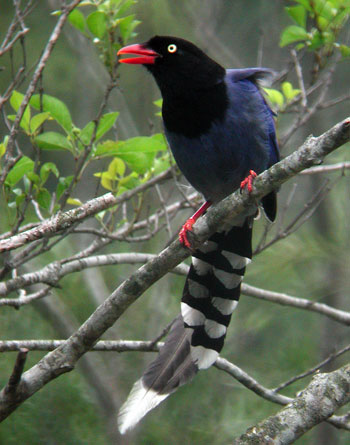
Few of Taiwan’s endemics are as splendid as this Blue Magpie. Photo: David Fisher
Early Portuguese sailors dubbed Taiwan “Isla Formosa”—the beautiful island—and although the title was abandoned some time ago in favor of the Chinese name, Taiwan is still a strikingly attractive island with some spectacular mountain scenery. Sitting astride the Tropic of Cancer, less than 250 miles from north to south and no more than 100 miles wide, Taiwan boasts impressive geographic and ecological diversity. A dramatic mountain range forms the island’s backbone and is flanked either side by a broad, flat coastal plain that is warm and humid.
Amazingly, few Western birders have experienced Taiwan’s rich bird life. We’ve been missing out, as many of the species are generally far easier to see here than in most other Asian countries. Moreover, Taiwan is an affluent nation with a good tourist infrastructure and road network, and traveling around is genuinely easy. Most important, Taiwan boasts an impressive array of 33 endemic species that include Taiwan Yuhina, Collared Bush Robin, White-eared Sibia, Steere’s Liocichla, and the more recently split Taiwan Cupwing, Striped Prinia and Black-necklaced Scimitar Babbler.
Endemic birds are not all that Taiwan has to offer, however. The island is the winter home of the bulk of the tiny world population of Black-faced Spoonbill, and we expect to see a few lingering birds. The tour’s timing, at the height of the northbound spring migration, means that we’re also sure to find a decent number of East Asian migrants. We also stand a good chance of seeing that most elusive of Asian birds, Fairy Pitta.
Day 1: The tour begins this evening at our hotel in Taipei. Night in Taipei.
This was a fantastic tour. Paul couldn’t have been better. Best eyes and ears I’ve ever experienced and a will to get everyone to see each bird.
Hank Kaestner, May 2016
Day 2: After breakfast we’ll travel a short distance to the Taipei Botanical Gardens for an introduction to Taiwan’s more common birds. These are sure to include Swinhoe’s White-eye and Light-vented Bulbul, and this site is also one of the best for both Taiwan Barbet and Malayan Night Heron. We should be able to find at least one of the latter stalking earthworms somewhere in the small gardens. A pair of Crested Goshawks also breed in the park most years. From there we’ll drive southwest, away from Taipei and up into the hills at Da Syue Shan (literally “Big Snow Mountain”). Even though this site holds most of the island’s endemic birds, we’ll make several stops en route, perhaps to search for Black-necklaced Scimitar Babbler or Taiwan Hwamei, but we should still arrive in time to explore some of this excellent reserve. The endemic Swinhoe’s Pheasant is relatively easy to see here, as is its rarer cousin, and Taiwan’s national bird, Mikado Pheasant. Night just outside Da Syue Shan Forest Recreation area.
Days 3-4: We’ll spend the following two days at Da Syue Shan searching for species such as White-bellied Green Pigeon and endemics such as Taiwan Bamboo Partridge, the startled-looking Yellow Tit, Taiwan Bush Warbler, Taiwan Scimitar Babbler, Grey-cheeked Fulvetta, Rufous-crowned, Rusty, and White-whiskered Laughingthrushes, Steere’s Liocichla, White-eared Sibia, Taiwan Vivid Niltava, Taiwan Yuhina, Taiwan Rosefinch, and Flamecrest.
Even with all these endemic species to search for, we won’t neglect the endemic subspecies Dusky Fulvetta or regional specialties such as Little Forktail.
Day 5: Depending on what we’ve seen at Da Syue Shan, we’ll have the choice of leaving early or late in the day. Our next destination will be Cingjing, which at 5640 feet is ideal as a base for searching again for several of Taiwan’s higher-elevation specialties, such as Taiwan Bullfinch or Taiwan Hwamei, that might have eluded us so far. All three of Taiwan’s endemic game birds occur near Cingjing, and we’ll probably spend some of our time quietly walking various trails through the bird-rich temperate forests in our quest to see them all.
The spectacular Swinhoe’s Pheasant is the easiest to see, the elusive Taiwan Partridge undoubtedly the most difficult, and while Mikado Pheasant isn’t common, we have lots of time. Several of the species we searched for at Da Syue Shan also occur here, while more site-specific specialties include the enigmatic Taiwan Wren-babbler and Taiwan Barwing. Night in Cingjing.
Day 6: We’ll leave Cingjing early today and drive up the Central Cross Island Highway and over the Hehuanshan Pass, which at 10,728 feet is the highest road pass in East Asia. Target species here include Collared Bush Robin, Flamecrest, and the recently described Alishan Bush Warbler. The higher-elevation patches of bamboo hold good numbers of Taiwan Fulvettas and a few Golden Parrotbills, though we’ll need a fair amount of luck to connect with the latter. Other target species include the endemic form of Alpine Accentor, Taiwan Rosefinch, and both Brown and Taiwan Bullfinches. Descending the eastern side, we’ll travel slowly through Taiwan’s premier tourist attraction, the spectacular Taroko Gorge, before reaching the coast near Hualien. Along the way we’re sure to come into contact with Styan’s Bulbul, Taiwan’s most threatened endemic, before we reach our hotel in Taitung where we spend the night.
Day 7: This morning we’ll take a two-and-a-half-hour journey on a large passenger ferry to Lanyu, or Orchid, Island, a volcanic jewel located off Taiwan’s southeastern corner. Species that we’ve seen from the ferry on past trips include Streaked Shearwater, Bulwer’s Petrel, Long-tailed Jaeger, Bridled Tern and Red-tailed Tropicbird. Still inhabited by some 2000 Yami aborigines, whose culture is closer to that of the Philippines and Pacific islands than it is to China, Lanyu is radically different from mainland Taiwan. Birds we’ll be looking out for on Lanyu include the endemic Taiwan Green Pigeon and endemic forms of Ryukyu Scops Owl, Brown-eared Bulbul, and Lowland White-eye. Night on Lanyu.
Day 8: Lanyu Island is also home to small numbers of both Philippine Cuckoo Doves and Japanese Paradise-flycatchers. In addition, we’re sure to come across numerous migrants at this time of year, anything from a Little Curlew to a gorgeous Ruddy Kingfisher or Narcissus Flycatcher. We’ll spend the morning and early afternoon on Lanyu before taking the ferry back to the mainland. Night back in Taitung.
Day 9: After some more birding close to Taitung we’ll drive south, past Taiwan’s second-largest city, Kaohsiung, to Budai. We’ll spend the night there, but not before we’ve started our search for more shorebirds.
Day 10: We’ll spend much of the morning traveling slowly along the southwest coastline, stopping at numerous sites to search for waders and terns. Our main target is Black-faced Spoonbill: the bulk of the tiny world population of this endangered species winter in Taiwan, and a few lingering birds should still be present. Other species here should include a host of waders such as Eastern Curlew, Terek Sandpiper, Grey-tailed Tattler, Great Knot, Long-toed Stint, and Sharp-tailed Sandpiper. With luck we might be able to find a Chinese Egret or, if we’re extremely lucky, even a Spoon-billed Sandpiper. In the afternoon we’ll swing away from the coast and head inland to Alishan. The enterprising proprietor of our comfortable home-stay hotel here has constructed a couple of bird blinds in the forest, and this site is now the best in the world for viewing Taiwan’s most elusive endemic bird, Taiwan Partridge. Night at Alishan.
Day 11: In the morning we’ll spend more time at Alishan before returning to the coast to search for more birds. There are a couple of recent records of Chinese Crested Tern here, but realistically we have only a very slim chance of connecting with one of these increasingly rare birds. In the afternoon we’ll head north, spending the night in a hotel at Douliou.
Day 12: Accompanied by a local naturalist, we’ll make an early morning visit to Pillow Hill near Douliou with the aim of finding the gorgeous and elusive Fairy Pitta, a few pairs of which breed here. With the help of a scientist who has been studying these birds we should be able to find at least one individual before we drive back to Taipei, stopping for any birds we may see along the way. Night in Taipei.
Day 13: The tour concludes this morning in Taipei.
Updated: 12 May 2023
Prices
- 2024 Tour Price : $5,290
- Single Occupancy Supplement : $580
- 2025 Tour Price Not Yet Available
Notes

Questions? Tour Manager: Erin Olmstead. Call 1-866-547-9868 (US or Canada) or (01) 520-320-9868 or click here to email.
* Tour invoices paid by check carry a 4% discount. Details here.
Maximum group size 10 with 2 leaders.
We can assist with booking extra nights at our Taipei hotel and airport transfers upon request.