Panama: Spring at the Canopy Tower
-
Mar 22-28, 2027
Gavin Bieber
Canopy Lodge Extension to Apr 2 -
Apr 8-14, 2028
Gavin Bieber
Canopy Lodge Extension to Apr 19
2027
Lodge Extension Price $2,490
2028
Tour Price to be Determined


2027
Lodge Extension Price $2,490
2028
Tour Price to be Determined
Panama is one of those fortunate places where two great avifaunas meet. As one moves from the Costa Rican border east toward the Colombian border, Central American birds drop out and the truly Neotropical groups such as antbirds, woodcreepers, tyrant flycatchers, hummingbirds and tanagers begin to dominate. It all makes for an exceedingly rich birding experience. Our trip is timed to take advantage of the tail end of the winter dry season when wintering migrants and transients from North America are still widespread and combine with the return of the first inter-tropical migrants to join the very rich resident bird assemblage. The acclaimed Canopy Tower serves as a delightful home base as we explore several remarkable birding areas including Pipeline Road, which offers arguably the best lowland birding in Central America, with over 400 species recorded! After our week-long stay at the Tower we’ll relocate to the delightful Canopy Lodge, roughly two hours west of Panama City and nestled in the beginning of the Talamanca Foothills. Here we’ll find extensive and lush cloud forest, dry pacific savannah, and a substantially new suite of birds.


Canopy Tower
Day 1: The tour begins at 6:30 p.m. with an introductory meeting in the main room at the Canopy Tower. Night at the Canopy Tower.
Day 2: Before breakfast, coffee in hand, we’ll stand on the top deck of the Canopy Tower, witnessing the sunrise over forested hillsides below us and scanning the skies and the trees for parrots, pigeons, mixed canopy flocks and the perhaps one or two of the true prizes of the forest canopy such as Green Shrike-Vireo or the stunning Blue Cotinga. After breakfast we’ll walk down the mile-long Canopy Tower entrance road, possibly encountering a troupe of Panamanian Capuchins, Mantled Howler Monkeys, or the charismatic Geoffrey’s Tamarin. The forest floor along the roadside is open in many places, increasing our chances of actually seeing such ground-dwelling species as Black-faced Antthrush and Great Tinamou. Three species of motmots, Crimson-crested, Black-cheeked, Lineated and Cinnamon Woodpeckers and a host of flycatchers and antbirds should help make for a very full morning of birding. We’ll return to the Canopy Tower for lunch and an early afternoon siesta, in our rooms or in hammocks on the top floor. Those not wishing for a nap can watch the hummingbird feeders for Blue-chested, Violet-bellied and Rufous-tailed Hummingbirds, White-necked Jacobin and Long-billed and Stripe-throated Hermits or return to the top deck to look for migrant Broad-winged and Swainson’s Hawks or Mississippi Kites. Later we’ll drive north along the Panama Canal to Gamboa and the justly famous but perhaps not-so-enchantingly named Ammo Dump Ponds. Here we’ll find our first waterbirds including numbers of Wattled Jacana. White-throated Crake and Gray-cowled Wood-Rail lurking in the reed beds, and there is always a chance of finding a motionless Rufescent Tiger-Heron along the pond margins. Here too, large grass beds contain mixed groups of Yellow-bellied, Ruddy-breasted and Variable Seedeaters and Thick-billed Seed-Finch while the tangled vegetation around the larger pond holds Buff-breasted and Isthmian Wrens. Large concentrations of Gray-breasted Martins and Mangrove and Southern Rough-winged Swallows often gather along the canal, which also serves as an Isthmus-crossing corridor for pelagic species such as Magnificent Frigatebird, Brown Pelican, Osprey and terns. Night at the Canopy Tower.
Day 3: We’ll rise early for an all-day expedition to Pipeline Road, considered by many to be the premier lowland birding location in Central America. We’ll walk Pipeline, followed by our vehicles (with our picnic lunch), and make a particular effort to locate such difficult species as King Vulture, Streak-chested Antpitta, Black-striped Woodcreeper, Moustached Antwren, Forest and Choco Elaenias, Velvety and Red-capped Manakins, Pied, White-necked, Black-breasted and White-whiskered Puffbirds and the loquacious Song Wren. We’ll keep a close eye out for army ant swarms that might be attended by ant followers such as Bicolored, Spotted and perhaps the superlative Ocellated Antbirds, as well as several species of Woodcreepers and Gray-headed Tanager. Watching dozens of birds in attendance on a swarm, seemingly oblivious to our presence, is a riveting experience for any birder/naturalist. In addition to the birds, the Pipeline forest is literally alive with butterflies, dragonflies and, depending on moisture levels, a host of frogs. Everywhere we look, there will be things of interest and it will not be easy to leave. Night at the Canopy Tower.
Day 4: We’ll repeat our early-morning watch with coffee from the top of the tower. Canopy flocks containing birds such as Brown-capped Tyrannulet and White-shouldered Tanager should be visible if we’re not distracted by the flocks of Red-lored, Mealy, Brown-hooded and/or Blue-headed Parrots wheeling around below us. Keel-billed Toucan and Collared Aracari are common around the tower early in the morning, often perching up in nearby Cecropias. After an hour on the deck, we’ll have breakfast and then drive to Plantation Road, a nearby forest trail. In this lowland forest we’ll hope to encounter flocks containing Dot-winged, White-flanked and Checker-throated Antwrens, Black-crowned Antshrike, Cocoa Woodcreeper and canopy species such as Yellow and Scarlet-rumped Caciques and Purple-throated Fruitcrow. This trail is often good for forest raptors such as Double-toothed and Gray-headed Kites, Black Hawk-Eagle, and Collared Forest-Falcon. In the mid-afternoon we’ll drive to the nearby Summit Ponds where edge specialists such as Buff-throated Saltator, Gray-headed Chachalaca, Jet Antbird and Golden-fronted Greenlet are often found along the access road. We should encounter as well a few mixed flocks of open-country tanagers and flycatchers including the incredible Crimson-backed Tanager. Around the ponds we could see Boat-billed Heron, Greater and Lesser Kiskadees, and kingfishers including Amazon, Green and possibly even American Pygmy. After dinner we’ll offer an optional night tour back down the road to the ponds. The forest feels like a very different place when it’s dark, with a diverse frog chorus and with Western Night Monkeys, Kinkajou, Tamandua and bats competing with a potential night bird list that includes Spectacled, Crested, and Black-and-white Owls, Choco Screech-Owl, Common Pauraque, and Great and Common Potoos. Night at the Canopy Tower.
Day 5: After an early breakfast we’ll drive past Gatun Lock and the Panama Canal before reaching the Achiote Road on the Caribbean coast. Achiote is widely regarded as the best place in the canal area for diurnal raptors, and we’ll keep our eyes upward for White, Gray-lined, Common Black, Great Black, and Short-tailed Hawks and several kites and falcons. We’ll also look for local species such as the declining White-headed Wren, Chestnut-headed and Crested Oropendolas, Spot-crowned Barbet, Pacific Antwren, Long-tailed Tyrant, Bare-crowned Antbird and Red-breasted Meadowlark. We’ll have a picnic lunch at a well preserved old Spanish fort located on a bluff above the mouth of the Chagres River where it meets the sparkling Caribbean. In the afternoon we can spend some time at a nearby mangrove forest looking for birds such as Streak-headed Woodcreeper, Mangrove Cuckoo, Black-tailed Trogon and Muscovy Duck. In the late afternoon, we’ll return to the Canopy Tower. Night at the Canopy Tower.
Day 6: We’ll leave early for Cerro Azul. Although only about two hours away, these highlands present a whole new world where trees are laden with epiphytes and colorful orchids. Mixed canopy flocks often include a variety of dazzling tanagers such as Emerald, Silver-throated, Bay-headed, Rufous-winged, Speckled and Black-and-yellow. We have reasonable expectations of seeing the endemic Stripe-cheeked Woodpecker, the beautiful (and near-endemic) Violet-capped Hummingbird and, with some luck, the amazingly colorful Yellow-eared Toucanet. We’ll visit a wonderful bank of hummingbird feeders, where during our veranda lunch we regularly encounter over 9 species and hundreds of individuals. After lunch we’ll drive toward Panama City to investigate the waterfront at Panama Viejo and Costa del Este, which hosts an amazing assemblage of shorebirds. We should encounter thousands of birds of over a dozen species, and we’ll look especially hard for Collared Plover and Cocoi Heron. Night at the Canopy Tower.
Day 7: The main tour concludes this morning with a drive to Panama City’s International airport in time to catch the 9 a.m. (and later) departures. For those continuing on the extension (or those with much later flights out from Panama City) we’ll spend the morning atop the tower and then around the immediate vicinity with by now old bird friends, and just perhaps something new.
Canopy Lodge Extension
Day 7: Those continuing on the Canopy Lodge Extension will drive toward the Talamancan Foothills of western Panama. A lush valley just above the lovely town of El Valle del Anton is home to the Canopy Lodge, situated along the scenic Rio Guayabo and abutting both a large plot of privately owned forest and the Cerro Gaital Natural Monument. We’ll spend the rest of the daylight hours birding the lodge grounds, which have been extensively planted with Heliconia, Erythrina and Verbena, and where there are several feeding stations continuously stocked with bananas. Hummingbirds abound: Violet-headed and Snowy-bellied Hummingbirds, Garden Emerald, Green, Stripe-throated and Rufous-breasted Hermits, White-vented Plumeleteer and Crowned Woodnymph are usually most common but with luck there’s even a chance for Long-billed Starthroat, White-tipped Sicklebill or Rufous-crested Coquette. The lodge verandah is both a great place to watch for many of these species, and where we’ll be served our excellent meals. Night at the Canopy Lodge.
Day 8: We’ll spend a relaxed day inspecting the nearby forested areas around the Macho Falls where, among large trees and a mix of open and tangled understory, we’ll have three main target birds: White-tipped Sicklebill, Tody Motmot and Sunbittern. Other species of interest include Bay and Scaly-breasted Wrens, Flame-rumped Tanager, and Black-headed and Streaked Saltators. In the afternoon we’ll explore a nearby trail in search of Lesson's Motmot, Lesser Elaenia, Barred, Great and Fasciated Antshrikes, Sepia-capped Flycatcher, Red-crowned Ant-Tanager, White-throated Thrush, and Black-chested Jay. In recent years a pair of Rufous-vented Ground-Cuckoos has become resident in the valley above the lodge, and if they have been recently detected, we’ll look for this amazing species. Night at the Canopy Lodge.
Day 9: We’ll spend the day birding several spots above the lodge, including the base of Cerro Gaital Natural Monument. At an elevation of 3,000 feet, Cerro Gaital encompasses a fine stand of lower cloud forest reminiscent of the forests around Cerro Azul although the birds are significantly different. We are now in the western highland’s range of the local Orange-bellied race of Collared Trogon as well as Scale-crested Pygmy-Tyrant, Tawny-crested Tanager, Black Guan, Bran-colored Flycatcher, Black-faced Grosbeak, Long-billed and Tawny-faced Antwrens, Plain Antvireo, White-ruffed Manakin and Silver-throated Tanager. After lunch we’ll stop briefly for shopping at a local market in El Valle, then spend the late afternoon birding one of the forest trails or roads below the lodge, where we’ll hope for birds such as Tody Motmot, White-thighed and Blue-and-White Swallows, White-lined Tanager and a wealth of wintering migrant species. Night at the Canopy Lodge.
Day 10: We’ll explore the higher country of Los Altos del Maria. At roughly 4,000 feet above Sea Level, the forest here is often shrouded in fog and is perpetually wet. Even at the height of the “dry” season these epiphyte-laden, soggy forests are remarkable. The road is generally in good condition and we’ll spend the day in the upland areas and on a long road back through the mountains to El Valle del Anton. New species here could include Rufous-browed Tyrannulet, Spotted Barbtail, Red-faced Spinetail, Brown-billed Scythebill, Slaty Antwren, Spot-crowned Antvireo, Pale-vented Thrush, Ochraceous Wren, Tufted Flycatcher, Silver-throated Tanager, Common Chlorospingus, Green-crowned Brilliant, and the exquisite Snowcap. The area also supports a fine array of quite scarce species and with some luck we might encounter gems such as Yellow-eared Toucanet, Black-eared Wood-Quail or Crimson-bellied Woodpecker. Night at the Canopy Lodge.
Day 11: On our final day we’ll descend to the dry Pacific forests of coastal Cocle Province. Here a host of new birds await us, including Crested Bobwhite, Ferruginous Pygmy-Owl, Pearl Kite, Brown-throated Parakeet and Yellow-crowned Amazon, Lesser Yellow-headed Vulture, Savannah Hawk, Blue Ground-Dove, Sapphire-throated Hummingbird and Rufous-browed Peppershrike. A few less common species such as the endemic Veraguan Mango, Mouse-colored Tyrannulet and the very attractive Lance-tailed Manakin are possible as well. We’ll spend the full morning in the lowlands, having a picnic lunch on the beach while frigatebirds and pelicans soar overhead, and then transfer to our hotel on the edge of Panama City to prepare for our flights home the following day. Night near the Panama Canal.
Day 12: The tour concludes this morning in Panama City.
Note: The information presented below has been extracted from our formal General Information for this tour. It covers topics we feel potential registrants may wish to consider before booking space. The complete General Information for this tour will be sent to all tour registrants and of course supplemental information, if needed, is available from the WINGS office.
ENTERING PANAMA: Panama requires of U.S. citizens a passport valid for at least three months after entry and containing at least one blank page for an entry stamp. Citizens of other countries may need a visa and should check with their nearest Panamanian embassy.
Anyone coming directly from a country where Yellow Fever is endemic must be able to show proof of a current vaccination.
COUNTRY INFORMATION: You can review the U.S. Department of State Country Specific Travel Information here: https://travel.state.gov/content/travel.html and the CIA World Factbook here: https://www.cia.gov/the-world-factbook/. Review foreign travel advice from the UK government here: https://www.gov.uk/foreign-travel-advice and travel advice and advisories from the Government of Canada here: https://travel.gc.ca/travelling/advisories.
PACE OF THE TOUR: We will try to be in the field at dawn. Most days will involve starting close to 6:30 a.m. with the exception of days spent at Achiote Road and Cerro Azul (5:30 a.m.). Mornings at the tower, other than on days with very early departures, will commence with an hour’s vigil atop the building looking out at the surrounding canopy. Many of the birding sites that we visit on the tour are within 30 minutes of our lodges. On about half the days we will return to the tower for lunch and then a mid-day siesta. The other half of the days we are away all day, to locations further afield. Other than some narrow, slightly uneven trails with the odd rock or root and some steep paved roads at Cerro Azul and Altos de Maria (Lodge), the walking presents no particular problems, and our walks are at most a mile and a half in length. At the Lodge we typically start with a 6:30 breakfast and 7:15 departure, returning for lunch and a 2-hour break in the afternoon and then going out again around 3pm, with the exception of our day at Altos, where we are out all day, and the final morning when we will leave the lodge at 6:00.
Important note: Moving between floors at the Canopy Tower requires climbing several sets of steps repeatedly on a daily basis. Guest rooms are located on the second and third floor of the tower. The dining room and lounge area are located on the fourth floor and the observation deck is five stories above ground level. There is no elevator. Those with knee problems or mobility issues should take these conditions under consideration.
On our day at Altos de Maria (on the lodge extension) is at 6,500 ft. We’ll be walking on steep paved roads at times. The van will be nearby and we’ll try to walk mostly downhill.
HEALTH: The Centers for Disease Control and Prevention (CDC) recommends that all travelers be up to date on routine vaccinations. These include measles-mumps-rubella (MMR) vaccine, diphtheria-tetanus-pertussis vaccine, varicella (chickenpox) vaccine, polio vaccine, and your yearly flu shot.
They further recommend that most travelers have protection against Hepatitis A and Typhoid.
Please contact your doctor well in advance of your tour’s departure as some medications must be initiated weeks before the period of possible exposure.
The most current information about travelers’ health recommendations can be found on the CDC’s website here: https://wwwnc.cdc.gov/travel/destinations/list
Malaria: It is the opinion of the Centers for Disease Control that travelers to central Panama including the Canal Zone and areas around El Valle are not at risk for malaria.
Elevation: Maximum elevation reached on the main tour is about 3,000 feet. On our day at Altos de Maria (on the Lodge extension) is at 4,000 ft.
Smoking: Smoking is prohibited in the vehicles or when the group is gathered for meals, checklists, etc. If you are sharing a room with a nonsmoker, please do not smoke in the room. If you smoke in the field, do so well away and downwind from the group. If any location where the group is gathered has a stricter policy than the WINGS policy, that stricter policy will prevail.
Miscellaneous: Sun in Panama can be very intense. Please bring adequate protection, including a sun hat and a strong sunscreen of at least 15 rating.
Insects: Biting insects and arachnids are seldom a major nuisance although chiggers and biting gnats can be locally numerous around the Panama Canal and in the dry forests below the Canopy Lodge. Careful application of repellent provides good protection and the leader will advise you when it will be necessary. In general, a repellent should contain 30% of the active ingredient, diethyltolumide (DEET). However, care must be taken to avoid getting the DEET repellent on optics.The tower and lodge both provide sulphur powder that can be applied to socks/lower trouser legs before field excursions. Sulphur is highly effective in repelling chiggers.
CLIMATE: The days will likely be between the mid 70s and low 90s and humid, with the occasional afternoon shower and in some years, steady wind. Rarely do these showers reach the intensity or duration that would impact on a birding excursion. At the higher elevations it can be cool (in the 60s), and, if rainy, the temperatures can feel surprisingly chilly. Bring at least one heavier shirt or light jacket to prepare for such conditions. In general, conditions at the lodge are about 10 degrees cooler than at the tower during the month of March.
ACCOMMODATIONS: Three hotels are used during the tour. The Canopy Tower near Panama City is a retrofitted U.S. radar tower. Although the rooms are not large and the noise-proofing leaves something to be desired, the novelty of your surroundings makes up for any of the hotel’s somewhat spartan conditions. If space permits, single travelers may request to stay in a double-occupancy room, In this case, a single-occupancy supplement will be applied to the tour price.
The Canopy Lodge is comparatively opulent, with large staterooms, balconies and all new fixtures. The Canopy Tower has a free public Internet terminal and wifi, and the Lodge has wifi that now reaches into all of the rooms. The single rooms at the Canopy Tower have been recently renovated and are all large and modern with en suite bathroom facilities.
On the last night of the tour will be spent at the Radisson Panama Canal, a fully apportioned hotel just west of Panama City along the Pacific entrance of the Panama Canal with good birding potential around the immediate grounds and the newly constructed Natural History Museum within walking distance.
INTERNET ACCESS & CELL PHONES: Internet access is generally available in almost every corner of the world, and wireless (Wi-Fi) is increasingly common in hotels, airports, restaurants and cafes. Free public internet and wireless are available at the Canopy Tower and the Canopy Lodge. It is worth noting that some of the rooms at the lodge are far enough away from the central dining area that the wifi can drop out from time to time in the room.
Cell phones can be useful while on tour but keep in mind that, depending on your plan, you may not have service (or it may be expensive) while in Panama. You can download apps such as Skype, Whatsapp, or Google Voice which can make calling home free or very inexpensive. Other options include paying your home provider for international access, replacing the data (“SIM”) card in your phone, purchasing an eSIM or perhaps even a cheap, pre-paid cell phone while in-country. Such SIM cards are available in the Panama City airport before clearing customs and immigration.
FOOD: Breakfasts will be at the Canopy Tower or Lodge before our morning departures and will involve fresh fruit, cereal, yoghurt, eggs, bread and a meat dish. Some lunches will be picnic and some will be held at the lodges. All dinners will be at either the Canopy Tower or Canopy Lodge, save for the final dinner at the hotel in Panama City (on the extension). The food is of very good quality and features local produce and seasonings. For our full day outings a mid-morning picnic snack will be provided, and at all times we will have an ice chest with water, soft drinks and juice in our tour vehicles.
Food Allergies / Requirements: We cannot guarantee that all food allergies can be accommodated at every destination. Participants with significant food allergies or special dietary requirements should bring appropriate foods with them for those times when their needs cannot be met. Announced meal times are always approximate depending on how the day unfolds. Participants who need to eat according to a fixed schedule should bring supplemental food. Please contact the WINGS office if you have any questions.
TRANSPORTATION: Transportation during the tour is by specially modified rainforest trucks with open seating in the bed, or by vans or comfortable buses. Transfers from the airport and between hotels will be by 15 or 22-passenger vans. Note that the drives to and from Achiote Rd and Cerro Azul are long (about 1.5 hours each way), though most of our birding on the main tour and extension takes place within 20 minutes of the lodges.
2026 Narrative
IN BRIEF: The 2026 Spring Panama tour coincided with the early onset of the wet season, with higher humidity than normal and a lot of resident birds busily constructing nests or courting. Our week at the Canopy Tower produced 270 species of birds (356 species of birds and 15 species of mammals with the extension included). Some of the highlights included an unparalleled encounter with a singing Pheasant Cuckoo that involved the bird actually touching one of the tour participants in the leg, watching a male Blue Cotinga sitting on a canopy tree from the top deck of the tower, a simply mind-numbing encounter with a flock of migrating Mississippi Kites that literally darkened the skies around the discovery center tower as thousands of birds wheeled up in the morning thermals, a wonderful encounter with an active antswarm along Pipeline Road with attendant Bicolored, Spotted and Chestnut-backed Antbirds, a wonderfully cooperative Rosy Thrush Tanager perched up in an eye-level vine tangle, and even a local rarity in the form of a Wilson’s Warbler up on Cerro Azul.
The lodge produced such highlights as an extremely cooperative Tody Motmot in a forested gully, both White-tipped Sicklebill and adult male Rufous-crested Coquette on the lodge grounds, Spectacled and Tropical Screech and Ferruginous Pygmy- Owls on day roosts, a soaring Ornate Hawk-Eagle, a completely surprising and actually visible Uniform Crake at a new feeder array near La Mesa and an epic encounter with a stunning and jaw-droppingly approachable Black-crowned Antpitta! And who could fail to mention the fiesta of colorful tanagers including Rufous-winged, Bay-headed, Golden-hooded, Emerald, Black-and-Yellow, Crimson-backed and Flame-rumped? On this tour we managed to record all 35 of the possible tanager species, a feat we will be hard-pressed to repeat!
Beyond the color and diversity of the birds though, we enjoyed 15 species of mammals including day-active Night Monkeys, foraging Kinkajou and a nocturnal Andean Porcupine, as well as an impressive array of reptiles, amphibians, dragonflies and even fish. This year’s trip participants each picked a different species as their bird of the trip, a testament to the sheer number of excellent species and sightings that we had. This tour continues to impress me, as the diversity and richness of the region, paired with ease of access and the comforts of the lodge make for a truly wonderful experience.
IN FULL: As most of this year’s participants arrived a day early and transferred over to the tower in the late morning there was an opportunity for some light birding around the tower grounds before our introductory meeting at six pm. This provided a gentle introduction to the common birds around the tower. The hummingbird feeders at the base of the tower were hosting a constant parade of White-necked Jacobins. The males are quite sharp with snowy white bellies and tails and are quite a nice species to have as the most common hummingbird. Virtually as common were the much smaller and equally dazzling Violet-bellied Hummingbirds. Among the throngs we also noted a few Blue-chested and Snowy-bellied Hummingbirds, both Long-billed and Stripe-throated Hermit and single White-vented Plumeleteer and Black-throated Mango. The trees around the feeders were hosting migrant Bay-breasted Warblers, and the occasional passing group of Broad-winged Hawks or Turkey Vultures made scanning the skies a productive endeavor. In the early evening, we met up for our introductory meeting and turned in for the night, looking forward to a week surrounded by birds.
We greeted the sunrise on our first morning with an hour-and-a-half-long vigil from the top deck of the Canopy Tower. Perched atop the 800ft high hill in Soberiana National Park, the tower overlooks a great expanse of forested slopes and lowlands. From the top of the tower, one has a great view of the expansive forest canopy and of the canal. Early morning on the top deck is a special place, as the dawn’s light creeps across the canopy and the birds begin to wake. Every morning is a bit different from the deck, and on our first day we were treated to a clear sunrise and light winds; perfect weather for birding with a tea or coffee in hand. During our time on the top deck we were treated to a nice array of species bouncing around in the nearby canopy. Close views of Blue Dacnis, Green Honeycreepers and Palm, Golden-hooded and Plain-colored Tanagers as they fed in the tower-side Melostome trees provided a nice introduction to what would become quite a large list of tanagers for the tour. Another nearby tree (rather annoyingly placed with the rising sun angle) stayed busy for most of the morning with a flock of migrant birds including Bay-breasted, Tennessee and Blackburnian Warblers, Summer and Scarlet Tanagers and a few local birds such as White-lored Gnatcatcher, Lesser Greenlet and Fulvous-vented Euphonia.
As is generally the case in the mornings here we were also able to scope a nice assortment of birds as they perched up in the early morning light, although for whatever reason a lot of the birds were somewhat distant. Scopes brought them closer though, and we were happy to study several gaudy Keel-billed Toucans a few attractive Scaled Pigeons and even a sitting Crane Hawk. Perhaps the most memorable sighting of the morning though was the male Blue Cotinga that was perched atop a tall snag well below our vantage point. This rather incredible species seems to glow with an inner blue flame, almost redefining what blueness really is. The males advertise their presence simply by perching up on a prominent canopy snag and glowing blue, eschewing such pedantic mating strategies as repetitive song. After admiring a sitting Common Squirrel Cuckoo and nicely close and vocal Yellow-backed Oriole we descended one floor to devour our plates of scrambled eggs, sausages and fresh local fruit juice.
After breakfast, we spent the rest of the morning walking down Semaphore Hill along the roughly one-mile-long driveway of the tower. The forest here is older second-growth, and in the dry season has patches with light understory, which provides an excellent opportunity for encountering mixed flocks. Undoubtedly the best flock of the walk occurred near the bottom of the hill, where we found an active swarm of army ants with a busy group of birds foraging around the marauding insects. Contrary to perhaps popular belief the birds are not after the ants but rather are keeping watch around the foraging insects looking for small vertebrates and insects that are fleeing from the ants. When faced with dismemberment by a swarm of ants these desperate critters make a dash for it, exposing themselves to predation by sharp-eyed birds in the process. As is typical with such active scenes, the birds paid little attention to our presence, going about their business just a few feet away from our position. The most common species here were Bicolored Antbird and Plain-brown Woodcreeper, but we picked out a handsome pair of very snazzy Spotted Antbirds, a skulky Chestnut-backed Antbird, several Grey-headed Tanagers, a pair of fast-moving White-breasted Wood-Wrens and single Cocoa and Northern Barred Woodcreepers as well. Our attention was so focused on the forest floor that it took over ten minutes before someone noticed a pair of quietly sitting Broad-billed Motmots just over our heads! Antswarms are always exciting to spend time with, and over the last decade or so have seemingly become more scarce than they used to be so to intersect with a nice sized group at close range on the first morning was a real treat. Another excellent midstory flock gave us a rather thorough introduction to the local antbirds including several pairs of Dot-winged Antwren, a pair of Checker-throated Stipplethroats, a female Dusky Antbird, a pair of Fasciated Antshrike and several pairs of Black-crowned Antshrike. As is often the case these understory flocks contained a few other species as well including a nice array of flycatchers; everyone’s favorite new world forest bird family. We spent a bit of time working out the identification features of birds like Southern Bentbill, Western Olivaceous Flatbill, and Golden-crowned Spadebill. The walk down produced a few more obviously charismatic species as well, with perched Slaty-tailed and Graceful Black-throated Trogon, a cooperative Slate-colored Grosbeak which came down to eye level for us as it plucked fruit from a roadside tree and a lovely female Cinnamon Woodpecker just over the road.
Eventually we reached the bridge at the bottom of the road, stopping to check along the quiet shaded rocky pools. Here we found few birds, but did locate a handsome male Common Basilisk Lizard, a couple of sprightly Yellow-headed Geckos and a perched Blue-and-White Helicopter Damselfly (one of the largest Damselfly species in the world). Just past the bridge we manage to successfully track down a vocal pair of Black-capped Pygmy-Tyrants, a truly tiny canopy flycatcher that is substantially smaller than the damselfly. By this point in the morning our thoughts had started to turn towards food and chairs, so we caught a ride back up to the tower for lunch and a siesta.
In the afternoon, we headed out to the nearby Ammo Dump Ponds just past the little town of Gamboa. This port town on the canal is a famous area historically as it represented the terminus of the French attempt at canal construction. Nowadays the town is largely used as a base for researchers from the Smithsonian Institution who have a large presence in Panama’s canal zone, although with every passing year it seems to gain a little bit more commerce (but thankfully not more traffic). Once out at the actual ponds I was surprised to see how low the water level was, quite in contrast to the massive flooding that we saw here a few years ago. The main lake has now effectively ceased to be, with a few small pools tucked into a wet savannah-like depression, and the normally shallow marshy area on the other side of the road was completely dry (for the first time in all of our March tours to the region). Despite the relative lack of water, we had a very enjoyable two hours slowly walking along the edge of the marsh, covering an impressive 400m during our walk. In the vegetation lining the road we watched a small group of Greater Anis (with some nearby Smooth-billed for comparison) as they clambered around in the shrubs, flashing their blue and purple highlights in the afternoon sun. Here too was a veritable parade of new birds such as the undeniably punk-rock Barred Antshrike, several handsome Yellow-rumped Cacique and in the seeding grasses little groups of Variable Seedeater with the occasional Blue-black Grassquit or Thick-billed Seedfinch.
The area was particularly good for flycatchers, and after teasing out some of the finer field marks that can be used to separate Greater Kiskadee and Rusty-margined and Social Flycatchers most participants were confidently identifying them along the road edge. Here too we located our first Streaked Flycatcher, and lots of vocal Tropical Kingbirds, and a quite cooperative pair of nest building Panama Flycatchers. We found a shallow marsh near the end of the road that was hosting foraging Purple Gallinules and Wattled Jacanas (here of the black-backed subspecies that is restricted to a small area of eastern Panama and Northwestern Colombia), a nesting pair of Rufescent Tiger-Herons and our first Anhinga and Striated Heron. Roadside wires were hosting an array of swallows including our first Southern Rough-winged and Mangrove Swallows and several hulking Gray-breasted Martins. As we were now birding in a more open habitat, we also enjoyed some of the more common edge species typical of the lowlands, such as Yellow-headed Caracara, Red-crowned Woodpeckers, White-tipped Dove, Great-tailed Grackle, Southern Lapwing and Clay-coloured Thrush. Some pulses of migrating raptors (Broad-winged and Swainson’s Hawks and Turkey Vultures) were regularly passing overhead and we picked out a few incongruous Magnificent Frigatebirds and a single Osprey among them. We spent quite some time birding around an area of swampy marsh with thin trunked and largely bare trees. Here we tallied our first handsome Crimson-backed Tanagers, a flock of Grey-headed Chachalacas (including one very tame bird that was squatting spread-eagle on the lawn perhaps drying out from the short burst of rain that had been in the area just before our arrival).
At the far point of our walk, we stopped to admire a wonderful mixed flock of mostly migrant species was bouncing around in the trees lining the marsh, and here we were thrilled to find our first Red-legged Honeycreepers, Chestnut-sided, Northern Yellow and Magnolia Warblers as well as a quite cooperative Streaked Flycatcher, an immature Grey-lined Hawk and some calling but invisible White-throated Crakes. Once back at the car we cracked open some cold drinks and while quaffing them down walked over to admire a little group of foraging Red-lored Parrots that were perched in some largely bare trees near the road. Here too were a few sitting Pale-vented Pigeons and an eventually cooperative Scrub Greenlet. We headed back to the lodge with a bit of time off before dinner, and when going over the birdlist were pleasantly surprised to find that we had easily cracked the 100 species mark for the day!
On our second day we set out for an all-day excursion to the world-famous Pipeline Road. This cross-country dirt road passes through an extensive swath of Soberiana National Park and provides unparalleled access to high quality forest and almost 400 species of birds. The forest here is vast, stretching all the way to the Colombian border in a virtually untouched state. The region was protected during the canal construction era because some of the engineers had the foresight to realize that in order to have an even and continuous flow of water into the canal throughout the year, they had to protect the vegetation in the watershed. Such an expansive patch of lowland forest is unique in Central America and provides one of the best examples of how the ecology and economy of an area can mutually benefit. The forest near the entrance is mature, well-established second growth forest, with many large trees and an undulating topography. This first stretch of road gets some vehicular traffic (even school buses apparently) but in general is quiet, and once past the gate that lies about two kilometers in from the entrance the only traffic is the occasional walker, birding group or Smithsonian Biologist. This year we found the road to be a bit busier than usual though, as some construction work on the Frijoles River Bridge was in process.
We first stopped near the edge of the forest, where several huge fruiting Gumbo Limbo trees were lining the roadside. Here we spent a bird rich hour or so combing through a host of birds that were perching up in the largely bare trees. A Slate-colored Seedeater was likely the least expected species here, as it is largely a nomadic species that shows up in areas of seeding bamboo. Some of the snazzier species that graced our binoculars here were Mealy Parrot, Whooping Motmot, White-whiskered and White-necked Puffbirds, a Lineated and Black-cheeked Woodpeckers, both Black-crowned and Masked Tityras, a quietly sitting male Golden-collared Manakin, and a lovely Rufous-breasted Wren that repeatedly crossed the road above our heads before eventually settling down and showing off its bright orange chest and striking striped cheeks. Not all the new birds here were large or colourful though, and we also teased apart some of the identification features of birds like Yellow-olive Flatbill, Forest Elaenia, a female Red-throated Ant-Tanager and Golden-fronted and Lesser Greenlets. Over this first hour we tallied an impressive 50 species with just 150m of our parked cars! Eventually we had to pull ourselves away and actually enter the closed canopy forest before the temperature started to climb and the bird activity dropped.
A strong rainstorm that hit the area back in August caused some substantial flooding along the beginning of the road, washing out the bridge over Juan Grande Creek. On our prior trip to the area back in November, we were forced to walk in from the initial creek. Happily for us on this trip the bridge was (mostly) repaired, and this meant that we were able to drive in and get as far back as a little past the Frijilito Bridge, some 5K from the entrance. We spent the rest of the morning exploring this stretch of the Pipeline Road, finding a good diversity of antbirds, from the perky little Dot-winged Antwrens and larger Black-crowned Antshrikes which were somewhat common, to a few pairs of White-flanked Antwren and Checker-throated Stipplethroat, and excellent views of Spotted and Chestnut-backed Antbirds. At a particularly active spot along a small, forested creek we managed to connect with an unusually cooperative Scaly-breasted Wren that remained perched for several minutes as it occasionally uttered its piercing whistled cries. At the same spot we found our first group of foraging Song Wrens, and another pair of perched White-whiskered Puffbirds. Just a bit further down the track from this creek we stopped to admire a large troupe of Mantled Howler Monkeys that were busy foraging in a large fruiting tree just overhead. The near continuous rain of fruit falling from their efforts was attracting a few White-nosed Coati and Central American Agoutis and a dozy-looking Red-tailed Squirrel to the forest floor below. While watching this mammalian scene we were shocked to spot a Great Potoo that was sitting in the midstory, keeping a wary eye on the assembled primates as it did its best to look like a broken tree stump.
Large and flashy species were a definite highlight throughout the morning, with Slaty-tailed, White-tailed, Black-tailed and Gartered Violaceous Trogons sitting up over the road. We also increased our count of motmot and puffbird species, with our first Rufous Motmot and Black-breasted Puffbird and located a few raptors including a soaring Snail Kite, another perched Crane Hawk and three separate Gray-headed Kites. A couple of groups of Purple-throated Fruitcrows joined us for a mid-morning snack, with one of the males flashing his vinous-colored throat wonderfully as it sat up in the canopy on some bare branches. At our picnic lunch spot (which was declared among the best picnics on a bird tour by several participants) we were serenaded by a prominently perched Yellow-throated Toucan and also enjoyed the antics of a Hoffman’s Two-toed Sloth that was hanging upside down and having a thorough scratch up in the canopy. In the several shallow clear streams that we crossed we picked out an impressive eight species of fish, although I suspect that none of this year’s participants are poised to launch into the fishlisting hobby!
Nearly every visit to Pipeline Road turns up a few unexpected species, and this year, in addition to the aforementioned Slate-coloured Seedeater we were thrilled to spot a Great Tinamou sitting quietly just below the road. Amazingly the bird stayed put while we stopped the cars and shuffled around, and we were able to watch it for several minutes as it placidly pretended to be a rock. A few participants also managed to spot a diminutive Moustached Antwren as it descended from the canopy to briefly join a roving flock of Dot-winged and White-flanked Antwrens. This is not a terribly rare bird along the road, but seeing one (rather than hearing them calling from the tops of the trees) is a notable experience! Since the afternoon was quite hot and the forest birds seemed to have retreated to the shade we decided to leave the forest earlier than we often do so that we could make a brief stop at the Gamboa Rainforest Resort Marina. This small set of docks is set just off the Chagres River on a short bay lined with tall trees. It’s often a great place to spot perching Kingfishers, wading birds and mixed flocks along the edge of the water. On the way though we were a bit sidetracked by a small flock of seedeaters along the edge of the canal. Most were female Variable Seedeaters, a species which is dull enough that it’s hard to get particularly excited about. In amongst them though were several dapper Ruddy-breasted Seedeaters, a much more colourful species with pale rusty underparts and grayish upperparts. Here too was a pair of impressively large Spiny-tailed Iguanas on the lawn. Upon our arrival at the marina, we were a bit surprised to see a group of over 100 people who had just finished a boat tour up the river milling around and slowly loading up into two large buses. Once they departed the area felt quite a bit more peaceful, and we wandered to the back of the development to do a bit of birding. A little mixed flock with a nice selection of warblers and tanagers also contained a fleeting Purple-crowned Fairy, a quite cooperative Rufous-tailed Hummingbird, Streaked Flycatcher, and another Bright-rumped Attila. Out in the hyacinth choked river edges we picked out our first Middle American Slider (a large turtle) and Spotted Sandpiper, and enjoyed the antics of a group of three juvenile Yellow-headed Caracaras that were parading around the river edge, occasionally running afoul of the local Tropical Kingbirds. After admiring some perched Mangrove and Southern Rough-winged Swallows and a few small fish along the docks which proved to be Nicaraguan Mosquitofish (an all-exciting write-in fish for our trip cumulative list) we headed back to the tower for a bit of a break before an early barbeque dinner. This early meal enabled us to head out on a short night-time excursion down Semaphore Hill at a reasonable hour. We gathered at the base of the tower a bit after dark, and after a brief pause to admire Jupiter and three of its moons in the scope we set off downhill. These nighttime drives from the tower usually produce few nightbirds, although on this evening we enjoyed excellent views of two perched Great Potoos and a quite cooperative Common Pauraque. We had even better luck with mammals, finding a snoozing Three-toed Sloth, a quite active Derby’s Woolly Opossum, an Armadillo and, best of all, an Andean Porcupine. The latter species is a small arboreal porcupine with an endearing rubbery-looking nose and short quills that we encounter quite infrequently. We piled out of the car, ready to head to bed but quite jazzed up by our day.
Due to the ongoing construction, and seemingly quite extensive work that has temporarily closed the Plantation trail at the base of Semaphone Hill we substituted a return trip to the Pipeline area for the following day. This time though we visited the private Rainforest Discovery Center Reserve which is on a short side road near the end of the publicly accessible section of the Pipeline Road. The reserve boasts a few kilometers of well-groomed and maintained trails, access to the scenic marshy Calamito Lake, a lovely, covered deck stocked with hummingbird feeders and fresh tea and coffee and a 32m high tower that offers excellent views of the surrounding forest canopy. On our way into the reserve, we stopped along the roadside in Gamboa to admire a nesting pair of Ringed Kingfishers along the canal, and a perched Bat Falcon that was sitting atop the Titan Crane (a massive floating crane that was built by the German navy during World War two and claimed as a war prize by the US). After this impromptu but productive stop we continued on to the reserve, where we were greeted by a little group of Scarlet-rumped Caciques and a flyover pair of Blue-headed Parrots around the small, forested parking lot. We started our visit with a bit of time up atop the canopy tower. The tower is a marvel of construction, with the top platform surrounding a 32m central mast. It’s a bit of a climb on the spiral staircase up, but once in place the view of the surrounding canopy is superlative. As soon as we reached the top we were treated to an amazing sight as a flock of easily a thousand Mississippi Kites was streaming northwards. A simple scan through bins would reveal hundreds of birds in just one field of view, and the overall effect was akin to being inside a shaken snow globe, surrounded by flakes of drifting grey snow. Eventually the kite show abated and we turned our attention to the surrounding treetops, finding perched Scaled Pigeons, Mealy Parrot, Keel-billed and Yellow-throated Toucans, a pair of Crane Hawks, a flying Short-billed Pigeon that passed just underneath our feet, and another distant male Blue Cotinga. In a bare tree above the small section of Calamito Lake that we could see from our vantage point we picked out a placidly sitting Wood Stork, and just before we decided to descend a good-sized group of migrating Cliff and Barn Swallows passed by.
The forest trails were surprisingly quiet as we made our way over to the viewing area for the lake, with a small mixed flock containing Dot-winged and White-flanked Antwren and a perched Whooping Motmot appearing as we walked. Once at the hyacinth and lily pad covered lake we spent a bit of time unsuccessfully trying to coax a vocal White-throated Crake out of its marshy bower. We had more luck looking at a family group of Wattled Jacanas dancing out on the lily pads and were happy to spot a pair of passing Double-toothed Kites over the distant trees. The walk back towards the visitor’s center deck produced much improved views of Western Olivaceous Flatbill and a male Lineated Woodpecker, as well as a little flock with a cooperative Black-crowned Antshrike. We also had a couple of interesting insects, with an impressively large Wax-tailed Planthopper (a roughly inch and a half long insect with inch-long white filamentous plumes protruding from its rear end), and also spotted a female Flame-tailed Pondhawk (a dragonfly) that had just caught a Mandarin Nica butterfly; an impressive feat as the two insects were close to the same size.
The deck produced our hoped-for mid-morning snacks, coffee, tea, restrooms and an inexhaustible number of White-necked Jacobins. These large and colourful hummers are very tame here, and the center provides hand-holdable feeders so that you can really get close views. One lucky participant also managed to hand feed a Long-billed Hermit as it came in to drink from their hand! It wasn’t all hummingbirds though, as a very tame pair of Broad-billed Motmots were perching on the deck posts, occasionally sallying out to grab some hapless prey item. Here too was a pair of Bright-rumped Attilas that were nesting under the roof of the deck and posing for photographs on a nearby open vine. At one point one of the birds came in with a Panama City Anole in its bill, illustrating nicely the predatory nature of the species.
Leaving the center behind we revisited the area around Juan Grande Creek along Pipeline Road. Along the creek we located a calling Bay Wren that popped up into a sunny patch in a burst of copper and black before dropping back down into the shrubs. Nearby we completed our sweep of the local puffbirds with a perched Pied Puffbird sitting high up in a bare tree. While spending a few minutes looking at the assembled diversity of fish and other critters in the clear running creek Eric heard a calling Pheasant Cuckoo in the distance back towards the turnoff to the Discovery Center. We walked back up and heard the bird sing once or twice more just a little off the road. It took a few minutes and a short burst of playback to locate the bird sitting on an open vine about 4m off the ground, but when we found it the views were exceptional. This is a large cuckoo, with a tapered and broad tail that it generally holds fanned out like the bustle on an ornate wedding dress. It has a wide range in the neotropics but is nowhere common, and for much of the year goes undetected as they forage quietly on the forest floor. The vast majority of sightings occur in the spring when the birds throw caution to the wind and occasionally perch up to give their quavering whistled song. Our bird remained perched for about 15 minutes before taking flight and incredibly coming right into the center of our group, landing on the ground amongst our feet to grab an insect and then continuing to the other side of the road! One participant was actually brushed by its broad wings as it passed! Elated with our experience we loaded up and headed back to the tower, stopping to admire what was likely the same motionless Great Tinamou that we had seen the prior day on the way.
After lunch and a siesta, we reconvened at three pm and set of for the old Gamboa road and Summit Ponds. We pulled into the parking lot area adjacent to the border police training center and were happy to find a few fruiting Gumbo Limbo trees lining the edges of the road. Before we knew it, we were simply surrounded by birds, and it took over an hour to traverse the roughly 300 feet to the road down to the ponds. Most of the birds that were tucking into the fruits were migrants, with our first Rose-breasted Grosbeak and a nice selection of warblers. In the understory we teased out an eventually cooperative Blue-black Grosbeak, furtive Red-throated Ant-Tanager, our first Buff-throated Saltator, an almost tame eye-level pair of Fasciated Antshrikes and spotted a perched Gray-chested Dove that thankfully stayed put for an extended scope view. As usual the area was full of tanagers, with Crimson-backed, Blue-gray, Palm, Plain-colored Tanagers, Blue Dacnis and Red-legged Honeycreepers bouncing around in the roadside trees, and a flock of Yellow-bellied Seedeaters scrounging around on some seeding grasses near the carpark.
Eventually though, lured by the welcoming shade, we made it to the forested Summit Ponds. Here we found a couple of roosting Boat-billed Herons, one of which in a position that we could discern its’ oddly shaped bill. Here too we scoped our first Green Kingfisher and Green Heron, located a pair of migrant Solitary Sandpipers that were teetering on some emergent branches, and admired a host of sun-bathing Middle American Sliders (a pond turtle). The forested trail behind the lakes was uncharacteristically quiet on this years’ visit, with none of the customary mixed flock action. Nevertheless, we drummed up a few interesting species, with the undoubted highlight being a young male Lance-tailed Manakin that played hide and seek with us for several minutes, occasionally perching in a good spot so that we could admire his scarlet cap. Nearby we also enjoyed our first visible Olivaceous Woodcreeper; a diminutive and short-billed species with a very large range that is likely to soon receive some extensive taxonomic revision. A family group of Golden-fronted Greenlets kept us entertained and slightly confused, as the juvenile birds were much greyer than the adults, somewhat resembling the similar but much rarer Ochre-crowned Greenlet. Near the end of the walk we heard the unmistakable sound of a calling Rosy Thrush-Tanager emanating from the dense undergrowth just off the trail. Sadly for us in this instance, and despite the fact that we had at least four individual birds calling and on both sides of the trail we were unable to get clear views. Some lucky folk saw movement in the darkness of the undergrowth, and many saw one male fly across the road but there were no gasps of delight that generally come with views of these spectacular birds. We decided that if any of us looked as well dressed and showy as a male Rosy Thrush-Tanager we wouldn’t waste our pizzazz by hiding so well… We had to content ourselves with the knowledge that we had several more opportunities to connect with a more cooperative individual and, as the hour was getting late, elected to head back to the tower for the evening.
On day five we departed the tower early (although not as early as planned due to an incorrectly set alarm clock; sorry again for the delay) and ventured north towards the Atlantic slope lowlands and the Caribbean. These lowland forests along central Panama’s Atlantic coast support several species of birds not found around the lodge area, and the recent spate of developments that have occurred after the new bridge and locks were finished happily included some much-needed road repair around the western side of the canal. Our first stop was in the western edge of Colon, where a new petrol station provided an excellent comfort stop. As we skirted through town or lingered around the restroom stop, we noted a couple of Saffron Finches perched up on a roadside fence as well as our first Feral Pigeons, House Sparrows and Eurasian Collared-Doves. Once on the move (with some Krispy Kreme doughnuts in hand) we soon crossed the Panama Canal using the recently finished and impressively high bridge that offers great views of both the old and new locks that step ships up and into Lake Gatun. On the grassy dam that created the lake we picked out a Savannah Hawk that was sitting on the ground, perhaps hunting for large grasshoppers. Nearby was a handsome Red-breasted Meadowlark atop a small pipe, glowing red and black in the morning sun. Leaving the rather flashy bird behind we continued a bit further west bound for our first planned stop along the recently repaved Achiote Road. Here we parked on the side of the Road near an entrance road to one of the many little coffee and chocolate farms that have sprung up over the last few years. The farmers have cleared a lot of the understory (in what is, on paper at least, San Lorenzo National Park) but happily they have generally left the overstory in place, although with the number of farms in the area a lot of the understory and habitat-specific birds have disappeared or become markedly rarer. The area supports an impressive diversity of birds, and although the day was marked by fairly high temperature we spotted over 90 species during the walk! Within minutes of exiting the car we were thrilled to spot a pair of tiny Pied Puffbirds sitting on the top of a tall bare tree just over the car. They stayed put long enough for us to get them in the scopes, providing better views that our prior one along Pipeline Road. Some larger trees just down the road were hosting several Yellow-throated and Keel-billed Toucans, perched Gartered Violaceous and Slaty-tailed Trogons and a single elegant Common Squirrel Cuckoo. The road was generally quiet, but the occasional truck or bus rather spoilt the mood, so we were eager to get birding on the side road to Providencia before it got too hot. It took us a while though to reach the site, as the road edges were quite active in the mid-morning sun. A couple of small mixed flocks contained some new species such as Purple-crowned Fairy, Cinnamon Becard and Black-chested Jay. At one particularly productive spot we teased out a female Spot-crowned Barbet, one of the chief avian targets of any trip to Achiote. This is a spectacularly colorful species, but during the dry season when the birds are generally nesting, they can be devilishly hard to encounter. We spent a bit of time admiring a nesting colony of Crested Oropendolas as they came and went from their impressively long pendular nests high up in an isolated tree. Their presence was not unnoticed by their parasite species, with both Giant Cowbird and Piratic Flycatcher hovering around the area; doubtless waiting for the perfect moment to lay an egg in one of the nests or co-opt it from the Oropendolas. As the day warmed up, we began to see kettles of vultures rising in the air, and by checking each group we turned up a single circling Great Black Hawk and migrant Swainson’s Hawk and Osprey.
By mid-morning we reached the small, graveled side road to Providencia, where we enjoyed some shade, snacks, coffee and seats near the small bus stop. Feeling refreshed, we slowly walked back along this much quieter road, slowly walking down to the end. The Providencia Road meanders along the base of a largely forested ridge, with a few overgrown fields and a couple of small and somewhat dilapidated (though obviously loved) houses along the road. It is often a bird-rich walk, and this year we were not at all disappointed. Back in the fall of 2024 one of the canopy tower guides located a pair of Barred Puffbirds (the first sighting for the region) here, and when we tried a bit of playback one of the birds appeared again on cue! This large brown puffbird possesses baleful and vaguely evil-looking yellow eyes and is typically found only in the Darien region of the country, with just a handful of reports this far west. The road also produced exceptionally good views of a pair of Pacific Antwrens. The fully streaked gray, black and white male was striking, but the apricot-headed female really stole the show. Here too was a cooperative Isthmian Wren (a recent split from the old Plain Wren), Thick-billed, Thick-billed, Yellow-crowned and Fulvous-vented Euphonias, Scrub and Lesser Greenlet and both Masked and Black-crowned Tityra. Once back in the car we continued on into the small community of Achiote, where we made a short comfort stop at a roadside restaurant. The owners are fans of the local wildlife, with quite accurate birds painted all over the building and a small fruit feeding table just off the back of their patio. The table still had a few bananas sitting out, and while we used the facilities, we were treated to excellent views of a female Flame-rumped Tanager and a few Thick-billed Euphonias that were busily devouring the fruit scraps.
Our last stop in the area for the morning was at a small loop trail that winds into a section of San Lorenzo National Park. We found the trailhead hard to located this year, as some recent road improvements had raised the verge up well above the small pull off and a large tree had partially covered the now quite faded signage, all obvious signs of the trail’s rather limited use. Perhaps due to the paucity of visitors, we found the area to be excellent for birding and with a vocal and quite active group of Purple-throated Fruitcrows and a few Keel-billed Toucans greeting us at the top of the trail we had high hopes for our visit. The trail was a bit quiet, but we drummed up our first Northern Waterthrushes along the small creek line, teased up Song Wren and Chestnut-backed Antbirds from the forest floor and were aurally assaulted by a very vocal group of Mantled Howler Monkeys that took quite an exception to our presence. Pleased with our morning, we headed for a picnic lunch on the banks of the Chagres River a bit downstream from the Gatun Spillway and, under the shade of a sprawling fig tree, devoured our lunches in the company of some hunting Osprey, a few passing Ringed Kingfishers, Green Heron, hawking Mangrove Swallows and a horde of Great-tailed Grackles that were just a bit too curious about the variety of foodstuffs laid out on the picnic tables.
Just after lunch we drove to the coast, crossing over a small bridge that spans the only extant section of the original French-built canal and eventually reaching the picturesque Fort San Lorenzo, a 16th century Spanish fort perched on a bluff where the Chagres River meets the ocean, where walked out to take in the atmospheric surroundings and to scan the somewhat sun-glared Caribbean Sea. The site has been undergoing some extensive renovations for the last several years, but most of the work has been completed, and the new visitors center (complete with bathrooms and entrance fees) is now fully operational. They now have also erected a large number of signs that explain a bit about the history of the fort construction, though I suspect most participants quickly lost count of the number of times the structure had been flattened and overrun by various ambitious sea captains and cavaliers over its 400 plus year history. The view of the ocean and river mouth from the elevated vantage point of the forts ramparts is beautiful, but our visit also held some avian treats for us with our first Royal Terns and Brown Pelicans, a perched pair of Boat-billed Flycatchers, and a passing immature Brown Booby. The drive back to the Pacific side of the country was quick, happily (almost) traffic free and uneventful and we arrived with time to spare before dinner.
Our last full day of the main tour was spent visiting Cerro Azul and Cerro Jeffe, east of Panama City. These mountains provided us with a taste of the highland/foothill forests of central Panama. The ridges and adjacent valleys around the top of the mountains here are privately owned by one of Panama’s wealthy families. Much of the developed land is set aside for chicken farming, but extensive forest remains away from the roads. The section that we visited has been turned into a large gated community for locals and expats. The myriad paved roads that snake around various parts of the mountain are variably developed, with opulent and less exuberant houses interspersed with tracts of good forest or small cleared plots. With the lower slopes of the mountains clad in primary forest the road system allows a visiting birder to access a surprising diversity of birds in comfort. On the way up to the mountain, we stopped at a roadside petrol station to fuel up and use the facilities. Of course, once you put a birding group outside there are the inevitable distractions, and behind the station we found some tall trees lining a little creek and teased up a couple of vocal Yellow-green Vireos and a single male Baltimore Oriole!
Once we reached Cerro Azul, we decided to start by stopping at one of the forested waterfalls on the lower slopes. A small platform afforded a nice vantage point for the falls, but also allowed us to scan the adjacent trees, where we located a perched immature Broad-winged Hawk, a nesting pair of Carmiol’s Tanagers (with a nest containing two young fledglings in the parking lot) and a foraging Olivaceous Woodcreeper. We then drove through the development with the goal of exploring the higher reaches near the trailhead that winds up to the ridge to Cerro Jeffe. The open yards around the houses near the end of the road have several fig trees, and with a bit of searching we found one tree that was laden with ripe fruit. It was a busy scene, but mose of the species present, bar the pair of Yellow-bellied Elaenias and a single Chestnut-capped Warbler were of a more lowland nature, although we did enjoy excellent views of the dazzlingly bright Golden-hooded Tanagers. We continued on a short distance to the base of the initially steep road that heads up to the Cerro Jeffe ridge and spent about an hour slowly walking up and then along a forested flat section of ridgeline. The forest here is dense, but short, and often during our visits here we locate fruiting trees with attending tanagers or small mixed flocks moving along the forest edge. On this trip we found a small fruiting melastome just off the trail that (rather briefly) was attracting Rufous-winged and Speckled Tanagers. Here too was a pair of Violet-capped Hummingbirds. This small and striking species is virtually a Panama endemic, occurring in a narrow elevation band from Cerro Azul to just across the Colombian border. As most of this foothill/pre-montane habitat is virtually inaccessible Cerro Azul may well be the best place to observe this species. Initially the male was quite flighty, but he eventually perched quietly close to eye level, glowing a glittering green even with the relatively dull lighting. A couple of elegant American Swallow-tailed Kites were languidly circling over our van upon our return, joining us for our mid-morning snack. We then made a return visit to the fruiting fig and this time hit pay-dirt with a wonderful encounter with a pair of cooperative Emerald Tanagers and our first Bay-headed Tanagers. It’s hard to pick a favorite tanager species from this area, but for me, the deep green and black tones of the Emerald Tanager are simply exquisite. The homeowner came out and gave us a friendly nod before returning to his house and returning with a bowl full of rice which he promptly tossed out on the street. Birds started coming in within a minute, enabling us to get close views of a group of Crimson-backed Tanagers, Thick-billed Euphonia, a pair of Shiny Cowbirds and several more cooperative Bay-headed Tanagers.
Leaving the Cerro Jeffe area behind, we moved a bit downhill and over towards the Pacific slope side of the development where we walked one of the neighborhood streets that passes through some large sections of undeveloped lots. Here we located our first visible Yellow-winged Flatbill (a welcome find as we had been hearing this species daily without laying eyes on one). A small mixed flock nearby contained our first cooperative Mistletoe Tyrannulet and several Hepatic Tanagers, here of the very distinctive highland subspecies which both looks and sounds extremely different from the birds further north in Central America and surely is due to be recognized as specifically distinct.
By now the overcast skies had cleared and the warm and windy conditions were causing the local birds to retreat into the shaded understory further off the roads. We elected to switch gears a bit and visit a private house adjacent to a nice patch of remaining forest in a more sheltered valley. The house is owned by an ex-pat American couple that maintain an amazing array of feeders in their backyard. It was here that we realized just how many hummingbirds could fit onto a feeder. We estimated that 30-50 birds were visible at any given time, often zipping in and out right between us as we watched. The diversity here was impressive, and in about an hour’s vigil we tallied an amazing number of White-necked Jacobin, Rufous-tailed and Snowy-bellied Hummingbirds, lots of very attractive Crowned Woodnymphs, Bronze-tailed and White-vented Plumeleteer, Green and Long-billed Hermit, and few Blue-chested Hummingbird! Even better we found an immature male Rufous-crested Coquette foraging on some flowering porterweeds just off the corner of the building. Although it wasn’t an adult male with a flowing rusty mohawk the birds’ bright rusty tones, white rump band and tiny size made for a memorable spectacle.
The visual fiesta was not limited to hummingbirds here though as the feeders and some proffered bananas and rice attracted an excellent showing of honeycreepers, with lots of Red-legged, Green, and Shining Honeycreepers (with their electrically yellow legs and feet) in constant view and regular visits from Thick-billed and Fulvous-vented Euphonia, Summer, Bay-headed, and Hepatic Tanagers and a pair of Rufous Motmots. The constant whorl of colour and activity was mesmerizing, somewhat akin to an open-air aquarium. With this density of birds around we had little trouble believing that the homeowners go through 5-8 gallons of nectar daily (and over a ton of sugar annually)! Our gracious hosts were welcoming as always, and in addition to the birds we were treated to an impressively ornate mossy walking stick that Jerry pulled out of one his potted orchids, and served an excellent lunch spread out on the tables on the back patio.
We still had a bit of time available up on the hill after lunch and decided to try walking down one of the older roads in the development, where larger houses on much larger lots result in a nice mix of clearings and tall epiphyte-laden trees. We started off at a spot where we had enjoyed a pair of Stripe-cheeked Woodpeckers the previous November. Although we didn’t have luck at the exact spot we did find a single bird a few hundred meters further down the road. It took a bit of time to track down, as it wasn’t moving around much and was perched quite high in some thin but very tall, introduced pines. This is a scarce denizen of Panamanian foothill forests and our first endemic species for the trip. It’s an attractive woodpecker, clad in an olive suit with a nicely patterned front, bronzy wings and mantle and a bright red crown, and one that we see on only about half of our visits to Cerro Azul. The area was very productive for mixed flocks as well, and at one particularly busy spot we were surrounded by migrant warblers. In addition to the by now familiar Bay-breasted, Tennessee, and Chestnut-sided we found two Black-throated-Green Warblers, several more Chestnut-capped Warblers, a young male American Redstart and a single Wilson’s Warbler. The latter species was a write-in for the triplist and a wholly unexpected species at this location, with only a handful of records further south than the highlands adjacent to the Costa Rican border. Here too was a perched Buff-throated Saltator, an inquisitive pair of Red-throated Ant-Tanagers, some busy little Bananaquit and a very vocal Southern Beardless-Tyrannulet. Our final stop on the mountain was along a scenic rocky stream, where we stopped to admire a family group of Black Phoebes, here of the southern subspecies which sports more white in the wing than birds to the north show. The juvenile birds were sitting on the boulders in the middle of the creek, occasionally being fed by their parents.
We then headed down the mountain in order to stop along the coast just east of Panama City to take in the extensive mudflats and their attendant waders on the way back to the tower. Panama Bay is a RAMSAR-designated shorebird site that supports over a million birds during migration and several hundred thousand throughout the winter months. Although almost all of the species here are familiar to most North American birders, the abundance of birdlife here is often spectacular. We can’t gear our arrival for a specific tide condition, and this years’ trip coincided with a very low tide. The tall mangroves that line the shore here quickly produced several hyper responsive Mangrove Yellow Warblers, with one beautiful male that was sporting the distinctive copper-brown head. A usually locked gate was for some reason open this year, so we were able to walk down to nearly the high tide line, away from the busy coast road, where we found a Buff-breasted Wren lurking in the undergrowth, and where we set up the scopes to scan the mudflats. A large flock of Neotropic Cormorants, Brown Pelicans and Laughing Gulls was congregating in a small channel roughly halfway out to the low tide line. Sifting through the flock we turned up at least 5 crisp looking Cocoi Herons and an impressive number of Yellow-crowned Night-Herons. Much further out we scoped an unusually large flock of Black Skimmers, Royal, Sandwich and Gull-billed Terns, a single Tricolored Heron that was sitting inside a group of nearly 200 Little Blue Herons and Snowy Egrets. There was a nice selection of shorebirds on offer too, from the odd Marbled Godwits, Western Willet or Hudsonian Whimbrels and huge flocks of passing Semipalmated and Western Sandpipers. Among the more common species we found a few foraging Short-billed Dowitcher, lots of Spotted Sandpiper and Black-necked Stilt, a single Least Sandpiper, and a few Semipalmated, Black-bellied and Wilson’s Plover (which provided our second write-in species with Wilson’s in the name). The incoming tide was beginning to push the furthest birds towards us, but with several more hours to go before high tide and dinner and our beds enticing us back at the tower we headed back in record time (somehow dodging virtually all traffic in the city in the process).
Our final morning of the main tour found us back on the upper deck of the tower for a bit of pre-breakfast birding. This second visit to the tower top proved markedly different from the first, with more activity in the trees close to the tower and a nice mix of new birds. A fruiting tree not too far off the tower hosted a pair of migrant Sulphur-bellied Flycatchers (an uncommon passage migrant in March-April through Panama) as well as Scarlet and Summer Tanagers, and our first Red-eyed Vireo. It took a bit of time to track down an occasionally calling Brown-capped Tyrannulet but when we did it actually stayed put, allowing us to take in its white goggles and eyeline, and undeniably cute rotund body and short tail. On the surrounding treetops we were happy to scope several parrots including our first pair of Brown-hooded Parrots that lingered for several minutes and some quite close Mealy Amazons. Raptors were about as well, with a small flock of several dozen Mississippi Kites put on a quick show as they passed by right at eye level and an impressive kettle of Turkey Vultures that rose from the canal side trees, virtually enveloping a massive container ship as they slowly circled upwards. As the activity around the tower began to drop, we pulled ourselves away and enjoyed a well-earned breakfast.
After breakfast we set of for the sprawling Gamboa Rainforest Resort grounds. Abutting the Chagres River, right where the river meets the Panama Canal, the lodge has an abundance of birdlife and a surprising amount of forest. Likely due to the particularly hot and dry year to date we found the forest around the grounds to be much drier than usual, with just a little bit of water in the small marshy impoundments, and a lot of bare trees, but the birding was still excellent. We began our morning with a quick check of the Chagres River bank, where we spotted a hunting Rufescent Tiger-Heron, some perched Southern Rough-winged Swallows and a small mixed flock with Red-legged Honeycreepers, Lesser Greenlet and our first visible Northern Waterthrush. With the building morning heat, we headed for the shady loop trail near the back of the property. This track passes through a section of drier forest with a grassy understory; a new habitat for us on the tour. At the small bridge over a marshy pond, we were thrilled to spot a perched American Pygmy Kingfisher that sat quietly on a large emergent stump for several minutes. These diminutive kingfishers are boldly clad in dark emerald green and copper, and as they tend not to perch out in the open they can be quite hard to spot. Once into the forest we were soon distracted by a little group of Panama Night Monkeys that were staring down at us from a large roosting hole in a trailside tree. Incredibly this was our 5th primate species of the tour, and probably the cutest, as these small nocturnal monkeys possess large dark eyes and round fuzzy bodies; the classic cuteness markers. Just a bit past the monkey tree we entered a clearing where a few years ago the Survivor Panama TV show was filmed. Around the grass and tangled trees that lined one side of the clearing we could hear two elusive species calling from somewhere deeper in the forest. We had to walk in a bit, picking our way around Black Palms and tangles of vines but once we were in place it didn’t take long to lay eyes on a hot pink and black shape on the forest floor. With a bit of patience, the bird resolved itself, and we spent a very enjoyable quarter hour or so watching as a male Rosy Thrush-Tanager foraged in the leaf litter. Neither a thrush nor a tanager, this truly exceptionally beautiful bird is in a monotypic family and occurs in only a few scattered populations from Mexico to Venezuela. It is never common and can be nigh on impossible to see if they stay hidden in the viny understory that they tend to inhabit. Our views were excellent of the male as it foraged, but shortly thereafter we spotted the same bird sitting well up off the ground and singing! Amazingly it stayed put for several more minutes, allowing us to all get digiscope images. The second skulky bird in the area was White-bellied Antbird, with a pair who played hide and seek with us for quite some time as they bounced around in the dense undergrowth. Eventually this species too graced all of our binoculars, with the male sitting on a sunny patch of the forest floor for long enough for the quicker photographers in the group to capture an image. We still weren’t done at this spot though, as while we were tracking down the pair of White-bellied Antbirds we heard the distinctive chuckling call of a Jet Antbird off in the distance. Again, it took a little while, but one member of the pair popped up nicely in the canopy for us, a deep black sprite with a long expressive tail and white wing spots. A little further down the trail we were marginally successful at finding a Black-faced Antthrush that was stalking along in the leaf litter, although a few participants kept getting distracted by a more obvious pair of Chestnut-backed Antbirds that were frequenting the same patch of the forest floor.
To our relief the trail also held a few birds that were not lurking in the undergrowth, and we enjoyed an excellent mixed flock that was foraging just over the trail. In this group of birds we picked up our first White-winged Becard and Long-billed Gnatwren, as well as a female Fasciated Antshrike that was busily pulverizing a recently caught prey item, a preening Black-bellied Wren and an actually visible Green Shrike-Vireo! By this point in the morning it was getting close to lunchtime so we walked back to the car, startled on the way by a White-whiskered Puffbird that swept across the road and tugged at the speaker cord that was dangling off Erics side pocket! Once back at the tower we enjoyed our final meal there, bade farewell to the staff and our excellent local guide Eric Rodrigeus and prepared to depart for the roughly two-hour drive to the Canopy Lodge, where we would be staying for the following four nights.
EXTENSION: Nestled in a forested valley just uphill from the picturesque town of El Valle de Anton, in the eastern (but isolated) edge of the Talamanca range that stretches westward into Costa Rica, the lodge offers a wealth of birds not accessible around the tower. Although the dry season is the time for a lot of the local birds to be off nesting, the daily show at the fruit feeders just outside the dining hall is still a treasure for the eyes. After we checked into our rooms, we decided to spend much of the late afternoon staking out a bank of flowering heliconias behind the main lodge building. The local lodge guides had informed us that a White-tipped Sicklebill was frequenting the area, and we hoped that a dedicated vigil would allow us to intersect with this unique and generally scarce species. Normally seeing one of these unique looking hummingbirds, with their heavily streaked underparts and an almost recurved bill is either a matter of extreme luck or great patience. Like hermits, Sicklebills are trapline feeders, visiting a series of flowers widely spaced around the forest, stopping at each only briefly at a time. A few participants came down from getting settled in their rooms a few minutes early, and for them, the Sicklebill took all of a minute to find. The rest of us arrived a few minutes later, and hearing of their quick success sat down for what turned out to be the rest of the late afternoon with nary a sniff of a return visit. The feeder table near the dining area was productive though, with an impressive number of Gray-headed Chachalacas and Chestnut-headed Oropendolas scrabbling around for the last scraps of bananas and rice. Here too we spotted a pair of vocal and quite charismatic (if rather dully coloured) Dusky-faced Tanagers which checked the entire dining area as well as the tables for any remaining traces of food. A Rufous-breasted Wren showed well above the heliconia flowers during our sicklebill vigil, and on the rocky creek that winds through the property we were happy to enjoy lengthy views of a Louisiana Waterthrush. We enjoyed dinner on their open-air deck, and then headed off to bed, with the cooler foothills air providing a welcome respite from the heat and humidity of the tower and the white noise created by the rushing stream that passes through the property and the myriad frogs chortling away making for a most comfortable environment.
The next morning, we revisited the heliconias just after breakfast and were thrilled to spot our hoped for White-tipped Sicklebill. Initially the bird came in and perched on a small bare branch, but then for the next five minutes or so it slowly visited all of the surrounding flowers, often perching on the flower bracts to get the correct angle of insertion for their specialized bills. Often there are a handful of staked-out rarities that are available to us when we arrive at the lodge. This year we had heard rumours of a special treat; as about a month prior to our visit a Uniform Crake had taken to occasionally visit a compost pile near a new feeder array about a kilometer from the lodge. This is a widespread species in the neotropics, ranging from southern Mexico to southeastern Brasil, but it is nowhere common and it is famously elusive. Unlike many crakes it is not particularly tied to water, often occurring in dense forest understory far from open water bodies. The initial sighting caused many of the canopy guides and Panamanian birders to hasten over for their life looks at this quite hard to locate bird. Apparently, the bird has not settled into a predictable schedule, but we decided that we had to at least put in an appearance, so after breakfast we settled into chairs at this new feeding station (with an amazingly well-designed telescoping branches that act as bird feeding tables). Once we were situated and the branches laden with goodies the birds started pouring in. It was an excellent show over the subsequent hour, with new birds such as Tawny-crested Tanager, Red-crowned Ant-Tanager, Gray-cowled Wood-Rail, and Orange-billed Sparrow vying for our attentions. Here too we enjoyed point blank views of some truly flashy species like Keel-billed Toucan, Spot-crowned Barbet, Black-chested Jay and Flame-rumped Tanagers. Just before we were planning to leave one of the participants casually asked “what’s this brown bird with the red eye?” Amazingly it was the Uniform Crake, and it was out in the open rather than lurking around the edges of the thick vegetation! We were able to watch it for several minutes as it moved around a small cleared muddy patch below our vantage point, picking up insects that were in the pile of decaying fruit cast-offs; an amazing start to the day, and one that was improved still further by the discovery of a snoozing Tropical Screech-Owl sitting along the roadside right near where we parked!
Leaving the crake feeders behind we headed uphill to spend the morning about 500 feet above the lodge exploring a few of the roads around the La Mesa Plateau. This region that has been partially developed for chicken farming but remains ringed with forested ridges that are largely protected as national park and significant intact forest remaining in the basin. At this elevation (roughly 3000ft) the relatively short forest is heavily laden with epiphytic growth and a lush undergrowth and we spent most of the morning slowly exploring the private loop trail that winds around a small farm. Although we were only just a few dozen meters into the forest for much of the walk it’s an extensive block of woods, supporting a wealth of birdlife. Along the entrance road through the open farm field, we spotted our first Black-striped Sparrow as it sang from a hedgerow, and were happy to get close views of a several close Southern Lapwing, some circling pairs of Swallow-tailed Kites and a few Western Cattle-Egrets that kept tabs on our progress as we made our way to the trailhead. We were accompanied on our walk by one of the lodge employees, and soon after we entered the woods we learned why. Out of his backpack Jose pulled out a plastic tub full of mealworms and he set up a few branches at a bend in the trail before placing some worms on a stump and tapping on the lip a few times. Before we knew it, we were joined in the clearing by an incredibly tame Black-crowned Antpitta! This large and spectacular bird is one of the top birds of Panama, if not all of Latin America. Virtually a Panama endemic, they occur in a narrow elevation band through a small part of Costa Rica to a very remote corner of far Northwestern Colombia. Not a true Antpitta, but rather a large species of Gnateater it is a scarce species that requires good quality forest and one that can be hard to spot in the dense wet undergrowth that it prefers. It is a striking and dramatic bird, with a coal-black crown, large bill, heavily scalloped underparts and deep chestnut mantle and neck.
Well over a decade ago in Ecuador a gentleman named Angel Paz learned how to train forest birds (initially antpittas) to come in to proffered worms and slowly that practice has been copied in other parts of Latin America. Only in the last year or so though has this practice come to Panama, and this trained individual started responding to Jose’s ministrations only about three months before our visit (after months of trying). The bird stayed with us for about ten minutes, hopping out right onto the middle of the trail and grabbing worms as Jose sprinkled them around, it even followed us a bit down the trail like a little puppy hoping for more treats. It was a surreal experience; it’s moments like these, with a group of participants able to study such a rare and beautiful bird at length and at such close range that really make memories on a tour; and we felt lucky indeed to share the experience.
We walked around the rest of the loop trail with a little bit of spring in our step, finding a couple of small mixed flocks and some interesting species along the way. Likely the most memorable was a pair of Collared Trogons, here of the distinctive orange-bellied subspecies that is endemic to the Talamanca Highlands of Costa Rica and Panama that perched up for us just over the trail. A roving flock of ant- birds came through a bit later which contained a pair of cooperative Russet Antshrikes, a single Spotted Woodcreeper and a very vocal pair of Spot-crowned Antvireos. A bit further around the trail we found another flock which rather stubbornly refused to be on the more useful side of the trees. Nevertheless, most participants got onto a male Golden-winged Warbler, and everyone connected with a Sepia-capped Flycatcher (a scarce mid-elevation species that can always be tricky to find) before much of the flock disappeared downslope. By this point in the morning our thoughts were turning towards lunch, so we set off back to the lodge for a meal and a bit of time off in the midday heat.
In the afternoon we met up and set off downhill to the town of El Valle, where we began with a stop at one of the Tody Motmot territories that Danilo keeps tabs on. This small and secretive Tody Motmot eschews the customary extravagant nature of the other species in its family by spending most of its time in dense tangles in the understory. The species is typically quite quiet in the heart of the dry season, becoming vocal with the onset of the rainy season. Once in place Danilo whistled an imitation of their call, and within a minute or so a flash of motion crossed the forest in front of us. It took a few minutes of searching, but soon we were looking at the bird as it sat motionless on a small vine just above our vantage point. In the end we managed scope views from multiple angles, the birds’ blue mascara glinting in a patch of bright sunlight. Often it takes us several attempts to track this species (which features on the lodge T-shirts) down, so to see it perform uncharacteristically well and quickly was a real treat.
Flush with our continuing success we made our way over to the other side of the valley to the Las Mozas area, where a friend of the founder of the canopy family has allowed lodge guests to enter and bird a section of his quite large property. It’s a fairly open grass trail that winds around a large area of overgrown weedy second growth. Thankfully a significant number of the large spreading canopy trees remain, shading the understory and making the area useable for a wide array of local species. Right at the parking lot we found a small mixed flock along the road which contained our first wintering Mourning Warbler. Our first target was well in the back of the property, where we carefully checked a known roosting area for Spectacled Owls and were thrilled to spot three of these huge owls (two juveniles and an adult) tucked into the dense shade of one of the largest palms. It’s a widespread but impressive species, in many ways filling the niche of the more familiar (in the temperate new world) Great Horned Owl. We spent some time with the birds, who kept a wary eye on us but generally seemed nonplussed by our presence. Once we had our fill of the owls we turned to general birding around the property, where the highlights included a snoozing and impressively large Masked Treefrog that was lounging by a small water feature, a pair of Yellow-crowned Euphonias and some passing Blue-headed Parrots. Several of the fig trees that are normally attracting birds during the time of our visit had unripe fruit, and the area as a whole seemed dry, windy, and hot in the late afternoon resulting in a general lack of bird activity. Danilo opted to try for one more very difficult species; the widespread but very shy Little Tinamou. We moved over to a small side trail and set up for careful scrutiny of the forest floor. Amazingly the playback produced the bird! Initially it stayed well back in the undergrowth, freezing a few times still partially hidden behind trunks, but soon it moved more into the open. Just before we readied to leave the bird made a run towards the trail, and to our astonishment crossed it just a few meters in front of us! Taking all our successes with truly difficult birds (Uniform Crake, Black-crowned Antpitta, Tody Motmot and now Little Tinamou) it was a truly exceptional first full day in the field around the Lodge!
The next day we started off with a visit to the Canopy Adventure grounds after breakfast. This is a patch of forest just upstream from the lodge, centered around the creek, several waterfalls, a small public swimming area and a seven-stage forest zip line. We arrived before the facilities opened, which enabled us to check as much of the creekline as possible for Sunbitterns before the crowds descended. Unfortunately, we didn’t connect with one of these distinctive and beautiful birds, though a pair was apparently present somewhere along the creek between here and the lodge. The local Mottled Owl was likewise absent, despite Danilo checking six or seven of its preferred roost sites. We did enjoy close views of a Rufous Motmot, and a nice selection of hummingbirds including Stripe-throated and Long-billed Hermits, and White-vented Plumeleteer though, and the walk across the suspension bridges and views of the impressively high waterfall were quite scenic.
Leaving the waterfall area behind we headed up to the base of Cerro Gaital, a well-forested mountain that dominates the skyline above El Valle. The forests here are laden with epiphytic growth, with stands of bamboo in the understory and moss and tree ferns seemingly everywhere, although like everywhere else that we visited this year the understory seemed much drier than normal; even for the tail end of the dry season. Unlike most years the guard house was actually operational during our visit, so we duly signed in before starting up the trail. Close to the start we successfully located a pair of calling Tawny-capped Euphonias, with the dapper male being particularly well received by the group. Perhaps the most exciting bird of the walk though was an eventually cooperative Northern Emerald Toucanet which remained perched high above us for long enough for scope views. These little toucans tend to stay hidden in the canopy rather than sitting up on bare perches like their larger cousins and given their overall leaf-green plumage they can be quite cryptic. We heard a distantly calling Northern Schiffornis and played with two separate and equally unresponsive pairs of Scale-crested Pygmy-Tyrants as we walked up to the beginning of the steeper section of trail. On the way back down there were a few chattering Tawny-crested Tanagers showing off their clearly orange crests, and a male Green Hermit sitting on a low bare branch and singing, with his white tail tip flashing in a little beam of sunlight that was hitting the forest floor. Around the edge of the woods, we could scan the skies, and here we located at least eight elegantly drifting Swallow-tailed Kites, a hovering dark-morph Short-tailed Hawk, and a lovely circling Black Hawk-Eagle that was occasionally giving its ringing two-part flight call. We then moved over to another section of the Candelaria property where we quickly located a flock of well over a dozen Tawny-crested Tanagers that were bouncing around in a large fruiting tree. As is often the case there were other species with them, and here we found our first Wedge-billed Woodcreeper, several much more cooperative Silver-throated Tanagers and a pair of White-ruffed Manakins. By now the morning was waning and we wanted to have a bit of time visiting a small garden between the Canopy Lodge and Canopy Adventure where a male Rufous-crested Coquette had been frequenting some planted Porterweed thickets. Although we had found a bird up at Cerro Azul on the main tour we were all eager to see what an adult male with full orange headdress really looked like. We didn’t have to wait long, as within just a few minutes of sitting down on the provided benches the bird appeared in front of us, checking a series of flower clusters in turn as it hovered near eye-level. Coquettes are simply fantastic little birds, and the adult males with their brightly coloured shaggy crests must rank well up there in any hummingbird beauty pagent. After a minute or so the bird shot off, but we soon relocated it perched on some high bare branches across the road, where it remained for quite some time. As an added bonus the flowers were attracting a lovely little Violet-headed Hummingbird as well as a nice selection of butterflies including a striking Crimson Patch and write-in Tanna Longwing and Irenia Metalmark. We arrived back at the lodge with a bit of time before lunch, so we opted to mount a successful search for the local pair of Buff-rumped Warblers. Often we see these charismatic little birds from the dining area, as they forage on streamside rocks or flash their apricot rumps and broad tails off from the adjacent lawns. This year though the birds were more reticent, and we had to look specifically for them. We found one bird happily sitting atop the grate that covers the lodge compost pile, picking off flies that were taking off from the refuse. We watched him for several minutes as he devoured multiple impressively large flies and then headed off to lunch ourselves.
That afternoon, after another midday break, we headed downhill, passing through the town of El Valle and then over to an adjacent valley with the small agricultural community of Mata Ahogado nestled along a shallow creek. Along a short side road with a few small watercress gardens, we enjoyed a shady walk through the streamside cover, finding a small feeding flock that contained a snazzy Golden-winged Warbler, a pair of sprightly Chestnut-capped Warblers and a tree full of gaudy tanagers including Golden-hooded, Silver-throated, Bay-headed and Crimson-backed. As we walked along the creek we kept a close eye out for Sunbitterns lurking in the shadows, but our efforts went unrewarded. A handsome, if a bit wary, Green Kingfisher made for some consolation though. This walk also produced a very active lek of Golden-collared Manakins, with several yellow and black males displaying not far off the trail to their prospective mates (who, it must be said, were looking on with much less apparent interest than we were showing). Leaving the side valley behind we carried on through the small town and then birded a stretch of road that passed through some small patches of brushy fields and pockets of forest. What we thought would be just a quick stop stretched out to almost an hour, as a parade of birds popped up in the brushy field across the street. Many of the species were new to the triplist, such as Yellow Tyrannulet, Long-billed Starthroat, a calling (but invisible) Great Antshrike, female Lesser Goldfinch and both Streaked and Black-headed Saltator. We were especially pleased with the latter species, as this is a species that we used to encounter more often on the tour, but now see only once or not at all. The open skies above the field were busy too, and it was there that we encountered perhaps the bird of the day when we spotted an adult Ornate Hawk-Eagle circling low over the road! The eagle vanished over the nearby ridge, which was our cue to pack up and move on a little farther to a private house owned by the parents of one of the canopy tower guides. Last year the family has set up an impressively attractive feeder set-up in their yard, subsequently opening up the space to visiting birding groups. The yard and lighting were nearly perfect in the late afternoon, with lots of potted ornamental plants strewn around, long log-style feeders with lots of available perches for the birds, and ample seating under the comfort of their porch. We settled in for a very enjoyable hour or so, picking up our first White-lined Tanagers and a rather ridiculous pair of Gray-cowled Wood-Rails, and going over some of the identification features of the species on offer. The real prize here though was the Motmot show. Within a few minutes of our arrival a stunning Lesson’s Motmot (our fifth and final species of this most appealing family for the trip) appeared to gobble down the newly placed treats. After having its fill, it lingered around the edge of the feeders, occasionally returning to grace on the remaining bananas or rice just a few feet in front of our feet.
The next day was reserved for spending our time in the highlands around Altos de Maria, a large housing development several thousand feet above El Valle. Here the orchids and bromeliads seem to outweigh the trees, and a profusion of flowers play host to hummingbirds and an array of butterflies. We set off in three four by four pickup trucks, as our customary van was not up to the task of the steep paved roads in the highlands. The drive up soon proved the worth of our vehicles, as we slowly crawled up the sometimes incredibly steep grades laid down by some particularly overambitious civil engineer with a mandate to use as little asphalt as possible. Our first stop was just before the really steep section, where a small rocky creek crosses under the road. Our main reason for the stop was to look for the resident pair of Dull-mantled Antbirds that we often find on the steep slopes above the creek. In this quest we were quite quickly successful, with both members of the pair perched up and in decent enough light that we could easily see that they are misnamed. Their mantles (and indeed their entire plumage) is anything but dull, and their deep crimson eyes are arresting. While watching the antbirds we became aware of some nearby fruiting trees that were hosting a wealth of birds. Of the nearly a dozen species present, well over half were new to us. Our first new bird in the flock was a cute pair of Tufted Flycatchers that were sallying out over the road at repeated intervals before landing with quivering tails on exposed bare branches. In the fruiting trees a small flock of tanagers which included a half-dozen Common Chlorospingus (a type of tanager-like social sparrow) a group of mostly female or immature Black-and-Yellow Tanagers and a dazzlingly bright male Scarlet-thighed Dacnis. Not all of the birds were boldly coloured though, and a huge adjacent tree that was laden with epiphytic growth hosted a single Spotted Barbtail, some quite vocal Pale-vented Thrushes and a pair of diminutive orangey-buff Ochraceous Wrens (a small species that is closely related to the Winter Wren but whose life consists of creeping around the canopy in Talamancan cloudforest). A little higher on the hill we stopped at another flat section of the road, where we tangled with a pair of Red-faced Spinetails that rather stubbornly were fixated on remaining on the back side of the canopy. Thankfully a little later in the morning we had a much more cooperative pair. A female Collared Trogon perched wonderfully for us here, lingering for minutes in near perfect eye-level position for photographs. Likewise a couple of Scaled Pigeons and another Scarlet-thighed Dacnis posed atop some bare branches, and a little flock containing the same mix of tanagers from our first stop showed quite well.
Our next stop was near the entrance to the Valle Bonito subdivision, where we availed ourselves of the restroom in the tiny guard house before starting to walk up into the subdivision, where most of the lots are undeveloped, although some have cleared understories. The area has a network of quite well-maintained roads, lined with streetlights which provide excellent (if a bit eerie) access. Here we found a few large fruiting trees that were attracting a host of frugivores. Clay-colored and Pale-vented Thrushes joined Thick-billed and Tawny-capped Euphonias and quite a few Silver-throated and Bay-headed Tanagers. In some of the undeveloped lots with extant undergrowth we teased up a fairly showy Grey-breasted Wood-Wren and finally connected (after many prior attempts over the past week) with a pair of Scale-crested Pygmy-Tyrants. The fruit bore fruit, so to speak, when we spotted a couple of foraging Northern Emerald Toucanets, and glimpsed a furtive Black Guan which somehow, despite its large size, managed to run up into the canopy and somehow vanish. This is a good-looking bird, satiny black with an electric blue cere, crimson eye and brick-red legs, although most of the participants spotted only a big black body with a long black tail. It is a Costa Rica/Panama shared endemic through the Talamanca Highlands and the birds around Altos are right on the far eastern edge of their range.
After a mid-morning snack, we moved over to a secluded and undeveloped side road for what we had initially planned would be a quick stop. We soon determined though that the road edge was hosting an active army ant swarm, a phenomenon that we usually only encounter in the lowlands. Although the swarm was on both sides of the road and fairly spread out ,we couldn’t find any evidence of attendant Black-crowned Antpittas or Rufous-vented Ground-Cuckoos (two particularly legendary species that often attend swarms in the foothills) but we did enjoy repeat views of Spotted and Bicolored Antbirds, Northern Barred, Wedge-billed and Plain-brown Woodcreepers over the ants. The trail at the end of the road revealed a pair of quite active Rufous-browed Tyrannulets that were chasing each other around in the canopy. This small and quite uncommon flycatcher is not a species that we often encounter around Altos, but as usual the birds failed to come low enough that we could really appreciate their more colourful face and wing ornamentation. A pair of Double-toothed Kites were circling high above us when we returned to the main road, looking somewhat intermediate between an accipiter and a small buteo. We then enjoyed a picnic lunch at a gazebo at the nearby lake recently installed by the developers as a bit of a social hub, with a pair of Piratic Flycatchers, garrulous Kiskadees and Social Flycatchers, a graceful Swallow-tailed Kite that came down to the lake for an in-flight drink and a busy colony of Chestnut-headed Oropendolas for company.
After our picnic lunch we took a stroll down the (paved!) continental divide nature trail that winds along a small, forested creek at the bottom of a large protected swath of forest. The trail was incredibly tranquil, a nearly perfect place for the quintessential forest bathing experience, but in the midday wasn’t particularly birdy (save for our first Sulphur-rumped Flycatcher and a busy flock of Tawny-crested Tanagers), so after a little while we decided to move on, heading further back into the Valle Bonito neighborhood than we usually go in a bid to find more fruiting trees. The fruit cooperated (even if the Yellow-eared Toucanets didn’t), and among the by-now more familiar species we spotted a pair of Shining Honeycreepers, migrant Olive-sided Flycatcher and Red-eyed Vireo (which were surprisingly scarce this year), and a singing, but distant, Streak-chested Antpitta. Our last stop up in the highlands was at a bank of flowering native hibiscus trees, where we were happy to find a pair of White-vented Euphonias and several Crowned Woodnymphs. On the way back down towards the lodge we made a final stop back at our initial creek, this time watching a few dozen impressively large White-collared Swifts spiraling around the ridge above us in the billowing clouds.
The next morning, our last of the tour, we set out for the dry savannah-like lowlands along the Pacific coast, with white sandy beaches, rice fields in the lower swales, and dense hedgerows were a completely new habitat type for us, and we added a remarkable number of species (over 25) to our trip. Our first stop was along a patch of grassland near the ridgeline of the caldera, where we quickly found a Wedge-tailed Grassfinch, perching up singing atop a small bush just above the road. Although these long-tailed and streaked back birds closely resemble sparrows recent genetic work has revealed them to be tanagers, closely related to the seed-finches. Here too were a few Lesser Elaenias, which the group declared to be well named given their rather drab plumage. A bit further along the ridge we stopped and managed to coax into view a covey of Crested Bobwhite. Initially the birds lingered behind a bush on a small cliff edge, and our views were limited to random body parts through gaps in the bush. Happily though they eventually walked down to the edge of the road, allowing everyone to take in their remarkably intricate and boldly patterned plumage. While watching the quail it began to lightly rain, which intermittently continued for much of the next hour as we descended the slopes. Perhaps this rain, which was occasionally heavy contributed to the birding, as between spells the birds seemed to be quite active. It certainly aided us in finding a perched and rather bedraggled looking Plumbeous Kite that was sitting atop a bare tree right along the roadside and obviously trying to dry out a bit after a particularly hard rain spell. About halfway down from the ridge, we stopped to look on a weedy slope for Bran-colored Flycatchers. Not only were we successful with excellent views of one of these pleasingly brown flycatchers at it sat up in a spindly tree, but we also found several Garden Emeralds, a quite bold pair of Scrub Greenlets, Isthmian Wrens out in the open and an excellent assortment of more common species. Further downhill we stopped at a small colony of Crested Oropendola, and while watching the birds perching above their impressively large nests also spotted several Yellow-rumped Caciques, a male Scarlet Tanager, and a selection of migrant warblers.
Perhaps our most productive stop occurred at a random spot where we noticed a White-tailed Kite hovering over the road. Here we drummed up quite a lot of responsive birds, with the standouts being a Mouse-coloured Tyrannulet and a pair of husky Rufous-browed Peppershrikes (a giant and quite colourful species of vireo). Nearby we stumbled upon an adult and immature Ferruginous Pygmy-Owl that were perched right along the road and which stayed put wonderfully for near scope-filling views. Our last stop before reaching the Pan-American highway was down an unpaved side road that passes through a patch of dense dry scrub. Here we were very happy to find a lovely adult male Lance-tailed Manakin; resplendent in his full powder-blue, scarlet and black livery. Here too were an instructive array of small flycatchers, and we spent a bit of time on some of the field marks that can be used to narrow down one’s identification options of this often-confusing group of birds.
A much-needed mid-morning stop along the Pan-American Highway revealed the hoped-for restroom facilities as well a pair of House Sparrows. After our comfort stop, we spent much of the rest of the morning slowly exploring a network of roads to the south of Anton. We stopped at a likely looking intersection with tall trees along the fenceline and broke out a mid-morning snack. It proved a fortuitous choice of locations, with a snoozing Tropical Screech-Owl tucked under the shade of a huge shelf of leaves, our first Yellow-crowned Amazons passing overhead, and Groove-billed Ani and Roadside Hawk along the road. A particularly bold Common Squirrel Cuckoo showed off here remarkably well, and we added yet another species of vaguely yellow flycatchers when we spotted Northern Scrub-Flycatcher just over our parked van. Continuing southwards towards the coast we kept an eye out for any blooming Coral Bean trees in the hedgerows. When we found a likely patch it didn’t take long to spot our main quarry for the day; the Veraguan Mango. Named after the adjacent Panamanian state of Veraguas this large hummingbird is a Panamanian endemic (notwithstanding the occasional sighting just along the border in Costa Rica). A walk down the road from these flowers allowed us to bird a taller patch of scrubby native forest, where the undoubted highlight was a perched up and singing Striped Cuckoo. This generally furtive grassland cuckoo can become quite bold when singing, and we enjoyed excellent views of the bird as it perched up for us in various positions just along the road. It’s a handsome species, with a pleasingly black-striped buff body, rusty tail and bright rufous erectable crown. The forest held a pair of quite dapper (for a woodcreeper) Straight-billed Woodcreepers that showed well as they clambered up roadside tree trunks. Overhead we noticed a low-flying vulture and quickly bringing the bins to bear were happy to see the yellow, purple and orange head of a Lesser Yellow-headed Vulture. Some nearby fields held a few interesting birds, with good comparison views of Eastern and Red-breasted Meadowlark and a single Fork-tailed Flycatcher.
We then moved over to another coastal road that leads eventually down to the Pacific Ocean and a scenic sandy beach. Recent road improvements here likely belie that other folk have some development ideas for the beachfront here (likely part of the slow but steady spread of increased development all along the central Pacific coast of the country), but at least for now it just meant that our customary bumpy and slow drive to the rice fields was much quicker. Enroute to the rice we took a small side road where the lodge guides had recently located a nesting pair of Aplomado Falcons. Our luck held, with one bird (likely the female) perched in a bare tree near the nest site. These elegant falcons are resident but scarce in Panama, and this sighting marked only the second in nearly a decade of WINGS tours. Not too far from the falcon we ground to a stop when we noticed a pair of small doves in the middle of the road. As we had hoped, they proved to be Plain-breasted Ground-Doves; a miniature ground dove that prefers these dry Pacific savannahs.
Once out in the rice fields proper we noted that most of the fields were bone-dry although a few had been recently burned and some small ditches held a bit of water and seeding grasses here and there. In the wetter sections of the complex we drummed up a few dozen Wood Storks and a few hundred herons (mostly Western Cattle-Egrets), Crested and Yellow-headed Caracaras, several hunting Savannah Hawks, and, best of all, a sizeable flock of migrant Dickcissels; a write in species for the tour. This proved to be the final addition to this years triplist, which officially stands at 356 species. Eventually we reached the beach, finding that even the normally wet marsh along the coast was bone dry. The sandy shores of the Pacific Ocean held passing Laughing Gulls, Royal Terns and Brown Pelicans, as well as the odd flying Magnificent Frigatebird and a few Hudsonian Whimbrel and Willet.
As it was at this point past noon, we headed back to the main highway and then drove east towards Panama City, bound for another beach access point in the small town of Santa Clara, where the owners of the Canopy Tower and Lodge have a small beach house. Here too were huge numbers of Magnificent Frigatebirds and Brown Pelicans, and a flock of loafing Laughing Gulls and Royal and Sandwich Terns sitting on floats and a small kayak just offshore. Likely due to the impending Easter Weekend the beach and water were busier than usual, and the increased boat traffic around the small island a bit offshore had chased off the customary little group of loafing Boobies that we often see from the comfort of the houses back deck. The holiday weekend also played a bit of havoc on our transfer back to Panama City, with the normally hour and three-quarter long drive taking a bit more than three hours! Nevertheless, we arrived at our comfortable hotel at the base of the Amador Causeway in time for some time off and a final meal out on the patio, with the occasional cruise or container ship passing by just to remind us of exactly where we were. I want thank this year’s wonderful participants and our two local leaders, Eric and Danilo, for making this such a rewarding and bird-rich tour. I look forward to many more trips to this dynamic and rich country in the coming years.
- Gavin Bieber
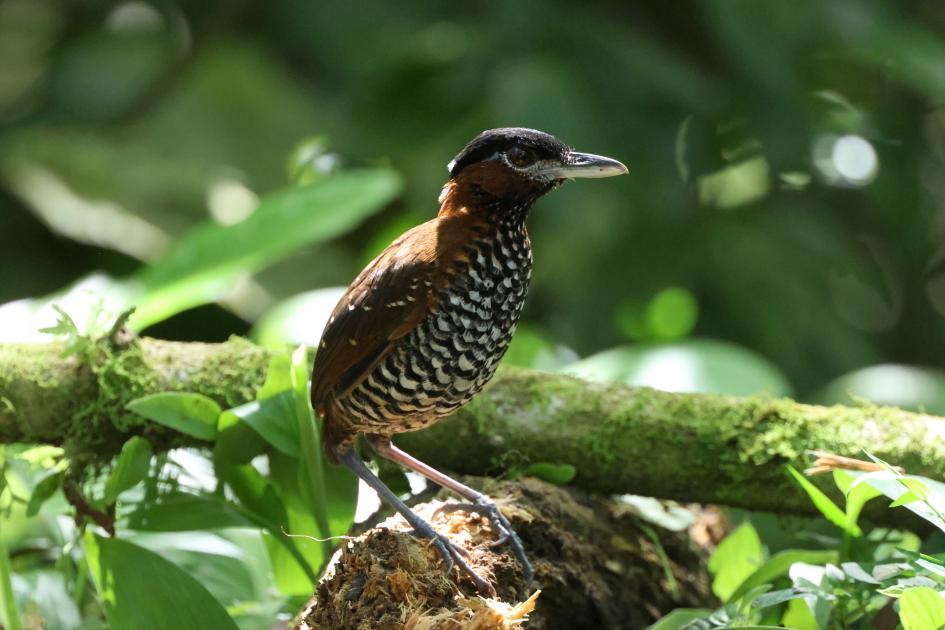
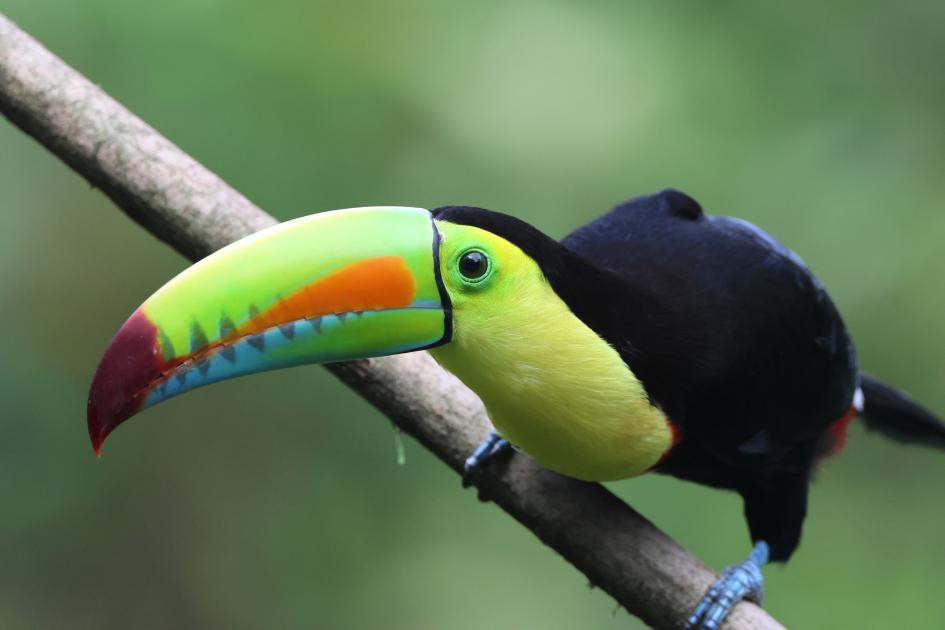
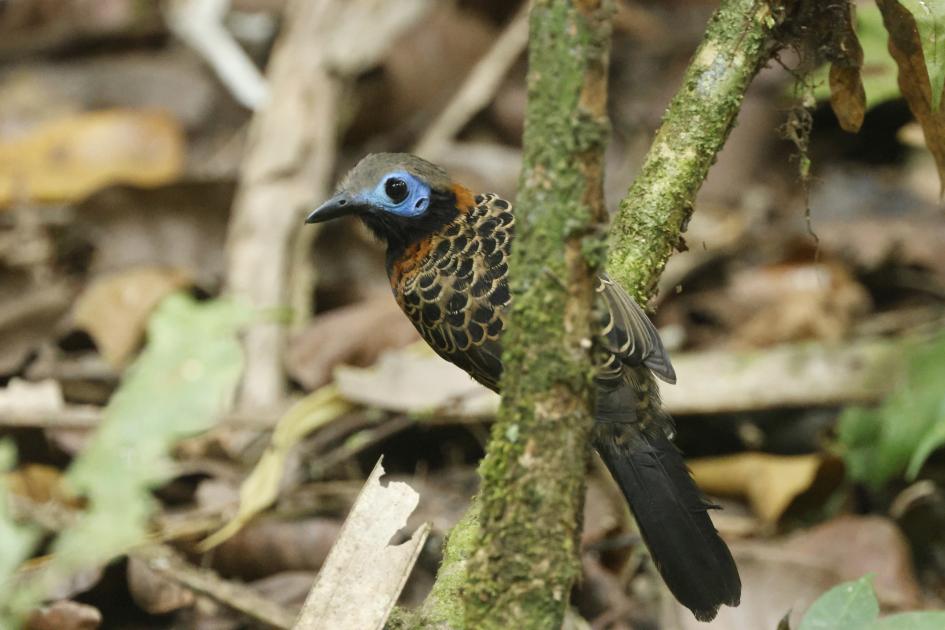
Gavin is an outstanding leader. Birding with him is a continuous learning experience. He's constantly talking about birds, their relationships and environmental requirements, etc., plus local history, geology, agriculture, and so much more. There is never a dull moment when traveling with Gavin.
- Jim W on Panama: Spring at the Canopy Tower
This was an excellent trip, relatively relaxed because of staying mostly just in two places, and the birding and guides were outstanding. Gavin was well organized, excellent at keeping us informed about what to expect on the schedule, and extremely knowledgeable on a number of natural history subjects, especially birds of course. He was an excellent bird spotter and provided great directions to get on the bird. He had lots of interesting and amusing tidbits to share, on various subjects. We have been on a number of birding tours but I would have to say that Gavin was the best leader that we have ever had. I really enjoyed him.
- Wille D. on Panama: Spring at the Canopy Tower
Gavin is a fabulous leader. His knowledge of the natural world and his skills with people are exemplary. Jorge and Tino were amazing guides.
Both Canopy Tower and Canopy Lodge had excellent facilities and service. Staying in just two places and having excellent food prepared for us there saved a lot of time and trouble from traveling from a-b-c and ordering as a group in a restaurant.
- Nick R. on Panama: Spring at the Canopy Tower
This was an excellent trip, relatively relaxed because of staying mostly just in two places, and the birding and guides were outstanding.Gavin was well organized, excellent at keeping us informed about what to expect on the schedule, and extremely knowledgeable on a number of natural history subjects, especially birds of course. He was an excellent bird spotter and provided great directions to get on the bird. He had lots of interesting and amusing tidbits to share, on various subjects. We have been on a number of birding tours but I would have to say that Gavin was the best leader that we have ever had. I really enjoyed him.
- Willie D. on Panama: Spring at the Canopy Tower
*Single Room Supplement (SRS): At the both the Canopy Tower and Canopy Lodge, single rooms are smaller but now have en suite bathrooms and showers. There is no SRS for these rooms. A single person requesting a larger double room at the Tower or the Lodge is subject to their $194/night supplement rate (so $1164 for the Tower tour, $776 for the Lodge extension).
Maximum group size 10 with one leader and a local guide.
More Tours with these Leaders
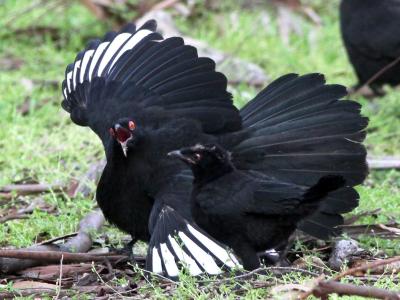
Australia: Victoria and Tasmania
Plains-wanderer, Pardalotes, and Penguins
Plains-wanderer, Pardalotes, and Penguins
Sep 16 to Oct 3 2026 • Gavin Bieber