
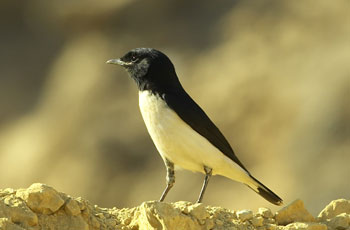
The elegant Hume’s Wheatear is perhaps most easily seen in Oman. Photo: Dick Forsman
The Sultanate of Oman – one of the most attractive, unspoiled, and safest countries in the Middle East – offers an extraordinary wealth of birds and an exceptionally pleasant, welcoming, and relaxed atmosphere in which to enjoy them. Located on the southern tip of the Arabian Peninsula, and with over one thousand miles of coastline, Oman’s varied habitats host a diverse selection of birds with significant elements drawn from the Europe, Asia and Africa. Offshore, Oman’s clean, fish-rich waters support an abundance of seabirds.
We’ll sample the best that this fabulous country has to offer – from the riches of the north coast and the wader-packed mudflats of the east to the hidden oases of the Empty Quarter and the almost Afrotropical fauna of the south.
Day 1: The tour begins this evening in Salalah. Night in Salalah.
Days 2–6: We’ll spend five days in the southern region of Dhofar. Every year, during the summer monsoon season (June to October), the area is cloaked in mist from the warm Arabian Ocean. These misty summer conditions make the Dhofar region one of the greenest in Arabia. The unique conditions mean this area is home to a number of Arabian endemics, such as Arabian Grosbeak, Arabian Partridge, Arabian Warbler, Arabian Wheatear, and Yemen Serin. We’ll visit a number of sites to search for these from impressive sinkholes to secluded springs. We’ll spend some evenings searching for two other Arabian endemics: Arabian Scops-Owl and Arabian Eagle-Owl. Staying out after dark gives us the added chance to encounter other creatures of the night, such as Arabian Wolf, with packs often howling from the hillsides as we wait for the owls to begin calling.
The region is also home to a number of East African species whose distribution creeps along the south Arabian coast, such as Cinnamon-breasted Bunting, Abyssinian White-eye, Black-crowned Tchagra, African Paradise Flycatcher, Blackstart, Tristram’s Starling, Singing Bushlark, and Bruce’s Green-Pigeon. Many of these are widespread in Dhofar’s lush wadis and ayns. Spotted Thick-knee though widespread can be difficult to locate by day but we’ll visit a site where we can view resting birds down to just a few yards. Raptors abound, and we should find a host of eagles – Steppe, Imperial, Bonelli’s, Greater Spotted and, if we’re lucky, Verreaux’s. Other birds of prey such as Oriental Honey Buzzard and Yellow-billed Kite are sometimes spotted from the roadside.
The southern Omani coast has many khawrs, coastal lagoons cut off from the sea by sandbars. These are home to a host of waders, wildfowl, gulls and terns such as Temminck’s and Little Stints, Eurasian Wigeon and Northern Pintail, Slender-billed Gull, and Lesser and Greater Crested Terns, as well as other sought-after species such as Medium Egret, Abdim’s Stork and maybe a rarity such as a Cotton Pygmy-Goose or a Small Pratincole.
Oman has a long history of ocean travel and on one day we’ll take to the seas for a pelagic where we’ll hope to connect with Persian Shearwater, Jouanin’s Petrel, Red-necked Phalarope, Bridled Tern, Masked and Brown Booby, and numerous dolphins and turtles. Another day will be spent inland, in the southern desert of Oman, looking for species such as Chestnut-bellied and Lichtenstein’s Sandgrouse, Asian Desert Warbler, Sand Partridge, Nile Valley Sunbird, and Hypocolius. We’ll also visit Salalah’s souk where we’ll have the chance to buy frankincense and other Arabian delights. Nights in Salalah.
Day 7: We’ll travel north from Salalah to Duqm, stopping en route, where roadside birds could include Long-legged Buzzard, Greater Hoopoe-Lark, or sandgrouses. Night in Duqm.
Day 8: From Duqm, we’ll continue north to Barr Al Hickman, a large bay on Oman’s east coast and home to tens-of-thousands of waders, include Crab Plover and, if we’re lucky, Great Knot. We can also expect to see Terek, Marsh and Broad-billed Sandpipers, Greater and Tibetan Sand-Plovers and thousands of Bar-tailed Godwits, Common Redshanks, Eurasian Curlews and Eurasian Oystercatchers. Terns frequent the area, including Gull-billed, Caspian and Little, while flocks of Greater Flamingos feed in the channels and Isabelline Shrikes and Desert Wheatears feed around the fisherman’s huts on the shoreline. Exactly where we’ll go will depend on the state of the tide and viewing conditions at that time of day. Night in Mahoot.
Day 9: We’ll spend the morning at Barr Al Hickman catching up with any species we missed the previous day before heading inland to Nizwa. If time allows, we’ll visit Nizwa’s famous date souk. That evening we’ll head out for a nearby wadi, looking for Plain Leaf Warbler, Lesser Whitethroat, and Menetries’s Warbler. An after-dark search for Omani Owl is possible. Night in Nizwa.
Day 10: We’ll leave Nizwa and head for the north coast, looking for species such as Indian Roller, Brown-necked Raven, Lappet-faced Vulture and Persian and Hume’s Wheatear en route. Later we’ll drive to the far northwest reaches of Oman, where we’ll finish the evening looking for Variable Wheatear, Namaqua Dove, Striolated Bunting, Arabian Babbler, Arabian Green Bee-eater and Eastern Black Redstart. Night in Sohar.
Day 11: The north coast of Oman is home to a wintering population of Pallas’s Gull, which we’ll search for during the morning. We’ll also keep an eye out for Collared Kingfisher and Sykes’s Warbler, both of which maintain small, isolated populations in northern Oman. The north of Oman is also home to a number of Indian species that we won’t have seen so far such as Purple Sunbird, Indian Silverbill and Red-wattled Lapwing. We’ll also check football pitches – rare patches of green – for Water and Red-throated Pipits, Eurasian Hoopoe, and Isabelline Wheatear.Night in Muscat.
Day 12: For our last morning, we will visit some wetlands close to Muscat, where previous visits have revealed Ferruginous Duck and White-tailed Plover. We will be back at our hotel mid-morning for final packing, and then will transfer to the Muscat International Airport where we will have our last lunch together. The tour concludes at 2 PM at the airport for our flights home.
Updated: 13 December 2023
Prices
- 2024 Tour Price Not Yet Known
- (2023 Tour Price $4,550)
- 2025 Tour Price Not Yet Known
Notes

Questions? Tour Manager: Matt Brooks. Call 1-866-547-9868 (US or Canada) or (01) 520-320-9868 or click here to email.
* Tour invoices paid by check carry a 4% discount. Details here.
This tour is limited to 10 participants.