
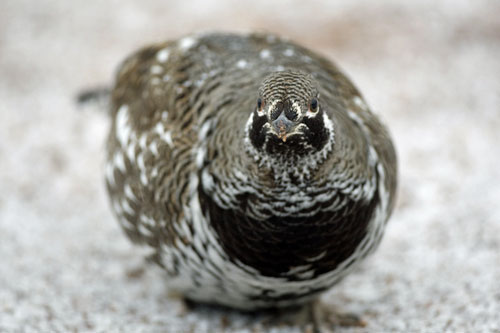
A male Spruce Grouse gathers gravel on a winter Minnesota road Photo: Chris Wood.
Traveling to Minnesota in the depth of winter may seem to defy reason, but for the birdwatcher, the season and place combine to produce a mouth-watering array of species. Northern owls always inspire the greatest interest; we’ll look for Snowy, Great Gray, and Northern Hawk Owls, and if we’re particularly lucky, we may find a Boreal Owl. Sharp-tailed and Ruffed Grouse are usually easier to find at this season, when energy demands dictate that they feed frequently and often conspicuously during daylight hours, and we have a reasonable chance at Spruce Grouse. Past tours have recorded as many as six species of woodpeckers, including Black-backed and American Three-toed, and the standard cadre of regular winter finches—Pine and Evening Grosbeaks, Red Crossbill and Common Redpoll—are sometimes augmented by less predictable species including White-winged Crossbill and Hoary Redpoll. And if regular winter residents such as Northern Shrike, Gray Jay, Boreal Chickadee, and Bohemian Waxwing weren’t enough, each year seems to harbor a surprise or two. Recent tours have recorded Ivory Gull, Slaty-backed Gull, Harlequin Duck, and Townsend’s Solitaire. There are also some great mammals—we’ve seen Moose on half our winter trips, we have also seen Gray Wolf at close range, and once a Lynx!
Weather conditions, including temperature and snow depth, vary from year to year. Food resources, and by extension bird population levels, fluctuate as well, so no two consecutive winters are the same. The weather can be challenging, with wind, snow, and sub-zero temperatures possible, but by dressing appropriately we’ll find deep winter surprisingly manageable, the landscape beautiful, and the birds well worth the effort. Our itinerary will remain flexible, allowing us to travel to the places where our target birds are most likely to be found.
Day 1: The group will convene around midday at Minneapolis-St. Paul airport. We’ll begin with a few birding stops during the afternoon and have dinner on our way to Duluth, where we’ll be based for five nights.
Fabulous tour. The owls cooperated! Frank is a wonderful leader. He knows the area extremely well and finds the birds that you want to see. He is concerned about your well being. A great value.
Karyn Delaney
Days 2-5: The vast boglands north and west of Duluth offer some of the best winter birding in the country. Highlights include the possibility of finding Great Gray Owl and Northern Hawk Owl, two species that are present each winter in varying numbers. We’ll keep a look out for these species throughout the tour, but the so-called Sax-Zim bog provides some of our best chances for these nomadic species. The habitat in these regions is also ideal for Sharp-tailed and Ruffed Grouse, while adjacent open farmland hosts Black-billed Magpie, here at the eastern edge of its range, and Northern Shrike. In years with less snow, Snow Bunting and Rough-legged Hawks can be found. Another day will be spent north of the scenic Lake Superior harbor town of Two Harbors, with a visit to the secluded boreal woodlands near the hamlet known as Isabella. This region is one of the most reliable haunts for some of Minnesota’s most highly sought-after winter birds. Our efforts will focus on two birds in particular: Spruce Grouse and Black-backed Woodpecker. We’ll also look for Gray Jay and Boreal Chickadee and the enigmatic winter finches, including Pine and Evening Grosbeaks, Common and perhaps Hoary Redpolls, as well as Red, and White-winged Crossbills. The birding in and around Duluth and other towns along the north shore of Lake Superior can also be surprisingly productive. Ornamental plantings attract fruit-eaters including Bohemian Waxwings, which are sometimes seen by the thousands (although we’d expect smaller numbers of this wandering nomad). The fruiting trees have in the past attracted Townsend’s Solitaire and Varied Thrush (both rare but regular winter visitors). We’ll scour the barren icescapes of the frozen Duluth-Superior harbor for Snowy Owl. We’ll also visit Canal Park, which is tended by hundreds of gulls when conditions are right. If gulls are present, we can expect Glaucous and Thayer’s and hope for rarities such as Iceland Gull; in 2008 we even saw a Slaty-backed Gull. Although our focus will be on the birds, with luck our travels through northern Minnesota may result in encounters with Mink, Pine Marten, Fisher, Porcupine, Moose, or if we’re very lucky Gray Wolf or Lynx. Nights in Duluth.
Day 6: This morning we’ll make our way back to Minneapolis where the tour concludes with midday dropoff at MSP airport.
Updated: 09 February 2024
Prices
- 2025 Tour Price Not Yet Available
- (2024 Tour Price $2,290)
Notes

Questions? Tour Manager: Erin Olmstead. Call 1-866-547-9868 (US or Canada) or (01) 520-320-9868 or click here to email.
* Tour invoices paid by check carry a 4% discount. Details here.
Maximum group size seven with one leader.