Georgia and South Carolina
Birding the American Civil War: Savannah to Charleston
-
Apr 2028
Jon Dunn
Tour Price to be Determined


Tour Price to be Determined
The old colonial towns of Savannah and Charleston are two of the most beautiful and historic cities in the Old South. Both figured prominently in the American Civil War, the latter at the start of the war and the former near the end. Both cities preserve important sites associated with the conflict. In addition both cities figured prominently during our American Revolution.
Both towns also have excellent birding close by. Our April visit is timed to coincide with the peak period of song for resident species and with the arrival of breeders. The wide variety of species we should see include the scarce and declining Bachman’s Sparrow, and there is a reasonable chance for the endangered Red-cockaded Woodpecker. The trees and wildflowers should be in full bloom, and April temperatures are ideal for birding and exploring the history of the Old South.
This tour is one in a series organized by Jon to explore the history and natural history of the sites associated with the American Civil War.
Day 1: The tour begins at 6:00 pm in Savannah, Georgia. Night near Savannah’s airport.
Day 2: We'll begin at the Webb Wildlife Management Area in South Carolina, searching for the endangered Red-cockaded Woodpecker, the declining nominate race of Bachman’s Sparrow, along with many other woodland species. Prothonotary, Pine, Prairie and Yellow-throated Warblers, Painted Bunting and Blue Grosbeak breed here and Barred Owl and both Red-headed and Pileated Woodpeckers are resident. We'll keep an eye on the skies for Swallow-tailed and Mississippi Kites, both of which breed here as well. After lunch we'll return to Savannah, this time to the Historic District where we will spend the next two nights.
Day 3: We’ll visit Tybee Island on the Georgia coast, where we should see a wide variety of waterbirds perhaps including specialties like American Oystercatcher and a lingering Piping Plover of the nominate subspecies. Gulls, terns and Black Skimmers should also be numerous, and we stand a fair chance of finding a lingering Lesser Black-backed Gull. At nearby Fort Pulaski the open woods contain resident Carolina Chickadee and other resident species, and Orchard Orioles and Painted Buntings breed here. Fort Pulaski, the site in January 1861 of the first offensive move by the Confederate Army when it seized the fort, a move carried out without firing a shot. The Union Army took it back in mid-April 1862 and their use of rifled cannon forever rendered these types of fort obsolete. Night in Savannah’s historic district.
Savannah was the location for John Berendt’s famous book Midnight in the Garden of Good and Evil, which was made into a film. Historically, the city played an especially prominent role toward the end of the Civil War. Unlike many of the other towns in the swath of Sherman’s infamous “March to the Sea,” Savannah was surrendered peacefully several days after the surrender of Fort McAllister in mid-December 1864, a historic event often known as Sherman’s Christmas present to Lincoln. Because Savannah avoided being burned and plundered, parts of the old town still preserve their pre-war appearance. We’ll take a walking tour of the downtown district, where we’ll pass a number of famous houses, some of which belonged to some of the South’s best-known generals as well as the one which General Sherman stayed in for an extended visit before continuing the campaign on into South Carolina; we’ll spend the afternoon seeing these old homes, then dine in one of the many celebrated restaurants here in the city’s old section. Savanna’s history dates back to well before the American Civil War. It was founded by James Oglethorpe early in the 18th century and was a site of one of the Americans’ worst defeats in the Revolutionary War on 9 October 1779, this despite the American forces greatly outnumbering the British. During the battle, Casmir Pulaski, the famous and beloved Polish cavalry officer, was mortally wounded. We’ll discuss that and the slave history, too, on the walking tour. Night in Savannah’s historic district.
Day 4: After breakfast we’ll cross into South Carolina to bird the Savannah National Wildlife Refuge. We should see Anhinga, a wide variety of herons possibly including American and especially Least Bitterns, Glossy and White Ibis, perhaps King Rail, and Sora; if conditions are right, we might also encounter a good variety of shorebirds. Passerines here could include such early-arriving breeders such as Eastern Kingbird, Orchard Oriole and Painted Bunting while migrants might include Palm Warbler and perhaps an early arriving Bobolink. From here we will head up to large rookery preserve at the Port Royal Cypress Wetlands where we may find Great and Snowy Egrets, Black-crowned and Yellow-crowned night Herons, Little Blue and Green Herons and Wood Storks. A circling boardwalk enables us to get close views of the nesting birds. Great Crested Flycatcher, White-eyed Vireo, Carolina Chickadee, Carolina Wren, Northern Parula, Yellow-throated Warbler and “Purple” Common Grackles might well be present too. After lunch we might visit Bear Wildlife Management Area if conditions are favorable, a location that is often excellent for shorebirds and other water birds. Along the way we’ll again watch the skies carefully for Swallow-tailed and Mississippi Kites. From here we’ll continue to Charleston. Night in Charleston's Historic District.
Day 5: We’ll visit the famous I’on Swamp, another location where we might find Red-cockaded Woodpecker as well as a variety of other species including Prothonotary and Hooded Warblers, Summer Tanager, and possibly Kentucky and Swainson’s Warblers. This is also an evocative locale in which to contemplate the disappearance of Bachman’s Warbler, which was best known from this region many decades ago (into the 1940’s); the last credible records of this species came from the Charleston area over a half century ago in 1962.
In the afternoon we’ll take the short boat trip to Fort Sumter. The American Civil War began here, before dawn on April 12, 1861, when Confederate batteries around the bay ultimately induced the Union commander, Robert Anderson, to surrender the fort the next day. Ironically, the only casualties came when the Union soldiers fired a final last salute before surrendering the fort. Later in the war (1863) Union ironclads reduced the fort to rubble, although the Confederates held the fort. The fort was rebuilt in a different style late in the 19th century when the Spanish American War was about to begin. From Fort Sumter we'll be able to see Morris Island to the southeast, site of Fort Wagner, where some 272 Black Union soldiers were killed in the failed Union assault on July 18, 1863 and memorialized in the film “Glory.” While birding here on our tour in 2024, there was a young male Common Eider at the pier, a rarity this far south. Gazing north from Fort Sumter we’ll be able to see Fort Moultrie where on 28 June 1776 the American forces held off a British fleet of nine men-of-war. The city eventually fell to Lord Cornwallis in 1780. A little more than a year later, Cornwallis would find himself trapped on the York Peninsula, Virginia and on 19 October 1781 was forced to surrender, a defeat which led the British to abandon their attempt to maintain America as part of the British Empire. Terms were eventually negotiated and the last British forces left America from Noe York City on 25 November 1783. The British withdrew earlier from the southern colonies, on 11 July 1782 from Savannah and 14 December 1782 from Charleston. Night in Charleston's Historic District.
Day 6: We’ll visit the north end of Folly Island, a good location for migrant shorebirds and home to breeding American Oystercatchers and Wilson’s Plovers. On the walk we should see a few passerines, quite possibly including Painted Bunting.
Steeped in American history from colonial and Revolutionary War days through the Civil War, Charleston offers plenty to see. We’ll take a walking tour past beautifully restored antebellum houses, then visit the city’s southern end at the Battery to peer south toward Fort Sumter. We’ll top the day off with dinner in one of the fine restaurants in the older, restored part of the city. Night in Charleston's Historic District.
Day 7: There are many fine birding areas near Charleston. This morning we'll visit the Pitt Street Extension to check for migrant shorebirds. Clapper Rails are numerous and the very gray griseus subspecies of Marsh Wren nests here. We will also search for Seaside Sparrow. We'll be looking down on the water birds and the light will be excellent, so we should enjoy great views. In our visits Gull-billed Tern has been quite accommodating, hovering above the flats looking for crabs. The tour concludes about noon at the Charleston airport in time to catch mid-afternoon flights.
Note: The information presented here is an abbreviated version of our formal General Information for Tours to Georgia and South Carolina. Its purpose is solely to give readers a sense of what might be involved if they took this tour. Although we do our best to make sure that what follows here is completely accurate, it should not be used as a replacement for the formal document which will be sent to all tour registrants, and whose contents supersedes any information contained here.
ENTERING THE UNITED STATES: Non-U.S. citizens will need a valid passport and may need a tourist visa. Consult your nearest U.S. Embassy or consulate for details. Canadian citizens should carry proof of citizenship in the form of a passport or birth certificate.
PACE OF THE TOUR: Although there is one day with a somewhat long drive, this is a fairly relaxed tour. Most walking is done along roadsides or level trails, with the occasional trail in marshy grass. There are no particularly strenuous hikes on this tour, although some of the walks will be about two miles (round trip), all on level ground! Most days we depart around 6:00 or 7:00 AM and return by 5:00 PM. Much of our dining will be at established fine restaurants and some meals might take a bit longer than one experiences on most tours. Since we have two walking tours and a boat trip to Fort Sumter, along with dinner reservations, we will, at times need to keep to a schedule.
HEALTH: Birdwatching in coastal Georgia and South Carolina poses no real health hazards.
Smoking: Smoking is prohibited in the vehicles or when the group is gathered for meals, checklists, etc. If you are sharing a room with a nonsmoker, please do not smoke in the room. If you smoke in the field, do so well away and downwind from the group. If any location where the group is gathered has a stricter policy than the WINGS policy, that stricter policy will prevail.
Miscellaneous: The sun can be intense in April on the coast so bring sun hat, protective clothing and a strong sunscreen essential.
Chiggers and ticks are present in small numbers and mosquitoes might be present in some areas. Tiny sand fleas can be troublesome, though they are less obnoxious on cool, windy days; insect repellent can be helpful to ward-off these pests. We recommend bringing protective clothing and using insect repellents with a high concentration of DEET.
CLIMATE: Spring temperatures are in the 70s and 80s but near the coast a breeze tends to moderate the effect of the heat. Nights remain mild to warm. Scattered rain showers and thunderstorms, some with brief, heavy rain, are possible. If a cold front passes through it could be much cooler (lows in the 40’s, highs in the 60’s, and windy).
ACCOMMODATIONS: We stay in standard accommodations in the center of the cultural areas (where possible) throughout the course of the tour.
FOOD: Food is an element of this tour as we’ll be dining at a number of excellent restaurants in Savannah and Charleston.WINGS tours are all-inclusive, no refunds can be issued for any missed tour meals.
Food Allergies / Requirements: We cannot guarantee that all food allergies can be accommodated at every destination. Participants with significant food allergies or special dietary requirements should bring appropriate foods with them for those times when their needs cannot be met. Announced meal times are always approximate depending on how the day unfolds. Participants who need to eat according to a fixed schedule should bring supplemental food. Please contact the WINGS office if you have any questions.
TRANSPORTATION: We will be traveling in 12 or 15 passenger window vans or minivan, depending on the group size. Participants should be able and willing to ride in any seat in our tour vehicles.
2026 Narrative
IN BRIEF
This year’s tour enjoyed near perfect weather throughout the week we were there, a little warm at the start and then cooling, but no rain and biting insects were very few as it had been pretty dry. We recorded 119 species , which included Wilson’s Plover, Least Bittern, Swallow-tailed and Mississippi Kites, Red-headed and Red-cockaded Woodpecker, Blue-headed Vireo, nine species of warblers including Prothonotary, Hooded and Prairie and a singing male Painted Bunting. An adult White-faced Ibis in alternate plumage at Savannah NWR, SC was rare. Other notable non-bird sightings were a Southern Cloudywing, a most cooperative Creole Pearly-eye, and a Swamp Rabbit. We took historical walking tours of both Savannah and Charleston, and enjoyed much fine dining in Savannah’s and Charleston’s wide selection of restaurants.
IN DETAIL
Our tour began with a brief meeting at the Holiday Inn Express near the Savannah, Georgia, airport followed by a short walk to dinner at Sam Snead’s grill. As we came out of the restaurant it was nearing darkness. We looked up and a loose string of Wood Storks flew past. The next morning after breakfast and packing the van we headed north and across the Savannah River to Webb WMA near Garnet in Hampton County, South Carolina. Along the way we saw two Wild Turkeys in Georgia before we crossed the state line. Webb WMA is an excellent place for birding and we pretty much had it to ourselves. Species of note included four species of woodpeckers: Red-headed, Red-bellied, Pileated and the endangered Red-cockaded, Great Crested Flycatcher, Red-eyed Vireo, Carolina Chickadee, Tufted Titmouse, Blue-gray Gnatcatcher, Brown Thrasher, Eastern Bluebird, Summer Tanager, Chipping and White-throated Sparrow and a variety of warblers which included Prothontary, Northern Parula, Pine, Yellow-throated, Prairie, and Northern Waterthrush. We also spent a good deal of time looking at a pair of Bachman’s Sparrows down Matthew Lane and listening to their beautiful songs. Overhead we saw both Mississippi (briefly) and the beautiful Swallow-tailed Kites. A Southern Cloudywing (a skipper) was photographed We had a late lunch at Subway in Hardeeville and continued on to the Historic District in downtown Savannah where we checked into the Hampton Inn. We walked to dinner dining at Churchill’s Pub.
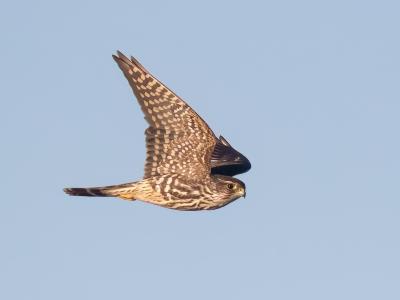
The next day we headed south to Tybee Island for a leisurely walk on the beach. I am grateful for the notice of the “Orange Crush” weekend on Tybee Island which would have meant a very crowded beach. Species on our walk included Brown Pelicans, a dozen Sanderlings, Laughing along with four Lesser Black-backed Gulls, a fast-flying northbound (for South Carolina) Merlin, and a large flock of terns which included many Royals, 10 Sandwich, a few Forster’s and some 80 Black Skimmers. From here we headed to Fort Pulaski where we birded a bit and noted a pair of adult Bald Eagles. One had alighted on a pine branch with a dead Laughing Gull and it proceeded to de-feather it, starting with one wing. An adult Red-shouldered Hawk flew over. We then visited the fort where we saw a short film in the visitor center and then walked the walls of the fort. This brick fort was thought impregnable until the Union Army proved otherwise in mid-April 1862 with their rifled parrot cannons which pulverized the northeast corner of the fort. After a day and a half it was surrendered to Union forces and the port of Savannah for the remainder of the war was in Union hands. We noted a few birds around the walls of the fort, notably many Northern Rough-winged Swallows. We had a delicious lunch at The Deck Beach Bar and Kitchen on Tybee Island and then headed back to our hotel for an ever so brief break before driving to our meeting point at Columbia Square for our walking tour with Bonnie Blue Tours. Bonnie has led us on many occasions in past years and we enjoyed a most informative walk taking in her favorite haunts. Birds noted included Downy Woodpecker, White-breasted Nuthatch, Carolina Wren, Gray Catbird, American Robin (they nest in Savannah) and Yellow-rumped (“Myrtle”) Warbler. Bonnie accepted our invite to join us at dinner at 1791 (very close to Columbia Square) and she continued to teach us all about the history of Savannah. We had our own private and well-insulated dining room. Speaking only for myself I felt we had our best and overall most enjoyable dinner there.
The next morning, after breakfast and packing, we headed back across the Savannah River to Savannah NWR and drove the five+ mile wildlife tour road. Our most surprising find (actually had been found earlier) was a White-faced Ibis, an adult in alternate plumage. This is well east of its normal range. A well-studied Clapper Rail and a female Least Bittern were seen well as were a flock of migrant Bobolinks. Other species seen included Common Gallinule, Black-necked Stilt, Wilson’s Snipe (3), Least, Gull-billed and Forster’s Terns, American Anhinga, White Ibis, Eastern Kingbird, numerous (some 150) Cedar Waxwings which were feeding on mulberries, Orchard Oriole, and Prairie and Yellow-rumped Warblers. Tree Swallows were abundant. We conservatively estimated 500 birds. And we can’t forget the dozen or more American Alligators, a few of which were very large. This is the main draw for tourists, especially on weekends. From here we continued on to Port Royal where enjoyed a fine lunch at Alvin Ord’s Sandwich Shop. Close-by is the Cypress Wetlands which has a circular wooden walkway that circles a large rookery. A number of herons nest here, the egrets all with their fine plumes displayed. A single Western Cattle Egret was flanked by nesting Snowy and Great Egrets. The herons on nests included Black-crowned and Yellow-crowned Night Herons along with Little Blue and Tricolored Herons. Nesting Wood Storks were also present as were nine loafing Roseate Spoonbills, including a colorful adult. Land birds included Carolina Wren, Northern Parula, Carolina Chickadee, Red-eyed Vireo, White-breasted Nuthatch, and White-eyed Vireo. We looked at “Purple” Common Grackles. These birds of the southeast lack the bronzy back of the subspecies that is found over much of the rest of North America. While there a northbound Merlin shot by overhead. Here we also noted Red-eared Sliders (“Yellow bellies”, the nominate subspecies which lacks a red ear) as well as the large-sized Swamp Rabbit. From here we headed northeast on to the historic district of Charleston and the Hampton Inn. A single Swallow-tailed Kite was seen in route. Dinner that night was at the French restaurant, Rue de Jean a few minutes away from our hotel.
The nest morning we headed northeast to a good birding spot (Little Hellhole) near Cordesville along the Swamp Fox Palmetto Trail. Here we saw another Red-cockaded Woodpecker and our first Brown-headed Nuthatches, a pair. Warblers noted included Black-and-white, Pine and Prairie. Great Crested Flycatchers and Blue-gray Gnatcatchers and two pairs of Wood Ducks flew over. Pileated Woodpeckers were calling loudly and pretty continuously but remained out of visual range. A Northern (“Yellow-shafted”) Flicker was our only one of the tour and here we got good views of White-breasted (eastern birds which sound very different from the two western subspecies groups) and Blue Jays. We had good views of several Eastern Towhees and noted their eyes were white, not red, thus resembling Florida birds. Green Treefrogs were calling. On the way to I’on Swamp a snake crossed the road. It appeared to be an Eastern Garter Snake. At the famous I’on Swamp, home to now extinct Bachman’s Warbler(last reliable sighting over 70 years ago), we noted few birds but one was a singing male Hooded Warbler. A Mississippi Kite circled overhead. The most notable sighting was a Creole Pearly-eye which landed on several of us. Brock and Kaufman’s guide to North American butterflies say it is rare and local and prefers mature woodland and canebreaks. After an early lunch at Seewee Restaurant in Awendaw, a place with delicious food and local color, we headed to Patriots Point for our boat trip to Fort Sumter.
Fort Sumter looks little like it did in early April 1861, just before the Confederates shelled it at 4:30 a.m. on April 12, the start of our American Civil War. The manner in which the war started galvanized both sides and the Civil War which followed lasted four years and cost roughly a million lives. It settled the unresolved issue of slavery with the passage of the 13th amendment in March of 1865. The lecturer on the boat (last name Moore) was excellent. It carefully reviewed the events of late 1860 until mid-April). While on Fort Sumter we were able to see all of the places that the South fired on the fort. A ranger told me that a Burrowing Owl had spent the previous winter at the fort, a real rarity for South Carolina. On a previous visit the rangers told me of a Snow Bunting there in late fall and last year we had a Common Eider under the pier. Fort Sumter is more than just a historical landmark. This year we had an immature Bald Eagle fly over the fort. Our dinner that night was at Stella’s, a Greek restaurant. We ate outside and it was a lovely evening. We closed the evening with a visit to Republic Ice Cream for dessert.
This morning we headed to the east end of Folly Island where we walked through the woods to the beach beyond. Just before we parked a juvenile Red-shouldered Hawk was seen perched which was seen by a few. As we walked through the woods a few passerines were seen and these included a Northern Parula, a male Black-and-white Warbler and our first ever (for this tour) Blue-headed Vireo. We also had a singing male Painted Bunting which was seen well by the entire group. Great Crested Flycatchers were vocal and visible and a Green Heron flew over. A Downy Woodpecker and Carolina Chickadee were also seen. Palamedes Swallowtails were numerous. Once on the beach we found two pairs of Wilson’s Plovers. Will noted that both the male and female of the near pair were banded. Other shorebirds present included American Oystercatcher, Black-bellied Plover, Sanderling, Dunlin, Ruddy Turnstone, “Eastern” and “Western” Willets, a pair of Least Terns and two Red-breasted Mergansers. A passing Merlin put the shorebirds up for a time. From here we headed back to the Hampton Inn where we took the trolley car down towards the south end of the island where we met our guide, Eric Lager, for our three hour walking tour. Eric discussed the history of Charleston from first settlement in 1670 (island occupied a decade later) through the American Civil War. He also discussed architecture and we saw many beautiful homes, particularly near the Battery. After the tour we walked to Eli’s Table where we had our final dinner. Eventually we picked up our luggage and drove out to the Holiday Inn Express near the Charleston airport.
The next morning we headed to Pitt Street Bridge (Pier) where we enjoyed a variety of shorebirds at close range. These included American Oystercatcher, Semipalmated Plover (35), Black-bellied Plover, Ruddy Turnstone (20), Sanderling, Dunlin, Least and briefly Semipalmated (one) Sandpipers, Short-billed Dowitcher (central arctic breeding subspecies, hendersoni), and two “Western” Willets. A pair of Gull-billed Terns was also seen along with Forster’s Terns and Black Skimmers. Two Bald Eagles came by and sat on a small shack at the end of a pier and one or more Ospreys were often present overhead. We eventually located a singing Marsh Wren of the very gray coastal southeastern subspecies, griseus. These are within the eastern group of subspecies which might be a different species from the western group of subspecies. Will found a cooperative Swamp Sparrow, which remained in view for minutes - long enough for scope studies for all. Calling Fish Crows were flying back and forth for much of the morning. We eventually headed back to the hotel where after a final checklist in the lobby, the tour concluded.
I could not imagine a better leader. Outstanding skill locating birds by call and assisting everyone in the group an opportunity to observe. Also, outstanding skill in history of the region. His discussions of historical activities were very interesting and entertaining.
- Evord K. on Georgia and South Carolina
The tour was everything that I had expected. I can’t imagine a better leader than Jon with his great skill both locating birds by call and assisting everyone with their observations. His knowledge of the region’s history was outstanding and his discussions of historical activities were both interesting and entertaining. I was fully satisfied.
- Evord K. on Georgia and South Carolina
This tour is scheduled to run every other year.
Maximum group size seven with one leader.