
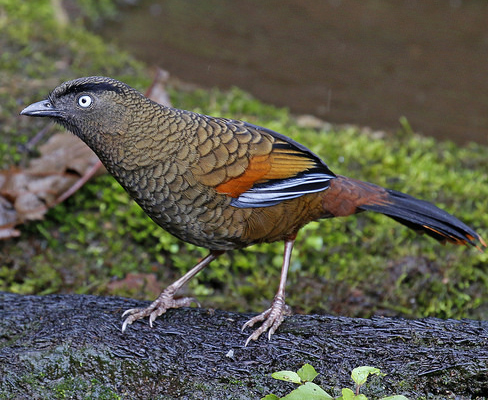
Blue-winged Laughingthrush Photo: David Fisher
Lying in the most south-western corner of China, Yunnan Province has received little attention from birders and yet it holds some of the most exciting habitats and alluring species in the whole of Asia. The area’s close proximity to Myanmar (formerly Burma) coupled with the ease of travel - good roads, often excellent hotels, and superb food – combine to produce a comfortable tour with some really special birds.
We’ll visit several areas in western Yunnan including a number of sites close to the border with Myanmar. The entire area, much of it on the Ancient Southern Silk Road, is a historical treasure trove replete with numerous attractions. We’ll start by visiting the border town of Ruili, one also blessed with good quality forest on its door step. Here we’ll look for species including Pin-tailed Green Pigeon, Cook’s Swift, Stripe-breasted Woodpecker, Red- and Coral-billed Scimitar-babblers, Scarlet-faced Liocichla and Pale-billed Parrotbill.
We’ll then move to Yingjiang, a smaller town that’s also close to the Myanmar border. Sought-after species here include Grey Peacock-pheasant, Great Slaty Woodpecker, Blue-naped Pitta and Collared Myna while other specialities could include both Collared Treepie and Vinous-breasted Starling. We’ll continue to Tengchong, both historic settlement and scenically stunning with its surround of a cluster of young volcanoes. We’ll concentrate here on finding Brown-winged Parrotbill and Slender-billed Oriole.
Gaoligongshan, our next port of call, was featured in the BBC’s Wild China TV series, and it’s easy to see why. Early 20th century naturalist-adventurers such as Frank Kingdon Ward explored much of this area and among the rich plant flora (the Nature Reserve boasts over 1,400 species of higher plants) we’ll search for avian delights such as Spot-breasted Parrotbill, Cachar Wedge-billed Babbler, Gould’s Shortwing and Black-breasted Thrush. Our final port of call will be historic Lijiang, a UNESCO World Heritage site famed for its distinctive architecture. The skyline of this quaint town is dominated by Jade Dragon Snow Mountain, a year round snow-capped peak that reaches almost 18,500 feet, and it’s the woodlands near there where we’ll search for another speciality, Yunnan Nuthatch. Nearby we’ll also hunt for Lady Amherst’s Pheasant, the severely threatened White-speckled Laughingthrush, Rufous-tailed Babbler and Black-bibbed Tit before heading back to Beijing.
Day 1: The tour begins this evening in Beijing.
Day 2: This morning we’ll connect with a flight south to Mangshi in western Yunnan. It’s unlikely that we’ll arrive in time to do any birdwatching. Night in Mangshi.
The birds were wonderful and the scenery terrific. The group size made the birding fun. Paul was a very capable guide and great birder. Wang Qingyu was amazing.
Bryan Smith, March 2018
Days 3-4: We’ll head south from Mangshi to Ruili. Known as the home of the Dai ethnic group, Ruili is bordered on three sides by Myanmar and is a large, prosperous border settlement. The import of gems, jade ware and jadeite from neighboring Myanmar have helped create China’s largest jewel market. Many of the low lying ridges immediately around Ruili are still also covered in good quality forest and we’ll concentrate on finding some of this area’s specialities. These include the likes of Jerdon’s Baza, Pin-tailed Green Pigeon, Brown Wood Owl, Stripe-breasted Woodpecker, Black-throated and Rufous-necked Laughingthrushes, Scarlet-faced Liocichla, Pale-footed Bush Warbler as well as both Pale-billed (previously Lesser Rufous-headed) and Rufous-headed Parrotbills. With a bit of luck we might also come across a Hodgson’s Frogmouth or a Spot-throated Babbler. Nights in Ruili.
Day 5: After another morning near Ruili, we’ll drive to Yingjiang, a smaller settlement than Ruili but one that’s also nestled close to the Myanmar border. We should arrive in time to do a little birding, perhaps seeing Little Pratincole, Black-breasted Thrush and Collared Myna around town. Night in Yingjiang.
Days 6-7: Spending two full days around the tiny border settlement, we’ll have ample time to search for the area’s lower elevation specialties such as Grey Peacock-pheasant and Spot-bellied Eagle Owl, both genuinely rare and decidedly elusive, but others, hopefully including Blossom-headed Parakeet, Collared Falconet, Blue-bearded Bee-eater, Red-billed and perhaps even Coral-billed Scimitar Babblers, Rufous-capped and Yunnan Fulvettas are less so. The forests here abound with birds and in our quest to see a representative sample of them, we’ll explore severalf forest trails and a small reserve not very far from our hotel. This is the best area in the whole of China for seeing species such as Oriental Pied, Great and Wreathed Hornbills, White-hooded Babbler and Golden-crested Mynas as well as White-tailed, Sapphire and Hill Blue Flycatchers. At times Myanmar will only be a stone’s throw away, and the river we’ll bird along is actually the border, so we’re sure to add species to our embryonic Myanmar list as we go.
Day 8: After a final morning near Yingjiang we’ll drive onto Tengchong, an area famed for ia mild climate, iancient volcanoes, and geothermal springs. Tengchong also played an important role during the Second World War when Allied pilots flew sorties over ‘the hump’, resupplying Chinese forces fighting the Japanese. We’ll spend the night in a comfortable hotel in Tengchong.
Day 9: We may be awakened by the attractive song of Black-breasted Thrush - the first of a handful of Tengchong specialties. A pleasant bird-thronged park holds our other targets - Mountain Bamboo Partridge, the localised Brown-winged Parrotbill and Slender-billed Oriole among others, and we’ll spend several hours here before heading on to Baihualing.
Our spectacular route takes us through deep valleys and across impressive dividing ranges. While the roads are now excellent and our progress likely to be rapid and easy, this wasn’t always the case. Indeed it’s the region’s former remoteness that has kept it an intact, vast refuge for an extraordinarily rich biodiversity. The Gaoligong range, sandwiched between the mighty Salween (Nujiang) river and neighboring Myanmar encompasses habitats ranging from subtropical evergreen forests to snow-capped peaks and glaciers at over 20,000 feet. We’ll likely be enthralled by the richness of the fabulous Gaoligong forests – forests that several early plant hunters, such as George Forrest and Frank Kingdon Ward (themselves immortalised by plant and birds that carry their names) explored for rhododendrons and other garden-worthy plants. We’ll spend three nights in a comfortable, new guest house on the edge of the reserve.
Days 10-11: Two full days based at Baihualing right in the heart of Gaoligong Shan’s incredibly varied forests will give us time to find some of its avian wonders. In stands of bamboo we’ll search for Broad-billed Warbler and Slender-billed Scimitar Babbler while deep forest gullies will hold more secretive species such as the often reticent Cachar Wedge-billed Babbler, Spotted and Grey-bellied Wren Babblers, Blue-winged and the gorgeous Red-tailed Laughingthrush. We’ll explore several forest trails, including one that was previously part of the Southern Silk Road. Other special species should include Black-headed and Blyth’s Shrike Babblers, Beautiful Sibia, Spot-breasted Parrotbill and with luck, even Gould’s Shortwing. Three tesias, Slaty-bellied, Grey-bellied and Chestnut-headed, also inhabit the mossy, lush forest. Hill and Rufous-throated Partridges are, unfortunately, both much more likely to be heard than seen while other secretive forest denizens include both Silver and Mrs. Hume’s Pheasants. There’s now a series of bird blinds, constructed by enterprising locals for Chinese bird photographers, and we hope to be able to visit at least a couple of these during our stay as they can afford spectacular views (and marvelous photographic opportunities) of a number of rarely seen east Himalayan specialties.
Day 12: After a final morning we’ll leave Baihualing and the mighty Gaoligong Mountain range for a short drive north to Baoshan.
Day 13: Leaving Baoshan early we’ll have a half-day’s drive north to Lijiang. We expect to arrive in Lijiang in time to do some local birding and will spend the night in a very comfortable hotel right on the edge of Lijiang’s historic old town. Originally inhabited eight centuries ago by the ethnically distinctive Naxi cultural group, Lijiang is an extremely attractive modest-sized town. Once a center for trade along the old pack horse road, Lijiang old town is famous for its orderly Naxi architecture with its distinctive system of waterways and bridges. Recently designated a UNESCO World Heritage site, Lijiang is now a booming tourist resort with equal numbers of visitors drawn to the town’s rich cultural heritage and to the nearby Jade Dragon Snow Mountain, a year-round snow-capped peak that boasts the northern hemisphere’s southernmost glacier. At almost 18,500 feet, this impressive mountain dominates the town’s skyline – and remains proudly unclimbed! Time permitting we’ll either spend the late afternoon searching for Yunnan Nuthatch, the province’s only endemic bird, or exploring Lashihai, a bird-thronged lake a short distance to the west of town where we hope to see Falcated and Ferruginous Ducks, while small flocks of Common Crane strut amid the tiny fields where Black-headed Greenfinches also feed. Night in Lijiang.
Day 14: We’ll spend most of the day around picturesque Lijiang and will leave early for a site where the poorly known and globally threatened White-speckled Laughingthrush was recently discovered. It’s extremely rare and persecuted so our chances of finding one are slim. Other target species in the rich forests here include the fabulously inquisitive Rufous-tailed Babbler, Black-bibbed Tit, vociferous but melancholy Black-headed Sibia, Black-streaked Scimitar-babbler, Chinese Babax, Elliot’s Laughingthrush, Rusty-capped and Spectacled Fulvettas, White-collared Yuhina. Night in Lijiang.
Day 15: After a final morning in Lijiang we’ll take a flight to Kunming, Yunnan’s provincial capital, before another from there back to Beijing. Night near Beijing International Airport.
Day 16: The tour concludes this morning with transfers back to the airport.
Updated: 29 March 2019
Prices
- 2025 Tour Price Not Yet Available
Notes

Questions? Tour Manager: Erin Olmstead. Call 1-866-547-9868 (US or Canada) or (01) 520-320-9868 or click here to email.
* Tour invoices paid by check carry a 4% discount. Details here.
Maximum group size 10 with two leaders. Both leaders will accompany the group irrespective of group size.