Arizona: Owls and Warblers
-
May 5-14, 2027
Skye Haas
Tour Price to be Determined


Tour Price to be Determined
Southeastern Arizona is one of North America’s great birdwatching destinations, particularly during mid-May when birdsong and breeding activity are typically at their peak. From the rich Sonoran Desert around Tucson to the lush cottonwood riparian habitat near Patagonia, the cool sycamore-lined canyons of the Huachuca Mountains, and the high-elevation forests of the Chiricahua Mountains, the region has remarkable natural beauty. Equally remarkable is the natural diversity one finds in this transition between the Rocky Mountains to the north and the Cordillera Occidental of Mexico to the south. We’ll visit virtually all the major birding locations and could encounter as many as nine or even ten species of owl and 11 species of hummingbird, as well as most of the specialties restricted to this part of the Southwest. Although owls and nightjars will be a major emphasis of the tour, very late nights will seldom be necessary, as several of our accommodations are close to excellent nightbirding.


Day 1: Our trip officially begins with a meeting at 6:00 pm where we will meet in the lobby of our Tucson, Arizona hotel for dinner and an introductory meeting. Night in Tucson.
This is my second tour with WINGS and it was beyond awesome! I really appreciate the small size of the group and more importantly the expertise of the tour leader. I really liked the night owl tours and breaking up the day sometimes by going out very early, back for a couple hours and out again in the afternoon and/or evening. - Kathy K.
Day 2: We’ll travel northeast of Tucson to the lower San Pedro River and Aravaipa Canyon. Passing through surprisingly lush Sonoran Desert, we’ll search for Harris’s Hawk, Gilded Flicker, Black-tailed Gnatcatcher, Rufous-winged Sparrow, and Pyrrhuloxia, on our way to the shady cottonwood-willow riparian habitat around Dudleyville, summer home to the southernmost reliable Common Black-Hawks in Arizona. At this season riparian corridors are alive with bird activity, including large numbers of Lucy’s Warblers, Yellow-breasted Chats, and Hooded Orioles. We’ll also look for Mississippi Kite, which has an isolated breeding population in this area, and Zone-tailed Hawk. If weather conditions permit, we’ll travel slightly farther north for Gray Vireo, here at the southern limit of its breeding range in Arizona and the sprightly and attractive Black-chinned Sparrow. We’re also likely to see riparian-favoring species such as Brown-crested and Ash-throated Flycatchers and Bell’s Vireo. In the afternoon we’ll return to Tucson, have an early dinner, and watch the sunset from the lovely desert landscapes of the Santa Catalina Mountains. In the waning moments of daylight we’ll scan for Lesser Nighthawks and listen for Elf Owls as they begin calling from the tall saguaros; it’s the quintessential Sonoran Desert experience. Depending on the weather (and our energy level), we may drive farther up the Mount Lemmon Highway for our first attempts to hear and hopefully see Whiskered Screech-Owls, Flammulated Owl, and perhaps Northern Saw-whet Owl, which are occasional breeders in the highest parts of the mountain. Night in Tucson.
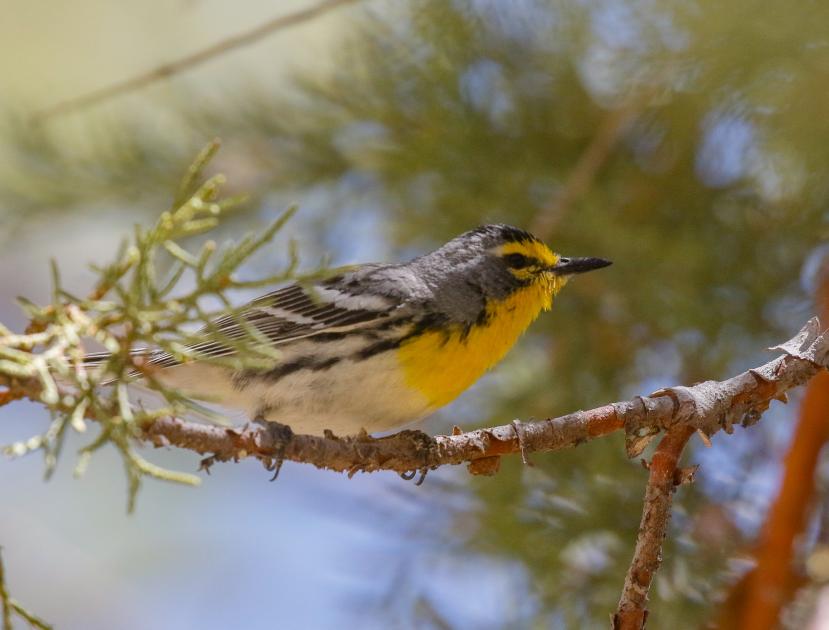
Day 3: We’ll return to Mount Lemmon, where we should be greeted by a cacophony of birdsong emanating from the lower oak-dominated canyons; the voices may include Acorn Woodpecker, Greater Pewee, Olive Warbler, Painted Redstart, and Black-headed Grosbeak. A bit higher on the mountain we’ll enter pine forest, where we’ll search for Western Bluebird, Pygmy Nuthatch, Buff-breasted Flycatcher, and possibly a migrant Townsend’s or Hermit Warbler. Higher still, we’ll arrive at a green canyon dominated by firs and maples where Red-faced Warbler is almost common. This is also a good area for such higher-elevation species as Cordilleran Flycatcher, Mountain Chickadee, Red-breasted Nuthatch, Brown Creeper and Steller’s Jay. After lunch we’ll travel to Madera Canyon, where the pine-oak forests and arrays of feeders should be filled with birds. We’ll take our time birding the lower and middle canyon, searching for Arizona Woodpecker, migrant flycatchers and warblers, and a host of glittering hummingbirds, including Rivoli’s and Broad-billed. Night in Green Valley or Madera Canyon.
Day 4: We’ll explore the remote border ranges of the Atascosa Highlands. We’ll stop in at Pena Blanca Lake, looking for nesting Canyon Wrens, Vermilion Flycatchers, and perhaps a surprise migrant or two tucked into the willows that line this picturesque lake before driving west into the Atascosa wilderness, not far from the Mexican border. A single dirt road skirts the south side of the Atascosa Highlands, passing several south-draining canyons that are the best place in North America to observe certain “Mexican” species. We may encounter Montezuma Quail along the drive, as well as the Southwest form of Eastern Bluebird, a candidate for species status, but our main focus will be California Gulch, a small steep-sided valley that empties into Mexico and is covered in short thornscrub. Here we’ll spend a few hours wandering along a dirt road, seeking border species like Black-capped Gnatcatcher, Northern Beardless-Tyrannulet, Varied Bunting, and the star of the show—Five-striped Sparrow, one of the most range-restricted bird species in the US. After a picnic lunch we’ll finish the loop around Ruby Road, stopping at Arivaca Lake and the Amado Sewage Ponds to check for wayward waterbirds. In the late afternoon we’ll visit the agricultural fields and ponds east of Rio Rico, where we should have excellent comparison views of Western, Cassin’s, and Tropical Kingbirds and perhaps will see comical Black-bellied Whistling-Ducks or glimmering White-faced Ibis feeding in the shallow ponds. If Buff-collared Nightjars are active we will make a late afternoon trip out to the California Gulch area to look for this scarce borderlands breeder. Night in Green Valley or Madera Canyon.
Day 5: We’ll begin the day with roadside birding around Patagonia and along Sonoita Creek, searching for Gray Hawk, Thick-billed Kingbird, Bridled Titmouse, and with luck an assortment of migrants. We’ll stop at the now-famous hummingbird feeders in Patagonia, where we’re likely to see a variety of species including Violet-crowned Hummingbird and large numbers of Broad-billed and Black-chinned. We’ll almost certainly visit Lake Patagonia too, a backup location for Black-capped Gnatcatcher. After lunch in a local café in Patagonia we’ll continue east, stopping in the Sonoita Grasslands to look for Scaled Quail, Grasshopper Sparrow, the Lillian’s form of Eastern Meadowlark, and Chihuahuan Raven. We’ll reach Sierra Vista and the delightful Huachuca Mountains in mid-afternoon. After a brief break at our hotel we’ll begin our investigation of the canyons on the eastern flank of the Huachucas, possibly including Ramsey and Ash Canyons, where feeders sometimes support Lucifer Hummingbird among the more common species. Night in Sierra Vista.
Day 6: We’ll begin in Miller Canyon, which supports a diverse avifauna, including Grace’s Warbler and Spotted Owl, and a famous set of hummingbird feeders where up to seven species are regular in early May, often including the scarce White-eared Hummingbird. A hike up the Miller Canyon trail should reveal Red-faced Warblers, Painted Redstarts, and Arizona Woodpeckers, as well as a good number of migrant birds. Our chief prize, though, will be a chance to see Mexican Spotted Owls on a day roost, often quite close to the trail. We often hear or see Northern Pygmy-Owl on the hike, as well as an interesting assortment of mid-elevation reptiles and butterflies. Once we’re done with the hike we’ll watch the feeders for a bit before driving to the quirky mining town of Bisbee, where we’ll have lunch at a small café.
In the afternoon we’ll drive to Portal, with stops at Whitewater Draw and Willcox Twin Lakes, where we hope to encounter a broad array of migrating shorebirds and waterbirds. Birds such as Wilson’s Phalarope, Eared Grebe, and American Avocet (all in full breeding plumage) should be common. Around the lakes we may encounter Bendire’s Thrasher or Scaled Quail, and every visit to Willcox during migration seems to produce a surprise or two. We’ll arrive in Cave Creek Canyon in time for dinner, followed by a short evening owling excursion to look for Western Screech and Elf Owls and perhaps Common Poorwill or Mexican Whip-poor-will. **Night in Portal.
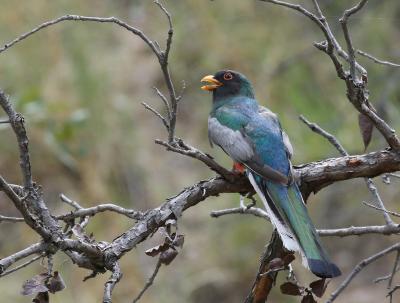
Days 7 and 8: Our two full days in the Chiricahuas is always special. A wide array of habitat types converge near Portal, including the sycamore-lined creek bed of South Fork, mid-elevation pine forests along Turkey Creek, juniper woodland near Paradise, and open Chihuahuan Desert around Rodeo NM. One early morning (pre-breakfast) outing to Rodeo should reveal skulky Crissal and Bendire’s Thrashers and perhaps singing Botteri’s Sparrows or migrating Lazuli Buntings. During our time here we’ll spend a morning walking along South Fork, where bird diversity can be staggering. Some of the specialties here include Blue-throated Mountain-gem, Elegant Trogon, and Sulphur-bellied Flycatcher, but the sheer beauty of the location can overshadow even such an exotic trio. We’ll have a some mid-afternoon rest time on each day. We will also plan to head uphill, looking for Mexican Chickadees near Turkey Creek. As the sun sets and nightbirds begin to take over, we’ll seek out Flammulated Owls among the higher-elevation pines. **Nights in Portal.
Day 9: This morning we’ll take an early-morning trip to the tiny town of Paradise, where we should be able to find Juniper Titmouse, Woodhouse’s Scrub-Jay, and perhaps Black-chinned Sparrow in the juniper forest. We’ll spend the rest of the morning near Paradise, and early afternoon driving up and over Onion Saddle, seeking out Mexican Chickadee and any other high-elevation species of interest. After a picnic lunch we’ll stop again at the ponds at Willcox, where a good variety of lingering ducks and migrant shorebirds can be expected. We’ll arrive at our hotel at a reasonable hour and then enjoy a leisurely farewell dinner at an excellent Mexican restaurant. Night in Tucson.
Day 10: The trip concludes this morning in Tucson.
Note: The information presented below has been extracted from our formal General Information for this tour. It covers topics we feel potential registrants may wish to consider before booking space. The complete General Information for this tour will be sent to all tour registrants and of course supplemental information, if needed, is available from the WINGS office.
ENTERING THE UNITED STATES: Non-U.S. citizens will need a valid passport and may need a tourist visa or visa waiver. Consult your nearest U.S. Consulate or Embassy for details. Canadian citizens should carry proof of citizenship in the form of a passport or birth certificate. U.S. citizens should bring some form of identification such as a driver’s license.
COUNTRY INFORMATION: There is no U.S. Department of State Country Specific Travel Information for the USA. You can access the UK Government Foreign Travel advice for the USA at https://www.gov.uk/foreign-travel-advice/usa , and the CIA World Factbook background notes on the United States at https://www.cia.gov/the-world-factbook/countries/united-states/ .
PACE OF THE TOUR: Early mornings are always the best time for birding activity, and we will often be out in the field by 7:00 a.m., sometimes preceded by a drive of 30 minutes or so. Breakfast will usually be 6:00 to 6:30 a.m. When possible, we try to schedule a siesta during the hottest portion of the day. Much of the birding will be on roads and wider trails, and on one day, in search for Spotted Owl, we will hike a rocky trail up hill for about a mile (at above 6000 ft). On some nights, we will have post-dinner outings for owling and nightbirds. We will try to leave about an hour’s leisure time before dinner.
HEALTH: Arizona presents no real hazards to the visiting birdwatcher.
Altitude: Much of our birding is at elevations between 4000 and 9000 feet, and while we normally do not schedule anything strenuous at the higher altitudes, anyone with known cardiac or respiratory problems should consult his or her doctor before scheduling the trip. We do one hike of about 1.5 miles round trip starting at an elevation of about 6000 ft and climbing to perhaps 6500ft but we take it at a very slow pace.
Dehydration: We urge everyone to bring a water bottle or canteen and to drink lots of water during the tour. In the intense sun and low relative humidity of Arizona, it is easy to become dehydrated before you are even aware of it with resultant low grade headaches and loss of energy. Drinking lots of water is the only sure way to avoid this, and fresh water will be provided in the van at all times.
Spiny Plants: The most common injury results from spines penetrating light weight shoes. Almost every desert plant in Arizona is armed with thorns or spines and we recommend tough canvas or leather shoes of at least ankle height and tough (and preferably cool, light weight) trousers as the best safeguards.
Smoking: Smoking is not permitted in the vehicles or when the group is gathered for meals, checklists, etc. If you are sharing a room with a non-smoker, please do not smoke in the room. If you smoke in the field, we ask that you do so well away and downwind from the group.
Miscellaneous: Rattlesnakes are not a hazard but one always needs to use common sense and be alert in desert areas. We actively look for reptiles and feel lucky to see one rattlesnake per trip. Scorpions are nocturnal and rarely seen, and the tarantulas often seen on the highways are not dangerous.
Chiggers or biting insects may be encountered occasionally in moist areas, but are generally not an issue on spring trips to AZ.
CLIMATE: Temperatures rise steadily from March through June with little rain, although rain and anomalously cool temperatures are possible. Much of the most interesting late spring birdwatching is in the deep mountain canyons between 4000 and 6000 feet where warm days and cool nights are the rule. At the elevations where we spend most of our time, the daytime highs average in the low 90°s F and nighttime lows average about 60-65° F, although we do spend some time at lower elevations where it can be 10 degrees warmer. If you have any questions about the climate, please give us a call. Cold fronts and unseasonable temperatures seem to be more common the last few years, so please prepare for some cool evenings in the mountains, with temperatures in the 40’s possible during owling excursions.
ACCOMMODATIONS: We stay at standard motels throughout the tour.
FOOD: Food is North American standard with most breakfasts and dinners taken at our accommodation or in in local restaurants. Lunches will be a combination of picnic lunches and local sandwich shop visits. We will include several good “Mexican” restaurants.
Food Allergies / Restrictions: We cannot guarantee that all food allergies can be accommodated at every destination. Participants with significant food allergies or special dietary needs should bring appropriate foods with them for those times. Tour meal times are almost always approximate. Participant who needs to eat according to a fixed schedule should carry supplemental food. Please contact the WINGS office if you have any questions.
TRANSPORTATION: We will be traveling by leader-driven 12 or 15 passenger window van or minivan, depending on the group size. Participants should be able to ride in any seat in tour vehicles.
2025 Narrative
In Brief:
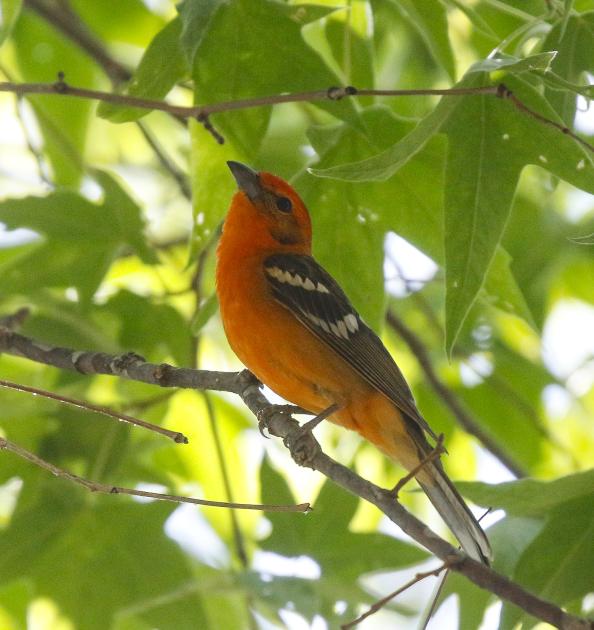
May 2025 was a very successful Owls and Warblers ramble across the Sky Islands of Southeast Arizona. Despite extreme drought conditions that made for sparse birding at times, we still tallied in a very impressive 208 species of bird as well as a delightful array of other species like Pronghorn, Gray Fox, Maderan Alligator Lizard and a Sonoran Mountain Kingsnake! The bird highlights were numerous and included species like Montezuma Quail, 11 species of hummingbirds including Beryline and Calliope, both species having only been recorded on five or fewer previous tours over the years (This is the 23rd year this tour has run!). 16 species of shorebirds was a great total, with the standouts being the first ever American Golden Plover and Red Phalarope for the tour history! Owls of course are a major component to this tour, and eight species were recorded including Spotted Owl and Flammulated Owl, the latter being a shocking lowland roosting bird providing atypical good looks of this shy and diminutive mountain species! Another standout rarity was stunning looks at a pair of Flame-colored Tanagers in Miller Canyon, with a Northern Goshawk further up the trail. Other standout raptors include Zone-tailed Hawk, Gray Hawk and Golden Eagle. A comment must be made about the abundance of migrants present for these tours. Spring was obviously running late this year, and migrants and lingering wintering birds were seen in profusion. Lingering birds like Ruby-crowned Kinglets, Green-tailed Towhees and Brewer's Sparrows were all surprisingly late and still in good numbers, and true migrants like Hammond's Flycatcher, Swainson's Thrush and Hermit Warblers were all seen in numbers that far exceed a typical year. Speaking of warblers, we did very well for warblers with 15 species recorded including Northern Waterthrush and the first ever Hooded Warbler for these tours! And a final goodie that bears mentioning is the strange and beautiful male hybrid Lazuli x Indigo Bunting we watched one morning at our catered (and delicious!) breakfast by Jackie Lewis at the George Walker House. In all, a great set of tours, and we're already looking forward to next year!
In Full:
We began our adventure in Tucson, over a nice Italian meal where we got to know one another before setting off on our grand birding caper. The following morning, as we loaded up the van to start our birding, the first bird of the tour alighted on a utility wire in the hotel parking lot- a Cassin’s Kingbird, which I took as a good omen for the tour and one that proved to be accurate. We headed across town to begin our ascent up Mount Lemmon. Beginning in spectacular Sonoran Desert dominated by stately saguaro cacti where we encountered our first Pyrrhuloxias and Black-throated Sparrows, we ascended all the way up to Ponderosa Pine and Douglas-fir forests at over 8000 feet where Olive Warblers and Yellow-eyed Juncos added a Sierra Madrean flair to high elevation Rocky Mountain species such as Hairy Woodpecker and Red-breasted Nuthatch, along with the southernmost Arizona population of Mountain Chickadee. We spent a long time birding at Rose Lake Canyon where in with the Mallards, was a Mexican Duck, certainly the first time I've ever seen one at 6,000 feet! Here we were also treated to an occupied nest of a Pygmy Nuthatch, as well as a Grace’s Warbler that sat right in front of our faces for an extended and incredible look! Another animal that showed well for us here was a Tassel-eared Squirrel. Native to northern Arizona, they have been introduced to Mt. Lemmon and their handsome pelage and adorable ear tufts make this one classy looking squirrel!
However what struck me the most as we birded the upper elevations was how quiet it was, with many of the resident breeding birds not yet back on territory. It was the first glimmer of how a late spring combined with a prolonged drought was affecting the avifauna of southeast Arizona. Still, we were able to observe quite the selection of bi
rds that day and even recorded our first owl of the trip, a day-calling Whiskered Screech-Owl. We came back down the mountain and after a hotel turnaround, we headed out for dinner at a favorite Oaxacan restaurant I like, and as we left, we were treated to some great looks at a few Lesser Nighthawks feeding right in the parking lot! We then took a sunset drive over beautiful Gate’s Pass into Saguaro National Park where we tried for Elf Owl, but as night fell, a strong wind really kicked up and we concluded the day.
We left our hotel for good the next morning, returning to the saguaros where we successfully tracked down a few Gilded Flickers. Enroute, we also had our first Greater Roadrunner right in a Lowe’s parking lot! We then headed over to Sweetwater Wetlands which was delightfully birdy. There were flocks of Ruddy Ducks, always so striking with their bright blue bills, a family of Common Galliunules was an exciting treat, and our only White-faced Ibis of the trip showed well. There were numerous passerine migrants with many Western Kingbirds perched prominently, as well as a flock of Lark Sparrows. We stopped by a spot I have that normally hosts a family of Barn Owls, but they sadly were not present. We did much better when we headed up north of Tucson to a colony of Burrowing Owls.
Afterwards we turned around and put Tucson in the rear-view mirror for Madera Canyon where we would stay the next couple nights at the idyllic Santa Rita Lodge, giving us easy nighttime access to forests of oak and alligator bark juniper where we heard more Whiskered Screech-Owls and got a look at a diminutive Elf Owl at its nest cavity. The feeders here gave great views of Bridled Titmouse, Mexican Jay, Acorn Woodpecker, Rivoli's Hummingbird, and hordes of Black-headed Grosbeaks as well as a rarity to the southwest, a beautiful male Rose-breasted Grosbeak. A morning hike up at the top of the canyon was full of migrant Ruby-crowned Kinglets and Hammond’s Flycatchers, and we had excellent looks at Red-faced Warbler. A stop at the Madera Kubo gave us a great look at a Berylline Hummingbird! An exploration of Box Canyon gave us a great Five-striped Sparrow experience, along with Western Tanagers and Hooded Orioles. Raptors were great here with a Golden Eagle that sailed back and forth over the canyon edge, saw our only Zone-tailed Hawk and an extended study of a Gray Hawk on the nest! A late afternoon stop at a park in Green Valley afforded us a nice visit with a flock of Lazuli Buntings and a good look at both a pair of Blue Grosbeaks and Rufous-winged Sparrows.
Upon leaving Madera Canyon behind, we headed to the Paton Center for Hummingbirds in Patagonia where we easily obtained great looks at a Violet-crowned Hummingbird among the many Broad-billed Hummingbirds. A Northern Beardless-Tyrannulet teased us with its vocal ventriloquist act, but a Thick-billed Kingbird teed up nicely for a good look. Yellow-breasted Chats flitted on the wood’s edge, and migrant Gray and Western Flycatchers foraged along the new birding path here. Down at the creek edge we had a small flock of Common Ground Doves and a notable rarity in the form of a Northern Waterthrush foraging in the stream. On our way to our overnight stay in Sierra Vista, we stopped in the Sonoita Grasslands for a herd of Pronghorn Antelope and saw our first Chihuahuan Meadowlarks as well. We Lucy’sff that day's birding at the Ash Canyon Bird Sanctuary, where we enjoyed seeing Bullock's Orioles, and a close look at a Lucy’s Warbler. We picked through the large flock of Anna's, Black-chinned and Broad-tailed Hummingbirds which paid off with eventual a male Lucifer Hummingbird!
The next morning began with a short drive from our Sierra Vista hotel up to Miller Canyon, a wild mountain canyon in the Huachucas. A hike up the trail resulted in great looks at Painted Redstart, Black-throated Gray and Townsend's Warblers. Further up in the tall pines, a young American Goshawk flew in and perched briefly. However, the high point of the morning was certainly the killer looks we had of a pair of Flame-colored Tanagers! Afterwards we took a rest at the hummingbird feeders at the start of the trail where we were delighted to have a female Calliope Hummingbird. After a picnic lunch, we headed off to Willcox for a waterbird fix. There were a half dozen duck species here including Cinnamon Teal and a Ring-necked Duck. Black-necked Stilts and American Avocets lined the pond, and twirling over the water surface was a large flock of Wilson’s Phalaropes peppered with Franklin’s Gulls. An American Golden Plover had been lingering here was the first time this species has ever been recorded on a WINGS Arizona tour. But it wasn’t the only rarity here. A large flock of Ring-billed Gulls were dropping in (notable enough!), but among them was a near adult Laughing Gull! And foraging a few feet away was a Snowy Plover! Over 15 Stilt Sandpipers feed alongside the Long-billed Dowitchers was a nice treat, and over by the golf course was a pair of Scaled Quail and a Bendire’s Thrasher! Whew! Quite the haul of goodies for a Willcox run!
We pulled ourselves away from Willcox to head to the famed Chiricahua Mountains. For the last two nights of the tour, we stayed at the Cave Creek Ranch in the tiny hamlet of Portal in the foothills of the Chiricahua Mountains. Set in the sycamore-lined Cave Creek Canyon, a location rich in ornithological history, bird life abounds here, with the largest North American hummingbird species, the Blue-throated Mountain-Gem being a common resident and prime attraction of the ranch. After check-in, we grabbed dinner and set off for an evening of owling that was quite a success. In addition to hearing numerous Elf Owls, we were able to get good looks at both Western and Whiskered Screech Owls. But even more of a prize was a Mexican Whip-poor-will that perched up in a cypress tree giving us an extended look- a rare treat as they almost never allow themselves to be seen in a flashlight!
Many of the people making their home in Portal are birders, and some have opened up their yards for the public to view their bird-feeding stations. We spent time at a few of these and got great looks at such species as Gambell’s Quail, Ladder-backed Woodpecker, Mexican and Woodhouse's Scrub-Jay, Hooded, Scott's and Bullock's Orioles, Bushtit, Cactus Wren, Curve-billed Thrasher, Black-throated Sparrow, Blue Grosbeak and many more. Further up in the canyon we saw Hepatic Tanagers, Painted Redstarts and a pair of Montezuma Quails! A couple of really cool reptiles found were a beautiful Sonoran Mountain Kingsnake and a Maderan Alligator Lizard. And back at the Ranch where we were staying, we were treated to some fun mammals like a White-nosed Coatimundi, Collared Peccary (Javelina) as well as a new all-time trip bird- a Hooded Warbler!
No springtime trip to the Chiricahuas would be complete without a trip to the conifer-dominated forests at the higher elevations and we spent the better part of our second day here exploring this region. We first headed up to a canyon that was hosting a nesting pair of Spotted Owls. It took quite some time of methodical searching, but in the end, another couple of birders spied a day roosting Spotted Owl! While we searched, we heard a Mexican Chickadee, which sadly ended up being our only one for the tour. We headed up to Rustler Park for lunch, but a blustery wind picked up and birding became a bit of a challenge. Still, we encountered a few new species like Western Bluebird and Greater Pewee. After getting back for the our day in the high country, we were just finishing up dinner when I received word that a roosting Flammulated Owl had been discovered below town at a nearby farm, Likely driven down from the high mountains by the cold spring, it only took a short time to find the roosting bird which was certainly my best look at this species ever! Some more evening birding gave us a great look at both Great Horned Owl and Common Poorwill.
On our last morning in the Chiricahuas, we traveled to the nearby town of Paradise for a delicious catered breakfast at the George Walker House. Highlights of our visit here was our only Juniper Titmouse of the trip, another Rose-breasted Grosbeak, and very exciting was a hybrid male Indigo x Lazuli Bunting! On our drive back to Tucson we again stopped at Willcox, where we were treated to our third new all-time trip bird for this tour in the form of a female Red Phalarope, a real surprise for the spring in Arizona!
It was a fantastic trip, and one that everyone, including myself thoroughly enjoyed. Though I will be hard pressed to be able to get a species count of 208 ever again! A testimony to the biological gem that is southeastern Arizona.
- Skye Haas, 2025
This is my second tour with WINGS and it was beyond awesome! I really appreciate the small size of the group and more importantly the expertise of the tour leader. I really liked the night owl tours and breaking up the day sometimes by going out very early, back for a couple hours and out again in the afternoon and/or evening.
- Kathy K. on Arizona: Owls and Warblers
Skye was great! His energy and enthusiasm were infectious. He was focused on giving people what the tour promised - many species, including excellent encounters with elusive owls and nightjars.
- Richard K. on Arizona: Owls and Warblers
**There MAY be shared bathrooms for 3 nights at our lodging in Portal depending on what space is available in the area.
Maximum group size seven with one leader.
More Tours with these Leaders
Cruise: Pacific Coast in Fall
Albatrosses, Pterodromas, and Seabirding in Comfort
Albatrosses, Pterodromas, and Seabirding in Comfort
Sep 19-25, 2026 • Ed Corey and Skye Haas
More Tours in this Region